
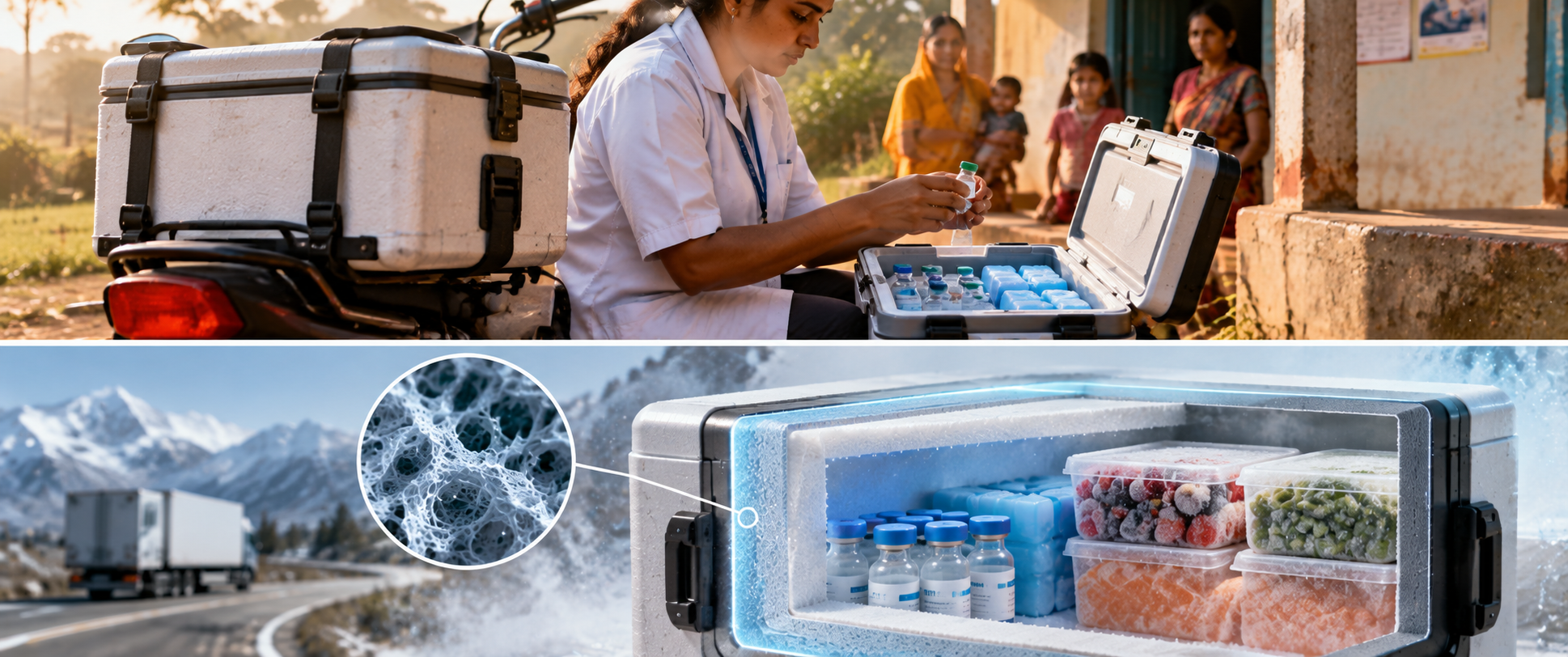
The cold chain is mostly infrastructure: cold rooms, ice-lined refrigerators, reefer trucks, freezer warehouses. The last mile is different. There, the cold chain shrinks to a single insulated box: a vaccine carrier strapped to a motorbike on the way to a village outreach session, or a tote of frozen desserts climbing four floors to a customer’s door. No compressor, no power. For those few hours, the box wall is the whole cold chain.
This article covers what “stable longer” actually means in engineering terms, why vaccines and frozen food fail in very different ways, where silica aerogel insulation changes the maths of shipper design, and where it doesn’t.
Why the Last Mile Is the Weakest Link
India’s routine immunization system shows the scale of the problem. The Universal Immunization Program serves roughly 26 million newborns and 30 million pregnant women a year, through about 9 million sessions run from some 27,000 cold chain points. The digital backbone that monitors this network has kept growing. By 2025, eVIN covered more than 30,000 cold chain points across every State and Union Territory. Vaccines move from state stores through regional and district stores down to the CHC, PHC, or UHC that serves as the last cold chain point. From there, they are carried to sessions in passive vaccine carriers and cold boxes. That hand-carried stage is the last mile.
Frozen food faces the same structural problem in a different temperature band. Under the Codex code of practice, quick frozen foods should be held at –18 °C or colder throughout the cold chain, transported in insulated equipment that keeps them there, and distributed to minimize any temperature rise above –18 °C. The code also says quick frozen foods should not sit at ambient temperature for any significant length of time. Doorstep delivery tests that every day.
In both cases, once the product leaves powered refrigeration, only two things protect it: the container wall’s thermal resistance and the cooling energy packed inside.
Two Products, Two Very Different Failure Modes
Vaccines: damage from heat and from cold
Most routine vaccines are stored at +2 °C to +8 °C. The upper limit gets most of the attention, but freezing is often the more serious threat. Vaccines adjuvanted with particulate aluminum salts must be kept between 2 °C and 8 °C and are highly sensitive to freeze damage. Once frozen, they lose potency irreversibly: the aluminum adjuvant structure breaks down, and the adsorbed antigen detaches. Freeze damage can reduce a vaccine’s immunogenicity and raise the likelihood of local reactions.
This isn’t a theoretical risk. A 2017 literature review in Vaccine, updating an earlier 2007 analysis, found that vaccines still face temperatures below recommended ranges across several segments of the cold chain, including transport and outreach work using vaccine carriers and cold boxes.
Frozen food: quality lost gradually
Frozen food fails more gradually. A few degrees of warming won’t make a product unsafe on the spot, but repeated excursions degrade texture and quality, and a partial thaw followed by refreezing can’t be undone. Codex allows some tolerance for certain categories. For example, cooked-frozen foods should stay at or below –18 °C but may rise to –12 °C for short periods during transport. That tolerance is narrow, and a delivery tote opened at every stop uses it up quickly.
So there are two design problems. Vaccines need a narrow band held in both directions. Frozen food needs a much larger temperature difference held against the outside air.
What “Stable Longer” Means in Engineering Terms
A passive shipper is essentially an energy budget. The coolant (ice packs, cool packs, phase change material, or eutectic plates) holds a fixed amount of cooling capacity. Heat leaks in through the walls at a rate set by Fourier’s law:
Heat leak ≈ λ × A × ΔT ÷ L
Here λ is the insulation’s thermal conductivity, A is the wall area, ΔT is the difference between outside and inside temperature, and L is the wall thickness. Hold time is roughly the coolant budget divided by the leak rate.
WHO formalizes this for vaccine containers. “Cold life” is measured by stabilizing an empty container at +43 °C, loading it with ice packs, closing the lid, and timing how long it takes for the warmest point in the vaccine compartment to reach +10 °C at a constant +43 °C ambient. Short-range vaccine carriers must achieve a minimum cold life of 15 hours and long-range carriers 30 hours, while short-range cold boxes need 48 hours and long-range cold boxes 96 hours.
That leaves designers two levers. They can add coolant, which takes up payload space and adds weight. Or they can cut the heat leak by lowering λ, which is the only lever that doesn’t cost interior volume.
Where Aerogel Changes the Arithmetic
Silica aerogel is a nanoporous solid whose pores are small enough to heavily suppress heat transfer through the trapped air. DashamLabs’ flexible silica aerogel sheet has a thermal conductivity of about 0.016 W/m·K at room temperature. For comparison, expanded polystyrene, the default material in single-use shippers, typically measures between 0.032 and 0.038 W/m·K.
The consequences show up in a simple one-dimensional calculation. The figures below are illustrative. They use room-temperature λ values (0.016 W/m·K for aerogel, 0.035 W/m·K for EPS) and ignore edges, corners, and lid seals.
| Design question | EPS (λ 0.035) | Aerogel (λ 0.016) |
| Thickness needed to match a 10 mm aerogel wall | ~22 mm | 10 mm |
| Heat leak through a 30 mm wall (relative) | 100% | ~46% |
| Wall needed for the same thermal resistance as 30 mm EPS | 30 mm | ~14 mm |
| Interior volume of a 300 mm outer cube with those walls | ~13.8 L | ~20.1 L |
A designer can use this in two ways. At the same wall thickness, heat ingress through the walls falls by roughly half, so in principle the same coolant lasts about twice as long. At the same thermal performance, the wall slims down enough that the interior of a fixed outer box grows by around 45% in this example. Volume scales with the cube of the inner dimension, so a few millimeters saved on each face add up quickly.
How much thinner a wall can get depends on the material being replaced. The table compares aerogel with EPS, one of the better-performing packaging foams. Against traditional insulation more broadly, DashamLabs rates its sheet at 70% lower thickness, with a thermal conductivity of 0.016–0.030 W/m·K compared with 0.030–0.090 W/m·K for traditional insulation.
Real shippers won’t match the ideal numbers. Lid seals, corners, thermal bridges, payload mass, and how often the box is opened all affect the result. Conductivity also changes with temperature, so values measured at room temperature are a starting point, not a final answer. Independent research points in the same direction, though. A peer-reviewed simulation study on cold-chain biologics packaging notes that aerogels have shown better insulating performance than extruded polystyrene and polyurethane foam. It describes its preliminary results for aerogel-based packaging as promising.
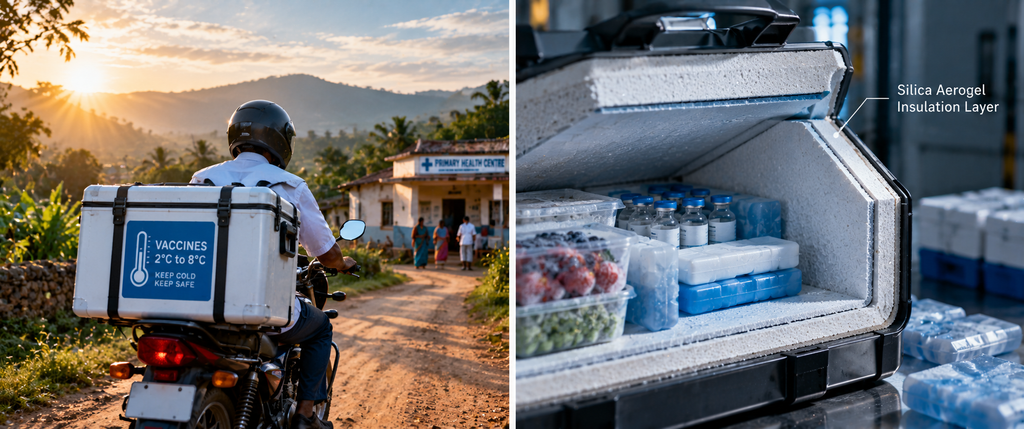
Vaccines: Longer Hold Time Is Only Half the Job
Better insulation keeps a box cold for longer. It doesn’t automatically keep it at the right temperature.
In a vaccine carrier, freezing risk usually comes from the coolant, not the weather. WHO defines an ice pack as a water pack frozen to between –5 °C and –20 °C before use. If those packs go into the carrier without conditioning, the vials next to them can drop below zero. A better-insulated wall holds that sub-zero pocket for longer, especially on cool mornings or in air-conditioned vehicles. The insulation retains cold in both directions.
WHO’s newer specifications reflect this. For carriers and cold boxes with freeze-prevention technology, the vaccine compartment must not go below 0 °C during the +43 °C cold life test, and containers are also tested at +15 °C or lower to find the minimum ambient temperature at which they still protect vaccines.
For a shipper designer using aerogel, several practical choices follow. The coolant should sit in or near the target band: conditioned water packs or a phase change material that melts around +5 °C can avoid the problem at its source. A thin, low-λ layer between the coolant and the payload can slow cold transfer to the vials while the outer walls handle incoming heat. A flexible 3 mm or 5 mm aerogel sheet is a reasonable candidate for that buffer role, but you need to validate it in your own pack-out before anyone relies on it. You should also qualify the pack-out at the cold end of the ambient range, not just the hot end.
Moisture matters too. Carriers are opened in humid air, and condensation forms on cold surfaces. DashamLabs’ blanket is hydrophobic and designed to prevent moisture ingress, so it doesn’t absorb condensate that would add weight and erode its insulating value over repeated trips. Our article on the science of aerogel insulation covers its hydrophobic nature in more detail.
Frozen Food: Holding –18 °C Through the Doorstep
Frozen delivery is harder on insulation than vaccine transport because the temperature difference is larger. Using WHO’s +43 °C test ambient as a reference, a 2–8 °C payload sits about 38 K below the outside air. A –18 °C payload sits about 61 K below it. Heat leak scales directly with ΔT, so a frozen tote carries roughly 1.6 times the heat load of a vaccine box with identical walls. Weak insulation shows up quickly in frozen lanes.
Repeated opening compounds the problem. A multi-drop delivery tote is opened at every address, and each opening swaps cold air for warm. Wall insulation can’t prevent that, but it determines how much coolant is left to absorb it. Good lid seals and handling discipline matter as much as the wall material.
Aerogel’s stated operating range fits this band easily. DashamLabs rates its sheet for continuous operation from –50 °C to 650 °C, which comfortably covers –18 °C payloads and typical frozen coolants. There is one important exception. Dry ice sublimes at about –78.5 °C, well below that –50 °C floor. If your pack-out uses dry ice, keep it out of direct contact with the aerogel layer, or qualify that specific configuration first. The same limit rules out ultra-low-temperature products, such as vaccines stored below –60 °C, as a use case for this material.
Outside boxes and totes, DashamLabs also lists small refrigerated vehicle and van panels as a target application, where thin, non-combustible insulation helps when interior height and width are tight. In a small delivery van, every millimeter of wall is close cargo space.e
Where Aerogel Fits, and Where It Doesn’t
Aerogel costs more per square meter than foam, so its value depends on the application. It makes the strongest case in space-constrained pharma and vial shippers, where payload density drives the economics. It also suits reusable carriers and delivery totes, where the material cost is spread over hundreds of trips, and retrofits, where an existing outer dimension has to perform better. It also works well in hybrid builds. Aerogel can go where the thermal load or space pressure is highest, with conventional foam everywhere else, an approach covered in our article on hybrid insulation systems.
It’s a weaker fit for low-value, single-use shipments where cheap foam already meets the hold time, and it isn’t suitable for ultra-low-temperature lanes below its rated range. No insulation material replaces thermal qualification of the complete shipper. As the DashamLabs cold chain page notes, the customer’s packaging team still designs and qualifies the complete shipper.
A Practical Path to Trialing Aerogel in Your Shipper
The most reliable way to evaluate aerogel is to compare it in a controlled way against the box you already use. Start by defining the lane: route duration, ambient extremes in both directions, number of openings, and payload mass. Baseline your current shipper with calibrated temperature loggers. Then build two variants, one with aerogel at the same wall thickness (to measure extra hold time) and one at equal thermal resistance (to measure interior volume gained). Test both against hot and cold ambient profiles. For vaccine lanes, include a freeze check with your actual coolant conditioning. Finally, run a handling trial, since last-mile boxes get dropped, stacked, and carried.
DashamLabs supplies samples as 1 m² sheets (3 m × 33 cm) in 3, 5, and 10 mm thicknesses for testing, prototyping, and pilot projects. That’s enough material to line and test several prototype shippers. You can request a sample or review the full technical specifications.
The Bottom Line
In the last mile, the box is the cold chain, and its performance depends on how much heat gets through the wall and how much coolant is left to absorb it. Aerogel’s low thermal conductivity lets designers either extend hold time at the same wall thickness or recover significant payload volume at the same performance. For vaccines, that benefit must be paired with a pack-out designed for both freezing and heat. For frozen food, it helps offset a much larger temperature difference. In both cases, the material makes a better box possible, and testing in your own lane confirms it.