
DashamLabs —
Aerogel Insulation for Oil & Gas
Patented silica aerogel insulation blanket, engineered in India for pipelines, refineries and process plants — λ ~ 0.016 W/m·K, hydrophobic, and 70–90% thinner and lighter than conventional insulation.
Why Oil & Gas Industry Teams
Choose Dashamlabs
Every Millimetre of Space Has a Cost.
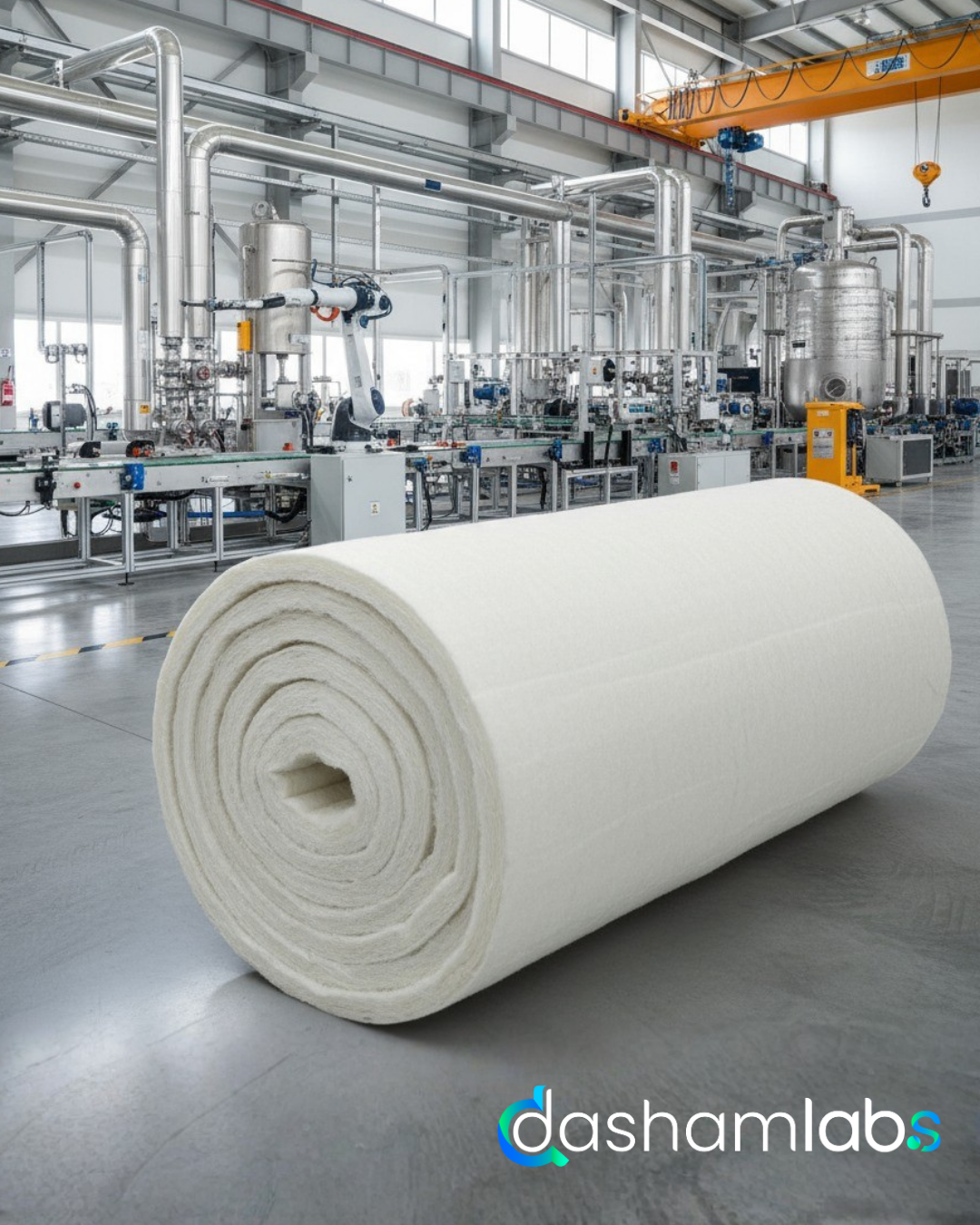
In a crowded pipe rack, every extra millimetre of insulation pushes the next line further away, loads the supports and widens the surface exposed to rain and humidity. Aerogel insulation for oil and gas changes that equation. DashamLabs’ silica aerogel insulation blanket delivers λ ~ 0.016 W/m·K at room temperature — up to 5× lower thermal conductivity than conventional insulation — so you reach your thermal target with a fraction of the build-up.
Oil and gas plants are hard on insulation. Hot lines must hold process temperature. Monsoon rain and coastal air find every jacket seam. Turnaround windows are tight, and rigid sections fight you at every bend. For decades aerogel stayed out of reach for this work — costly, brittle and made only in small batches. We set it free. DashamLabs’ patented, India-engineered process turns aerogel into a flexible roll-format blanket that you can specify, wrap and maintain like any other insulation.
Key Features:
Upto 5X Lower Thermal Conductivity vs conventional insulation
70% Lower Thickness vs traditional insulation
–50 °C to +650 °C range for Continuous Operation
Nano-porous Structure
Fiber Reinforcement
Aerogel Pipe Insulation for Refineries and Process Plants
Heat lost from a process line is fuel you paid for twice — once to make the heat, again to replace it. Insulation is one of the lowest-hanging fruits for cutting that loss, and thermal conductivity is where the arithmetic starts. At λ ~ 0.016 W/m·K, DashamLabs’ aerogel blanket resists heat flow more effectively than conventional materials in the ~0.030–0.090 W/m·K class, which is why it can do the same job in far less thickness.
For plant engineers, that translates into practical outcomes: steadier process temperatures, lower energy loss from piping and equipment, and lower surface temperatures where personnel work near hot lines. The blanket is also non-combustible and fire-resistant, and light enough to handle without heavy lifting.
Sizing still depends on your line data — operating temperature, pipe size, ambient conditions and allowable heat loss. Our team gives application and installation guidance on request, and our thickness guide explains how 3, 5 and 10 mm options are typically chosen.
How Aerogel Insulation Helps Mitigate Corrosion Under Insulation (CUI)
Corrosion under insulation starts with a simple recipe: water, steel and time. When insulation soaks up moisture — after a jacket seam opens, a fitting leaks or humid air finds a way in — it can hold that water against the pipe surface, out of sight, until the damage is done.
DashamLabs’ silica aerogel blanket is hydrophobic. It is engineered to repel water rather than soak it up, so a breach in the jacket is less likely to turn into a wet, corrosive layer against the metal. That is why we say the blanket mitigates CUI — not that it eliminates it. Good coatings, careful jacketing detail and routine inspection remain part of a sound insulation system; aerogel removes one of the biggest weak links.
For operators in India’s humid and monsoon-affected regions, that difference matters over the life of an asset. Read more in our explainer on aerogel and CUI and why rockwool struggles in high humidity.
Thin, Lightweight Insulation for Congested Pipe Racks and Retrofits
Less Bulk. More Usable Space. Smarter Design.
Brownfield sites rarely give you spare room. Adding conventional insulation to an existing line can mean re-spacing pipes, reinforcing supports or accepting compromises at tight bends. A slim aerogel blanket lets you insulate — or upgrade — without rebuilding the layout around the insulation.
Because the blanket is flexible, it wraps elbows, flanges and valves and follows irregular or curved surfaces instead of fighting them. That makes it well suited to retrofit work, maintenance jobs and confined spaces where access is limited. Fewer bulky sections to handle also means less to carry, cut and store on site.
Where DashamLabs Aerogel Insulation Is Used in Oil & Gas:
- Process piping and pipelines — Hold process temperature and cut heat loss along lines where thick build-ups are impractical.
- Refinery piping and vessels — Insulate vessels and long pipe runs with a slim, lightweight blanket that stays dry on the surface.
- Valves, flanges and elbows — A flexible blanket conforms to fittings that rigid sections struggle to cover.
- Boilers and heat exchangers — Keep heat where it belongs while limiting the added weight and bulk on equipment.
- Turbines and power generation equipment — Thin, non-combustible insulation for energy and power generation assets.
- Chemical processing plants — Improve energy efficiency and help lower surface temperatures near hot equipment.
- Retrofit and confined-space jobs — Upgrade existing insulation without re-spacing lines or reworking supports.
- Irregular and curved surfaces — Wrap complex geometry cleanly, with fewer gaps and thermal bridges.
Download Technical
Documentation
Access full technical specifications, performance curves, safety data, and installation guidelines.
Why Oil & Gas Teams Choose DashamLabs
- Patented technology, engineered in India: Patented silica aerogel insulation technology — the 1st Made in India patented technology of its kind — developed under the Make in India initiative.
- A genuine manufacturer: Engineered and manufactured at DashamLabs, and supplied direct from the maker. Not a trading company.
- Scientist-founder team: Founders from IIT Roorkee, Harvard Business School and Clemson University, with two decades of aerogel research behind the technology.
- Technology partner and backers: ARCI as technology partner; backed by Speciale Invest, IIMA Ventures and Theia Ventures.
- Documentation and guidance: TDS and MSDS on request, plus application and installation guidance for your project.
- Local manufacturing, responsive support: Made in India for responsive technical support across India, with customised and bulk requirements welcome.
Frequently Asked Questions: Aerogel Insulation for Oil & Gas
What is aerogel insulation and why is it used in oil and gas? Aerogel is a nanoporous silica material, up to 99.8% air, that resists heat flow far better than bulk insulation. In oil and gas plants it lets you hold process temperature and reduce heat loss with much less thickness. DashamLabs’ silica aerogel blanket offers λ ~ 0.016 W/m·K at room temperature and is 70–90% thinner and lighter than conventional insulation.
Does aerogel insulation help prevent corrosion under insulation (CUI)? It helps mitigate it. CUI needs water sitting against metal, and DashamLabs’ blanket is hydrophobic, so it is engineered to resist moisture uptake if a jacket is breached. It is one layer of a sound system: good coatings, jacketing detail and routine inspection still matter.
What temperatures can the DashamLabs aerogel blanket handle? Continuous operation is –50 °C to +650 °C, which is the rating to use for design. The wider –200 °C to 1,000 °C range is a headline temperature range, not a continuous rating. Share your operating and excursion temperatures and our team will advise on suitability for your line.
How thick should aerogel pipe insulation be? It depends on operating temperature, pipe size, ambient conditions and the heat loss or surface temperature you need to meet. DashamLabs offers 3, 5 and 10 mm. Send us your line data with a sample request and we will help you choose the right thickness for the job.
Can aerogel be used on valves, flanges and elbows, and in retrofits? Yes. The blanket is flexible and conforms to curved surfaces, bends, flanges and valves, which makes it practical for retrofits, maintenance work and confined spaces. DashamLabs provides application and installation guidance to help your team get a clean, well-fitted result.
Do you supply samples and bulk rolls for oil and gas projects? Yes. Samples are 1 m² sheets (3 m × 330 mm) in 3, 5 and 10 mm, available in limited quantities for qualified projects. Bulk rolls are 20 m × 1.5 m (30 m²) in 3, 5 and 10 mm for full-scale deployment. Use the sample form or write to info@dashamlabs.com.
Is aerogel more expensive than mineral wool or calcium silicate? Aerogel may cost more upfront per square metre. Its value comes from thinner build-ups, lower weight, less heat loss and reduced maintenance, which is why total cost of ownership is the fair comparison. DashamLabs does not publish list prices; send your requirement and we will quote against it.
Changing the Game with
Dashamlabs' Aerogel
Scalable
Affordable
Flexible
Real-world ready
Sustainable
Minimal environmental footprint
λ ~ 0.016 W/m·K, –50°C to 650°C stability, fire-resistant, hydrophobic, 70–90% thinner/lighter. Read the Full Technical Specifications
Transform Your Industry Today
Be among the first to deploy scalable aerogel insulation made in India — for better performance, lower costs, and a greener future.
Request your sample now and see the difference in energy efficiency and durability.