
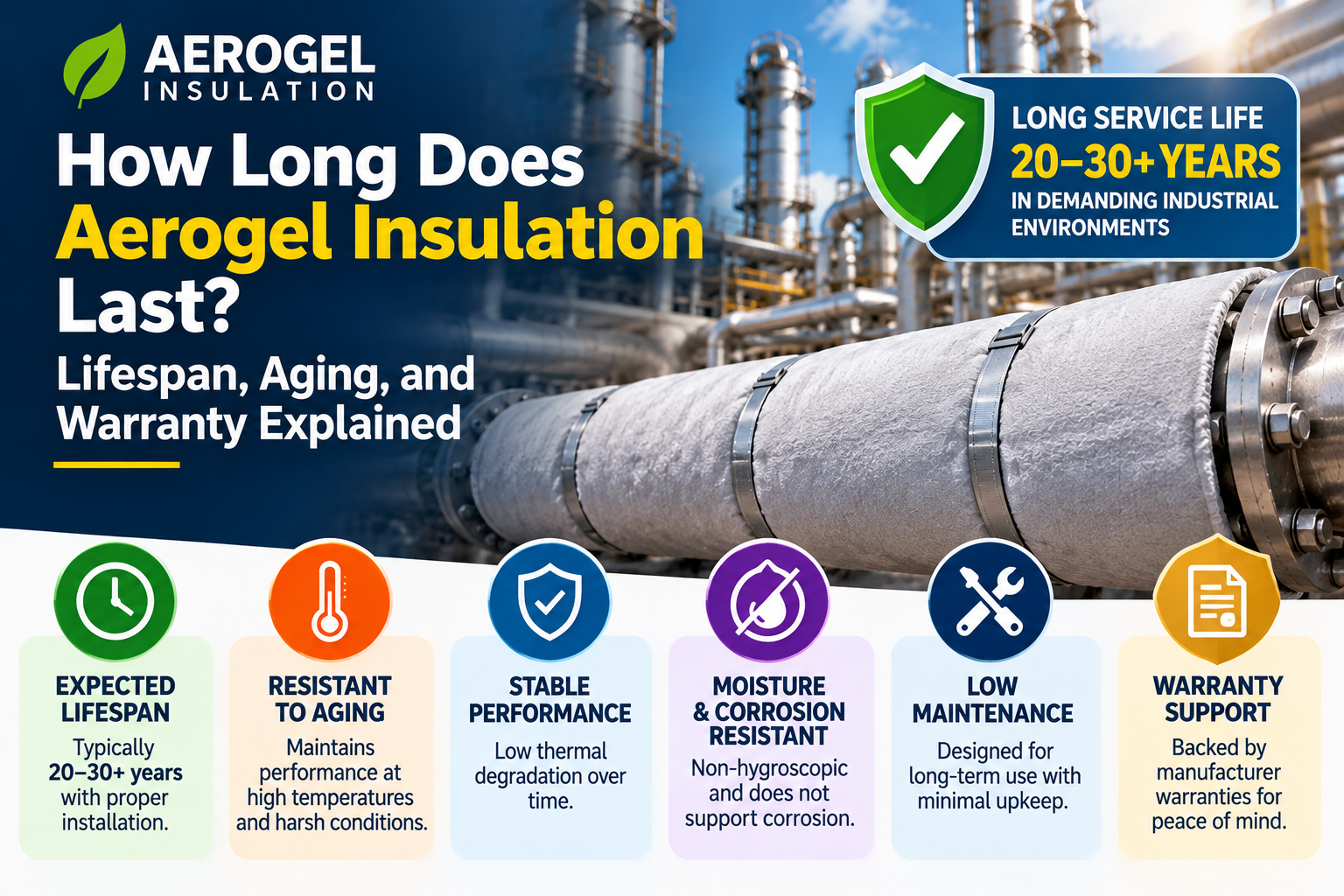
“How long will it last?” is one of the first questions buyers ask about aerogel insulation, and one of the hardest to answer with a single number. Insulation rarely fails all at once. It slowly loses performance, and the rate depends on temperature, moisture, mechanical stress, and the quality of the surrounding system. A blanket that stays effective for decades on a dry, moderate-temperature line can degrade much faster at a leaking flange or under failed cladding.
This article explains what “lifespan” actually means for insulation, what independent research shows about how aerogel ages, which mechanisms really limit its life, and what to look for in a warranty.
The Short Answer
Aerogel insulation has no fixed expiry date. Its useful life ends when it no longer insulates well enough to justify keeping it. Accelerated-aging studies are encouraging: under laboratory conditions designed to simulate many years of service, aerogel products have generally lost little thermal performance. In real installations, though, the insulation system usually fails first: cladding, vapor barriers and seals that let water in, plus operating conditions that exceed what the material was designed for. Specify, install, and maintain the system well, and the aerogel layer is unlikely to be the weak point.
What “Lifespan” Means for Insulation
Two ideas are worth separating.
Material life versus system life. An insulated pipe or vessel is a system: insulation, fasteners, cladding or jacketing, sealants, and for cold service, a vapor retarder. Each has its own failure modes and its own life. A high-quality insulation core under poor cladding can still fail early because water reaches it.
Performance-based end of life. Insulation is effectively worn out when its heat loss, surface temperature, or condensation control drifts outside acceptable limits, not when it falls apart. That’s why the useful questions are how much thermal conductivity increases over time, and what causes it.
Inspection matters for both. The U.S. Department of Energy advises repairing or replacing damaged or wet insulation immediately, because wet or damaged insulation compromises its insulating value. Whatever a material’s theoretical life, its real life depends on finding and fixing problems early.
What the Research Says About Aerogel Aging
Aerogel is newer than mineral wool or calcium silicate, so long field records are still limited. Researchers have noted that the lack of long-term experience with aerogel products leaves open how consistent their performance will be under climatic aging. Most evidence therefore comes from accelerated laboratory aging, where heat, humidity, freeze-thaw cycles, or UV are applied at higher intensity to simulate years of service.
Climatic aging of aerogel mats. A 2025 study in Energies compared aerogel and basalt fiber pipeline insulation under combined heat, humidity, and sunlight, in cycles intended to simulate 20 years of outdoor exposure. After 20 cycles, the aerogel mats’ thermal conductivity was unchanged, while the basalt fiber mats increased by about 10%.
Aging of aerogel-enhanced products more broadly. A study in Energy tested aerogel-enhanced plasters, blankets, and boards under extreme temperature swings, high humidity, and UV. It found that thermal conductivity increased by typically less than 10% for aging equivalent to 20 years under typical conditions; even after aging, the aerogel materials still insulated considerably better than traditional materials did when new.
Compression and recovery. In a study of aerogel blankets under uniaxial compression, blankets stayed highly effective under load. After 20 compression and release cycles, thermal conductivity changed by 5% or less, and permanent deformation was 6% or less.
These results come with caveats. Accelerated tests model real service, not substitutes for it, and the studies tested specific commercial products under specific conditions. They do suggest that well-made aerogel products don’t have any built-in tendency to degrade quickly. The real risks come from the mechanisms below.
The Aging Mechanisms That Actually Matter
1. Moisture
Moisture is the main enemy of any insulation, aerogel included. Water conducts heat far better than the air or gas in an insulation’s pores.
Hydrophobic aerogel strongly repels liquid water, which is a major advantage over fibrous insulation that can wick and hold water. But humid air is a different problem. Studies of aerogel-based products found that humidity has a much bigger effect on thermal conductivity than temperature does. In one study, conductivity doubled at 95% relative humidity compared with standard test conditions.
Two practical points follow. On cold lines, where moisture is driven inward toward the cold surface, a properly installed vapor retarder is essential. ASTM C1728, the flexible aerogel insulation specification, explicitly requires one for below-ambient applications. On hot and outdoor lines, sound cladding and sealed joints keep rain and washdown water out, protecting both the insulation and the pipe beneath it from corrosion under insulation (CUI).
2. High temperature and hydrophobicity
This mechanism is specific to aerogel and is worth understanding before specifying it for hot service.
Most commercial silica aerogels get their water repellency from methyl (–CH₃) groups bonded to the silica surface. Research shows these groups are thermally sensitive. In one detailed study, hydrophobic silica aerogel changed little when heat-treated below 350 °C, but its water contact angle dropped sharply, from 139° to 44°, between 350 °C and 400 °C. The surface went from water-repelling to water-attracting. A separate study on fiber-reinforced aerogel blankets found that while the hydrophobic organic groups decomposed at these temperatures, the aerogel’s silica skeleton remained intact.
So at high temperatures, aerogel keeps its insulating structure, but the hottest part of the blanket can lose its water repellency over time. Because temperature falls across the insulation thickness, the outer layers of a hot-service system typically stay much cooler than the pipe surface. They can keep their hydrophobicity even when the inner face doesn’t.
For buyers, this means asking the manufacturer:
- What data do you have on hydrophobicity retention after exposure at my operating temperature?
- In a multi-layer build, how will temperature be distributed through the layers?
On hot lines in wet environments, keeping the outer layers below the threshold and keeping the cladding intact is part of good design. DashamLabs rates its aerogel sheet for continuous operation from –50 °C to 650 °C. Discuss the temperature profile of your specific application with the manufacturer.
3. Mechanical stress
Repeated compression, vibration, a nd abrasion wear any blanket insulation. Aerogel’s compression recovery is good, as the study above shows. Still, over-tightened bands, foot traffic on insulated lines, and vibration from rotating equipment all stress the insulation and, more commonly, the cladding over it. Removable jackets on frequently serviced fittings take the most handling and need the most robust construction.
4. System failures
In practice, this is where most insulation life is lost. Cladding gets dented or cut and never repaired, sealants crack in the sun, vapor retarders get punctured during maintenance, and insulation removed for repair isn’t put back. None of this is specific to aerogel, but it determines how long any insulation investment keeps paying off.
How Long in Practice? It Depends on the Service
Life expectancy varies with conditions, so it’s more useful to think in terms of service profiles than single numbers.
Dry, moderate-temperature service. Indoor lines or well-clad outdoor lines below the threshold where hydrophobic groups degrade, with sound cladding. Accelerated-aging evidence suggests aerogel performance changes very little over long periods. Here, the cladding and the plant’s maintenance practices are likely to decide service life.
High-temperature service. The silica structure is stable, but hydrophobicity at the hot face can decline over time. Service life depends heavily on keeping water out, through cladding integrity and layer design.
Cold and cryogenic service. Performance depends almost entirely on the vapor retarder. If it stays intact, the insulation stays dry and effective. If it’s breached, moisture migrates inward, and performance falls.
Frequently disturbed fittings. Valves, flanges and equipment that need regular access put the most wear on insulation: durable removable jackets and disciplined reinstatement after maintenance matter more than the core material.
For building products, European technical assessments for aerogel insulation have been issued based on an assumed working life of at least 50 years, provided transport, storage, installation, use and maintenance conditions are met. That’s an assessment assumption about the product in a protected building application, not a guarantee, and it doesn’t directly transfer to outdoor industrial piping.
Making Aerogel Insulation Last
Most of what extends insulation life is good engineering practice.
At design: Check the temperature through the insulation thickness and keep hydrophobicity-critical outer layers within limits. Specify vapor retarders for any cold service. Choose cladding suited to the environment, with joints that shed water.
At installation: Don’t over-compress the blanket with bands or fasteners. Seal all penetrations and terminations. Follow the application practices in IS 14164 or the relevant project code. Protect the insulation from rain and site damage before the cladding goes on.
In operation: Fix leaks at valves and flanges quickly, since they’re a common source of wet insulation. Make reinstating insulation a sign-off item on every maintenance permit.
Through inspection: Use thermal imaging to survey regularly and find hot or cold spots. Inspect cladding seams and sealants. Open sample locations on high-risk lines to check for moisture and corrosion.
For more on the moisture side, see our articles on the hydrophobic nature of aerogel and CUI and asset life.
Warranties Explained
An insulation warranty is only as useful as its wording. Before relying on one, make sure you understand five things.
What exactly is warranted. A material warranty usually covers manufacturing defects in the product as supplied. A less common performance warranty commits to a stated thermal performance over time. For a performance commitment, check which property is guaranteed (usually thermal conductivity), at what mean temperature, using which test method, and how a claim would be verified.
Who gives it. The manufacturer’s warranty normally covers the material. The installer’s warranty covers workmanship. Most real failures, such as water ingress through poorly sealed cladding, fall under artistry, so ask about both.
The conditions are attached. Warranties typically require installation to the manufacturer’s instructions and use within the rated temperature range and service conditions. Damage from mechanical impact, fire, unrepaired leaks, or cladding or vapor barrier failure is usually excluded. Read the exclusions as carefully as the cover.
The records you’ll need. Keep batch numbers and certificates of conformity, installation records and photos, operating temperature data, and inspection reports. Without them, supporting a claim is hard
How long it lasts compared with the investment. A warranty period is the minimum the supplier is willing to stand behind contractually, not a prediction of service life. Base life-cycle cost calculations on realistic service conditions and maintenance practices, not on the warranty term.
For DashamLabs products, ask the DashamLabs team directly about warranty terms for your application. The technical specifications give the published performance data, and you can request a sample for your own evaluation.
The Bottom Line
Aerogel insulation doesn’t have a fixed lifespan. Its life ends when performance drifts outside acceptable limits. Independent accelerated-aging studies show aerogel products losing little thermal performance over simulated decades of service, and aged aerogel generally still insulates better than new conventional materials. The factors that actually shorten its life are moisture, loss of hydrophobicity at very high temperatures, mechanical damage, and above all failures in the surrounding system. Design for your actual temperature profile, keep water out, install carefully, inspect regularly, and understand exactly what your warranty does and doesn’t cover.