
DashamLabs —
Aerogel Insulation for Aerospace & Defence
Patented silica aerogel insulation blanket, engineered in India and for the world — λ ~ 0.016 W/m·K, 70% lower thickness, fire-resistant and hydrophobic. Built for platforms where weight, space and heat leave no margin.
On a flight-weight budget, every gram is spoken for — and every millimetre of space has a cost.
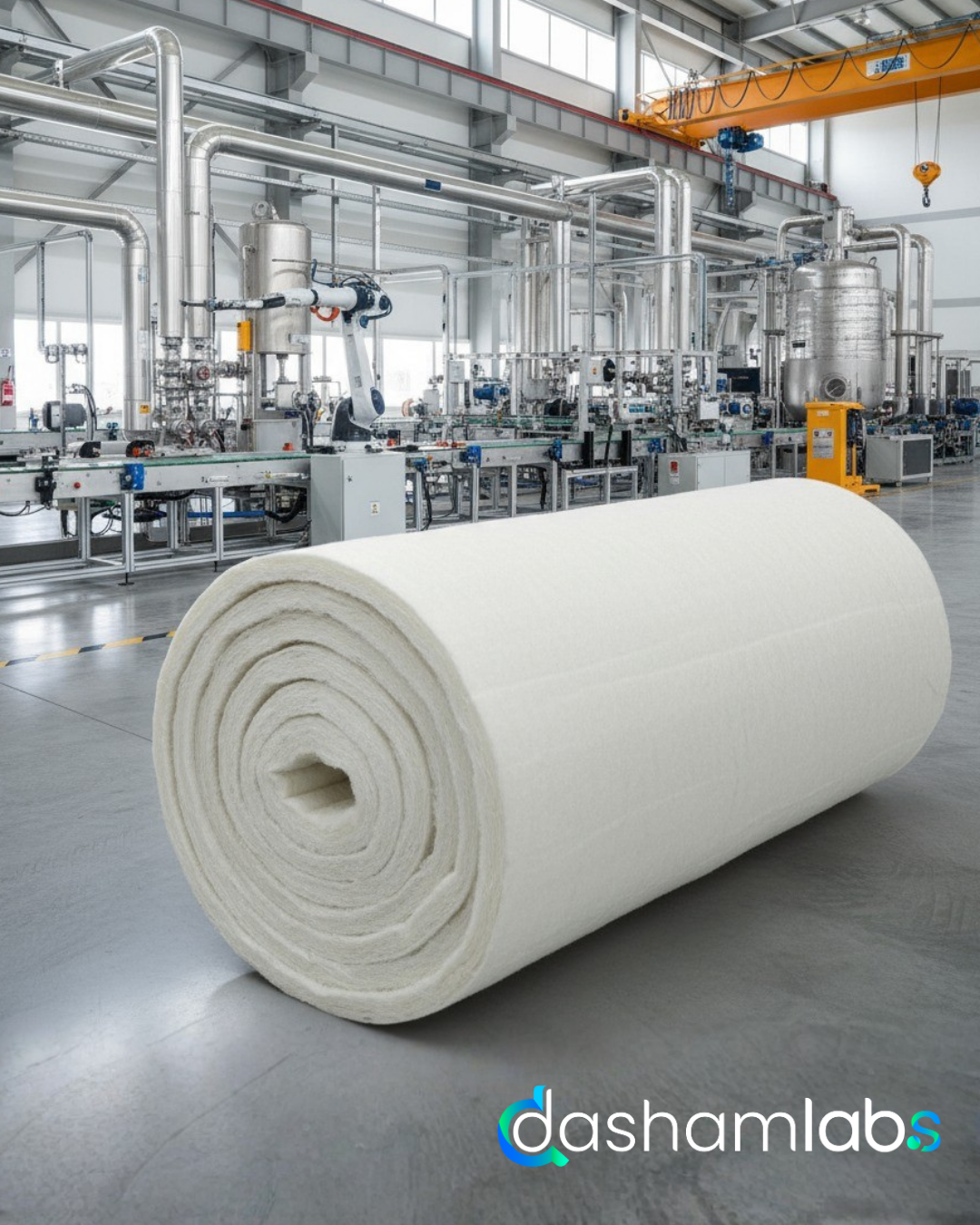
Aerogel insulation for aerospace and defence exists to solve that squeeze: keep heat where it belongs, using the thinnest, lightest layer that will do the job. DashamLabs’ silica aerogel insulation blanket delivers λ ~ 0.016 W/m·K at room temperature — up to 5× lower thermal conductivity than conventional insulation — in a flexible blanket that is fire-resistant, hydrophobic and easy to install.
Aerogel was first developed for aerospace, then stayed locked in labs by cost, brittleness and batch-scale production. DashamLabs’ patented process changes that: flexible, continuous, industrial-scale. From Atoms to Impact — nanoscale pores, engineered into a material your design team can actually specify.
Key Features:
Upto 5X Lower Thermal Conductivity vs conventional insulation
70% Lower Thickness vs traditional insulation
–50 °C to +650 °C range for Continuous Operation
Nano-porous Structure
Fiber Reinforcement
Why Aerospace & Defence Teams
Choose Dashamlabs
Lightweight Thermal Insulation for Weight- and Space-Critical Platforms
Aerogel is the world’s lightest solid: up to 99.8% air, held in a labyrinth of microscopic pores that throttles heat flow. Peer-reviewed research describes aerogels as nanoporous materials with ultra-low thermal conductivity that are drawing growing attention for aerospace vehicle insulation. The same literature is candid that mechanical fragility has held back adoption.
DashamLabs addresses that directly. Silica aerogel is integrated into a fibrous matrix with reinforcing layers, so the finished blanket is flexible, safe to handle and tough enough for real installation. The payoff for a designer is simple: reach your thermal target with 70% lower thickness, then spend the recovered clearance and mass on equipment, payload or margin.
Thickness options are 3 mm, 5 mm and 10 mm, so you can match the blanket to the space you actually have. Thicker is not always better; the right build-up depends on your temperature profile, surface and thermal target, and our team can help you work through it.
High-Temperature and Sub-Zero Insulation in One Flexible Blanket
Two temperature figures appear on this page, and they describe different things.
- –50 °C to +650 °C is the continuous operating temperature. Use it for steady-state design.
- –200 °C to 1,000 °C is the temperature range the technology addresses, from cryogenic conditions to high-heat exposure. It is the wider envelope, not a continuous rating.
If your profile includes cryogenic service or short-duration high-heat exposure, request the TDS, which covers specifications, performance curves, safety data and installation guidelines, and talk to our team about your conditions. For the background, read aerogel performance at –50 °C vs 650 °C.
Fire-Resistant, Hydrophobic Aerogel Insulation That Is Easy to Install
Fire performance. The blanket is fire-resistant and non-combustible. That is a material description, not a certification claim; if your programme specifies a flame, smoke or toxicity standard, test a sample against it. More in our post on fire resistance of silica aerogel blankets.
Moisture. A hydrophobic treatment keeps water out and mitigates corrosion under insulation, which matters for equipment that sees condensation, washdown or humid storage.
Handling. Lightweight, flexible and safe to handle, the blanket wraps irregular and curved surfaces and suits retrofit and confined spaces. Fewer awkward cuts and fittings mean less time on the installation floor. See mechanical strength and flexibility.
Aerogel Insulation Applications in Aerospace & Defence
DashamLabs’ blanket is a thin thermal layer for any system where heat, weight and space compete. These are the areas where design teams typically evaluate it.
-
- Airframe and UAV equipment bays: A thin thermal barrier around heat sources where clearance is measured in millimetres.
- Hot ducts and pipework: Flexible wrap for bends, flanges and valves on hot lines, within the –50 °C to +650 °C continuous range.
- Battery and power-electronics packs: Thin, non-combustible thermal barrier between modules on electrified platforms. See our note on thermal runaway barriers.
- Cryogenic and sub-zero lines and tanks: Thin insulation where the –200 °C end of the range matters. Read why liquid hydrogen storage is driving interest.
- Defence vehicles, shelters and field equipment: A lightweight, easy-to-install blanket for irregular and curved surfaces, retrofits and confined spaces.
- Ground support and test infrastructure: Pipelines, vessels and heat exchangers, where the same blanket used in process industries applies.
Download Technical
Documentation
Access full technical specifications, performance curves, safety data, and installation guidelines.
Why DashamLabs
- Patented Indian technology: Patented silica aerogel insulation technology, engineered in India and for the world; the first Made in India patented technology of its kind.
- A genuine manufacturer: Engineered and manufactured at DashamLabs, not a trading company; supply is direct from the manufacturer.
- Performance you can specify: λ ~ 0.016 W/m·K and up to 5× lower thermal conductivity, documented in a TDS on request.
- Technology partner and backers: ARCI as technology partner; backed by Speciale Invest, IIMA Ventures and Theia Ventures.
- Scientist-led team: Founders from IIT Roorkee, Harvard Business School and Clemson University, with an inventor co-founder who has two decades of aerogel research. Meet the team.
- Local manufacturing, responsive support: Made in India, with technical documentation and application and installation guidance across India. See why an Indian aerogel supply chain matters.
Aerogel Insulation for Aerospace & Defence: Frequently Asked Questions
Why is aerogel insulation used in aerospace and defence? Aerogel is a nanoporous solid, up to 99.8% air, with very low thermal conductivity, so a thin, light layer can do the work of a much thicker conventional one. That matters wherever weight, volume and heat compete for the same space. DashamLabs’ silica aerogel insulation blanket offers λ ~ 0.016 W/m·K at room temperature in a flexible, fire-resistant, hydrophobic format.
How thin can aerogel insulation be? DashamLabs’ blanket is offered in 3 mm, 5 mm and 10 mm thicknesses. The published figure is 70% lower thickness than traditional insulation. The right thickness for your design depends on your temperature profile, surface and thermal target, so share those with our team, request the TDS and test a sample against your requirement.
What temperature range can the blanket handle? Continuous operation is –50 °C to +650 °C. The technology’s wider temperature range is –200 °C to 1,000 °C, from cryogenic conditions to high-heat exposure. Design steady-state conditions to the continuous range, and share any cryogenic or short-duration high-heat requirements with our team so they can be reviewed against the TDS.
Is aerogel insulation fireproof? DashamLabs’ aerogel blanket is fire-resistant and non-combustible. We use those terms rather than “fireproof”, and we do not publish a fire-classification rating. If your programme requires a specific flame, smoke or toxicity standard, request the TDS and MSDS and test a sample against that standard.
Is DashamLabs aerogel qualified for flight or defence use? Qualification is defined by your programme’s specification, not by a datasheet alone. DashamLabs has not published aerospace or defence qualification data. What we offer is a manufacturer’s TDS and MSDS on request, samples in 3, 5 and 10 mm for testing, and direct technical support to help you evaluate the blanket against your own requirements.
Can I get samples and bulk rolls? Yes. Samples are 1 m² sheets (3 m × 330 mm) in 3, 5 and 10 mm, in limited quantities for qualified projects, for testing, prototyping and pilots. For volume production, bulk rolls are 20 m × 1.5 m (30 m² per roll) in 10, 5 and 3 mm. Use the sample request form and tell us about your application.
Who makes aerogel insulation in India? DashamLabs manufactures silica aerogel insulation blankets in India, at IMT Bawal in Rewari, Haryana, using its own patented technology. It is a manufacturer, not a trading company, backed by Speciale Invest, IIMA Ventures and Theia Ventures, with ARCI as technology partner. Supply is direct from the manufacturer, with technical documentation and installation guidance.
Changing the Game with
Dashamlabs' Aerogel
Scalable
Affordable
Flexible
Real-world ready
Sustainable
Minimal environmental footprint
λ ~ 0.016 W/m·K, –50°C to 650°C stability, fire-resistant, hydrophobic, 70–90% thinner/lighter. Read the Full Technical Specifications
Design Thinner, Lighter Thermal Systems Today
Be among the first to deploy scalable aerogel insulation in your platform, made in India and built for the world. Samples currently available in limited quantities for qualified projects.