
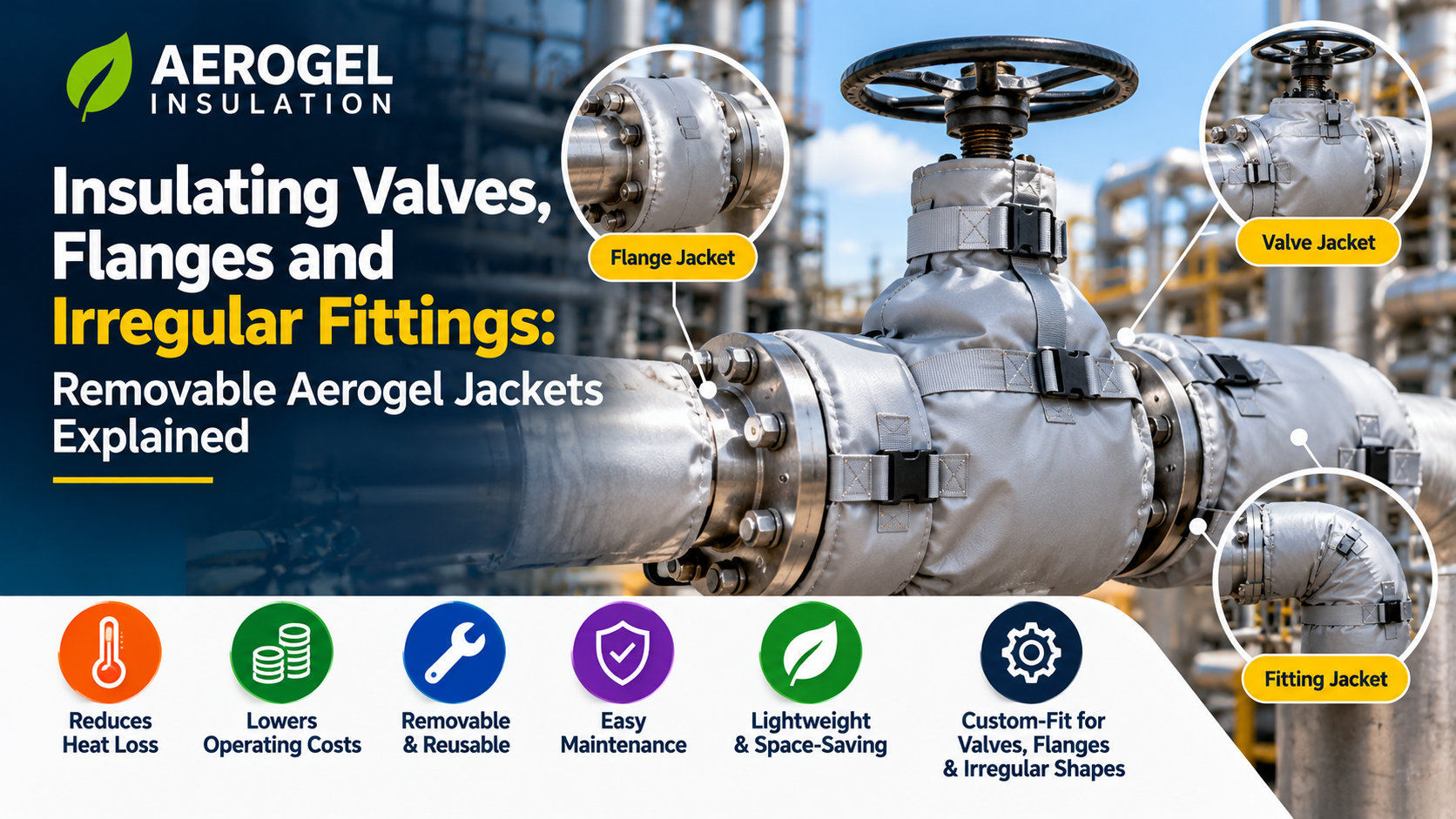
Most plants insulate their straight pipe runs reasonably well. Gaps show up at valves, flanges, strainers, steam traps, and pump casings. Maintenance teams need to reach these components, so they’re often left bare, or wrapped once and never rewrapped after the first repair. On a thermal camera, they stand out as bright hot spots along an otherwise well-insulated line.
Removable insulation jackets exist to fix exactly this. This article explains what the jackets are, how much energy they save, what goes into a good one, and why a thin, flexible aerogel core suits the job.
Why Fittings Get Left Bare
Fittings are hard to insulate for two reasons. The first is access. Valves need to be operated, packed, and overhauled; flanges need their bolts re-torqued; strainers need cleaning; and traps need testing. Conventional insulation such as preformed sections, cladding and mastic isn’t designed to come off and go back on repeatedly. The second is geometry. Handwheels, stems, bonnets, bolt heads and actuators don’t suit rigid materials.
The result is predictable. The U.S. Department of Energy notes that insulation on pipes, valves, and fittings is often damaged or removed during maintenance and not replaced, which leaves both a safety hazard and a source of heat loss. Every shutdown can add to the problem unless reinstatement is built into the work.
How Much Heat a Bare Valve Loses
Fittings have more surface area than their pipe size suggests. The DOE points out that a single 6-inch gate valve can have more than 6 square feet (over 0.5 m²) of surface radiating heat.
The DOE’s Steam Tip Sheet #17 estimates the savings from fitting a 1-inch insulating pad to a bare valve. The figures were calculated with a program that meets ASTM C680, the standard method for heat loss and surface temperature calculations, and they represent the difference in heat loss between an uninsulated and an insulated valve at the same temperature. Converted to watts, the savings look like this:
| Valve size | 93 °C | 149 °C | 204 °C | 260 °C | 316 °C |
| 3 inch | ~230 W | ~500 W | ~850 W | ~1,320 W | ~1,960 W |
| 4 inch | ~320 W | ~670 W | ~1,000 W | ~1,820 W | ~2,670 W |
| 6 inch | ~460 W | ~970 W | ~1,700 W | ~2,640 W | ~3,900 W |
| 8 inch | ~650 W | ~1,410 W | ~2,430 W | ~3,810 W | ~5,630 W |
| 12 inch | ~970 W | ~2,110 W | ~3,660 W | ~5,770 W | ~8,590 W |
Converted from the DOE table (Btu/hour). The DOE figures assume a 1-inch pad on an ANSI Class 150 flanged valve, 65 °F (about 18 °C) ambient air, and no wind.
These are continuous savings for every hour the line is live. The DOE’s own worked example is a 6-inch gate valve on a 250 psig saturated steam line (about 17 barg and 208 °C). A 1-inch pad saves roughly 1.76 kW, which over a year of continuous operation at 80% boiler efficiency comes to about 65.6 MMBtu of fuel, or about 19 MWh per valve.
Multiply that across a real plant. A steam distribution network typically has dozens or hundreds of isolation valves, control valves, flanged joints, strainers and traps. Individually, each one looks minor; together they can make fittings one of the largest remaining heat losses in an otherwise insulated system. For the straight-pipe side of the picture, see our article on steam system insulation and uninsulated steam lines.
There’s a safety angle too. The DOE’s general guidance is that you should insulate any surface above 120 °F (about 49 °C) to protect personnel. A bare valve on a steam header is well above that, and it’s usually at hand height, exactly where operators reach.
What a Removable Jacket Actually Is
A removable jacket, also called a removable/reusable insulation pad or blanket, is a sewn, fitted cover built for one specific component. The DOE describes the basic construction as three layers: a noncombustible inner cover, the insulation material, and a noncombustible outer cover that resists tears and abrasion. Jackets are held in place with wire laced through grommets or with straps and buckles.
That construction gives jackets their main advantages. They’re flexible and vibration-resistant, and they work on horizontally or vertically mounted equipment and in hard-to-reach places. You can remove them for inspection or maintenance and refit them afterward. They can also be built with acoustic barriers to help with noise.
The main standard for these products is ASTM C1695, which sets minimum material and fabrication requirements for flexible removable and reusable blanket insulation for hot service, from above ambient up to 538 °C. It covers industrial, outdoor commercial, and indoor commercial applications separately. Industrial and outdoor jackets must resist both weather and liquid chemicals. Referencing ASTM C1695 in a purchase specification gives buyers a common baseline for comparing fabricators.
Every layer in a jacket has its own temperature rating: the facing fabrics, thread, insulation core, and closures. The jacket is only as capable as its lowest-rated component, so you need to check the service temperature against all of them, not just the insulation.
Why Aerogel Makes a Good Jacket Core
Almost any flexible insulation can go inside a jacket. The core material decides how thick, heavy and durable the finished jacket is, and fittings are where thickness causes the most trouble.
Thinner jackets fit crowded hardware. A valve jacket must clear the handwheel, stem, and bonnet. A flange jacket must cover bolt heads without fouling nearby pipes, supports, or instruments. DashamLabs’ flexible silica aerogel sheet has a thermal conductivity of about 0.016 W/m·K at room temperature, and DashamLabs rates it as 70% thinner than traditional insulation. A thinner core means a jacket that closes properly around congested fittings, and a jacket that closes properly performs as designed.
Flexible sheets conform to complex shapes. DashamLabs manufactures its aerogel blanket by combining silica aerogel with flexible reinforcement, producing blanket solutions tailored for piping, vessels, and industrial equipment. Because the core bends rather than cracks, it can be patterned around bonnets, tees,s and flange edges without leaving gaps.
It survives repeated handling. A jacket is meant to be taken off and refitted many times over its life. DashamLabs states that its flexible aerogel blanket is designed to withstand handling, vibration, and thermal cycling, all of which a valve jacket goes through with every maintenance cycle.
It deals with water. Flanges and valve packings are common leak points, and outdoor jackets get rained on. DashamLabs describes its aerogel as fully hydrophobic and designed to prevent corrosion under insulation. For flanged joints, where hidden corrosion on bolts and flange faces is a real inspection concern, a core that doesn’t soak up water is a practical advantage. We cover this in more detail in our article on moisture resistance and aerogel’s hydrophobic nature.
It covers the temperature range. DashamLabs rates its sheet for continuous operation from –50 °C to 650 °C. That covers steam service and most hot process fittings, and it exceeds the 538 °C upper limit of ASTM C1695. For very hot surfaces, the jacket’s fabrics and closures, not the aerogel core, will usually set the limit. As with any insulation, aerogel’s thermal conductivity rises with temperature, and DashamLabs publishes a λ range of 0.016–0.030 W/m·K. Calculate jacket thickness for hot service using the value at the insulation’s mean operating temperature, as listed in the technical data sheet.
Aerogel cores cost more than conventional fibrous cores, and jackets are custom-made anyway. The aerogel premium makes the most sense where space is tight, jackets are removed often, or moisture and CUI are known problems. For large, open, rarely accessed surfaces, a conventional core may be the more economical choice.
Where Removable Jackets Earn Their Keep
The DOE lists common uses for reusable insulating pads, including flanges, valves, expansion joints, heat exchangers, pumps, turbines, tanks, and other irregular surfaces. In a typical Indian process plant or utility block, the highest-value targets are usually these:
- Isolation and control valves on steam headers and branch lines.
- Flanged joints, particularly at equipment nozzles.
- Strainers and pressure-reducing valve stations.
- Heat exchanger channel heads and end covers.
- Pump and turbine casings.
- Expansion joints.
Steam traps need more care. The DOE recommends removable, reusable snap-on insulation for inverted bucket traps. She says thermostatic and disc traps should be insulated only per the manufacturer’s specifications so they keep working properly. Some trap designs depend on losing heat to operate, so check before wrapping.
Specifying and Installing Jackets Well
A good jacket program starts with a survey. Walk the system with a thermal camera, list every bare fitting with its size and operating temperature, and rank them by estimated heat loss using the table above. Since jackets are made to measure, have the fabricator measure the fittings on site. The DOE notes that most suppliers can take on-site measurements to get the best fit on irregular surfaces.
In the purchase specification, reference ASTM C1695, state the maximum service temperature, and specify whether the location is indoor or outdoor so the facings are weather- and chemical-resistant where needed. Ask for a durable identification tag on each jacket so it goes back onto the right fitting after maintenance.
When fitting jackets, fasten them snugly but don’t crush the core. Over-tightened straps or lacing compress the insulation and reduce its performance. Where water can reach a fitting from above, make sure the jacket’s overlaps shed water rather than channel it inward.
Before removing any old insulation from fittings, particularly in older plants, check for asbestos. The DOE recommends checking for asbestos in line with occupational safety regulations before removing existing insulation.
Finally, make jacket reinstatement a sign-off item on the maintenance permit. A removable jacket only saves energy while it’s actually on the fitting.
The Bottom Line
Valves, flanges, and other irregular fittings are often the biggest remaining heat leaks in a steam or hot process system, because they need access and don’t suit conventional insulation. Removable jackets solve both problems: the DOE puts the savings from a single 6-inch steam valve at nearly 2 kW every hour the line runs, and the jacket can come off and go back on as often as maintenance requires. An aerogel core makes jackets thinner so they fit crowded hardware, flexible enough to conform to complex shapes, durable enough for repeated removal, and hydrophobic enough to protect flanged joints where water collects.
To evaluate DashamLabs’ aerogel as a jacket core, request a sample or review the full technical specifications.