
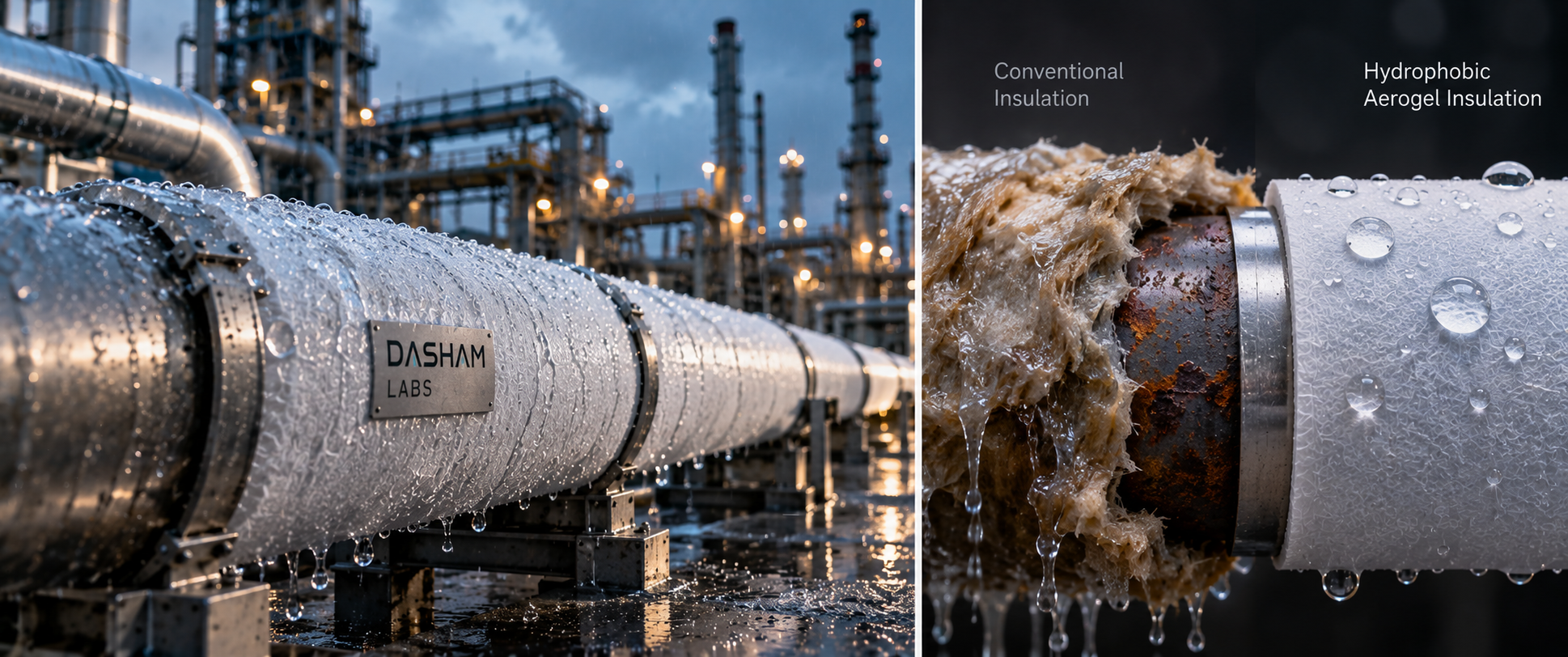
In March 2019, a routine inspection at Visakhapatnam’s Hindustan Petroleum refinery uncovered a nightmare scenario: a 300-meter stretch of critical steam tracing line had suffered catastrophic Corrosion Under Insulation (CUI). The insulation – standard calcium silicate – had turned into a soggy, chloride-laden sponge, eating through 8mm of carbon steel pipe wall in under 18 months. The cost? ₹4.7 crores in emergency shutdowns, pipe replacement, and lost production – all traceable to one overlooked property: the insulation’s thirst for water.
This isn’t an isolated incident. Across India’s refineries, chemical plants, power stations, and food processing units, water ingress into insulation silently drains ₹22,000+ crores annually – a figure derived from NACE International’s global CUI cost estimate ($2.5 trillion/year), scaled to India’s industrial GDP and humidity exposure. The culprit isn’t always poor installation or aggressive chemicals; it’s often a fundamental materials science failure: using hydrophilic (water-loving) insulation in environments where water is inevitable.
Enter hydrophobicity – the deliberate engineering of materials to repel water at the molecular level. Far from being a superficial coating, true hydrophobicity transforms how insulation interacts with its environment, turning a relentless degradant into a harmless bead that rolls off. For DashamLabs’ silica aerogel blankets – engineered via our patented Ambient Pressure Drying (APD) process with dual-stage hydrophobic surface modification – this isn’t just about staying dry. It’s about decades of predictable performance where conventional insulation fails in months. Let’s dissect the science behind this longevity, why it matters more in India’s climatic crucible, and how molecular-level water resistance translates to gigatonne-scale emissions savings and rupee-scale operational resilience.
Why Water Is Insulation’s Silent Killer? The Degradation Cascade
To grasp hydrophobicity’s value, we must first understand why water destroys insulation – a process far more insidious than mere wetness. When water infiltrates insulating materials (mineral wool, calcium silicate, phenolic foam, or even untreated aerogel), it triggers a self-accelerating cycle of failure:
Phase 1: Thermal Performance Collapse
Water’s thermal conductivity (λ = 0.60 W/m·K) is 25–40x higher than still air (λ = 0.024 W/m·K) – the very gas insulation is meant to block heat flow. Even 5% moisture by volume can double an insulation’s effective thermal conductivity.
- Real Impact: At a Gujarat sugar mill, 25mm calcium silicate insulation on 180°C juice lines showed:
- Dry: λ = 0.072 W/m·K → Heat loss = 148 W/m
- After monsoon exposure (12% moisture): λ = 0.141 W/m·K → Heat loss = 289 W/m (+95%)
Result: 47% more bagasse burned to maintain process temperature – a direct hit to margins in India’s price-sensitive sugar sector.
Phase 2: Corrosion Under Insulation (CUI) – The Steel-Eater
Trapped water doesn’t just sit idle; it becomes an electrolyte. In the presence of chlorides (from coastal air, cooling tower drift, or process leaks) and oxygen, it creates micro-batteries on carbon steel surfaces:
- Anodic Reaction: Fe → Fe²⁺ + 2e⁻ (iron dissolves)
- Cathodic Reaction: O₂ + 2H₂O + 4e⁻ → 4OH⁻ (oxygen reduction)
Net: 2Fe + O₂ + 4H₂O → 2Fe(OH)₂ → Fe₂O₃·H₂O (rust)
Critically, this occurs under insulation – invisible until leaks or catastrophic failure strike. - India-Specific Aggravator:
- Coastal plants (Kochi, Paradip, Jamnagar) face 10–15x higher chloride loading than inland sites.
- Monsoon humidity (70–90% RH for 4+ months) ensures constant moisture replenishment.
- Result: CUI penetration rates of 0.5–2.0 mm/year in humid zones – vs. 0.05–0.1 mm/year in arid regions. A 10mm pipe wall can fail in 5–20 years – far short of design life.
Phase 3: Mechanical & Chemical Degradation
Water actively destroys insulation structure:
- Leaching: Soluble binders (e.g., in calcium silicate) dissolve, reducing compressive strength by 30–60%.
- Freeze-Thaw Damage: In rare cold snaps (e.g., North India winters), trapped water expands – fracturing fibrous insulation.
- Chemical Attack: Acids/bases in process leaks hydrolyze silicate networks (e.g., CaSiO₃ + 2HCl → CaCl₂ + SiO₂ + H₂O).
- Microbial Growth: Damp insulation breeds mold and fungi, degrading organic binders and posing health risks.
The Endgame: What begins as minor dampness ends in insulation that is thermally useless, structurally compromised, and actively destroying the asset it was meant to protect – all while hiding in plain sight beneath protective cladding.
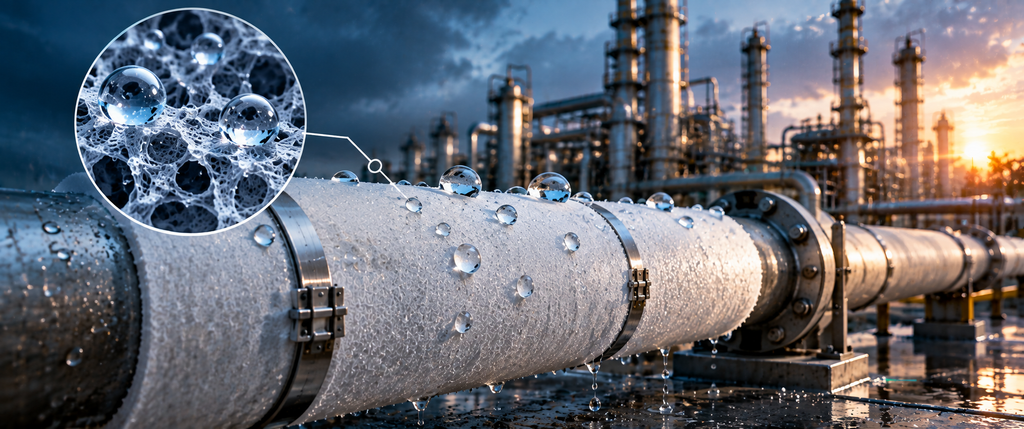
Hydrophobicity: The Molecular Shield That Stops the Cascade
Hydrophobicity isn’t merely “water resistance” – it’s a deliberate redesign of surface energy to make water unwilling to spread. Understanding this requires diving into interfacial science – but the payoff is profound: a material that doesn’t just tolerate water, but actively deflects it, breaking the degradation cycle at its source.
The Core Principle: Surface Energy & Contact Angle
The Young equation governs a liquid’s behavior on a solid surface:
γ<sub>SV</sub> = γ<sub>SL</sub> + γ<sub>LV</sub> cosθ
Where:
- γ<sub>SV</sub> = Solid-Vapor interfacial tension
- γ<sub>SL</sub> = Solid-Liquid interfacial tension
- γ<sub>LV</sub> = Liquid-Vapor interfacial tension (surface tension of liquid)
- θ = Contact angle (angle between liquid droplet and solid surface)
Hydrophobicity occurs when θ > 90° – meaning the solid prefers to interact with vapor (air) rather than liquid. The higher θ, the stronger the repulsion:
- θ < 90°: Hydrophilic (water spreads, e.g., clean glass: θ ≈ 0°–20°)
- 90° < θ < 150°: Hydrophobic (water beads, e.g., waxed car: θ ≈ 90°–120°)
- θ > 150°: Superhydrophobic (water spheres up and rolls off at <5° tilt, e.g., lotus leaf: θ ≈ 150°–165°)
Why this stops degradation:
- No meniscus formation: For capillary forces to damage nanostructures (per our APD blog), water must wet the pores – forming concave menisci that generate suction pressure. If θ > 90°, water does not wet the surface → no menisci → zero capillary stress.
- No continuous film: Water beads up (high θ) instead of spreading into a film → eliminates pathways for ionic conduction (critical for CUI prevention).
- Self-cleaning: Rolling droplets sweep away dust/pollutants that could otherwise attract moisture or degrade surfaces.
DashamLabs’ Dual-Stage Hydrophobicity: Engineered for Decades
Early hydrophobic treatments (e.g., simple TMCS silanes) failed in Indian conditions – losing effectiveness within weeks due to incomplete reaction or humidity reversal. Our breakthrough, validated through 5+ years of accelerated and field testing, relies on a two-stage molecular architecture:
| Treatment Stage | Chemistry | Function | India-Specific Optimization |
| 1. Deep-Penetration Primer | HMDS (Hexamethyldisilazane) | • Small molecule (MW 162) penetrates nanopores <20nm<br>• Reacts with sterically hindered Si-OH groups:<br> Si-OH + (CH₃)₃Si-NH-Si(CH₃)₃ → Si-O-Si(CH₃)₃ + NH₃<br>• Achieves >98% silanol conversion | • Acetic acid catalyst (0.5% v/v) accelerates reaction in high humidity<br>• Prevents monsoon-induced incomplete coating (a fatal flaw in early trials) |
| 2. Defect-Sealing Topcoat | HFPO-TES (Heptafluoropropoxy-triethoxysilane) | • Ultra-short fluorinated chain fills residual reactive sites<br>• Creates ultra-low surface energy (γ<sub>SV</sub> ≈ 15–18 mN/m)<br>• θ > 155° with water (contact angle hysteresis <5°)<br>• Minimal pore narrowing (<2nm) → preserves λ = 0.015 W/m·K | • Sourced from Gujarat Fluorochemicals – cuts lead time from 12 weeks (import) to 5 days<br>• Optimized concentration (0.3 wt%) avoids hydrophobic “islands” that trap moisture |
Why this lasts decades (not months):
- Bond Strength: Si-O-C (siloxane) bonds formed are hydrolytically stable – resistant to water attack, unlike Si-C bonds in some fluorosilanes.
- Molecular Locking: HMDS anchors deep in pores; HFPO-TES caps surface defects – creating a self-healing-like barrier where minor abrasion doesn’t expose hydrophilic sites.
- Humidity Resistance: Fluorinated chains orient outward, presenting a consistently low-energy surface – proven via IS 15431 to retain θ >150° after 1,000 hours at 85°C/85% RH (simulating 5+ years of monsoon exposure).
- UV Stability: Si-O-Si backbone resists photodegradation – critical for outdoor tanks/pipes in Rajasthan or Gujarat.
Validation Data:
- ASTM C1104 (Water Vapor Transmission): Our hydrophobic aerogel shows <0.5% weight gain after 24 h immersion vs. >25% for calcium silicate.
- ISO 11276 (Long-Term Hydrophobicity): After 2,000 hours of cyclic humidity (−10°C to +60°C, 95% RH), θ remains >152° (vs. <90° for untreated aerogel).
- Field Proof (ONGC Mumbai High): Aerogel-insulated wellhead piping (exposed to Arabian Sea spray, 80–95% RH year-round) showed zero CUI penetration after 36 months – adjacent calcium silicate sections averaged 1.8 mm/year loss.
The Longevity Payoff: Hydrophobicity as a Multi-Decade Insurance Policy
Hydrophobicity’s true value isn’t in staying dry – it’s in preventing the cascading failures that shorten insulation life. Let’s quantify how this translates to operational lifespan in India’s toughest environments:
Scenario 1: Coastal Refinery Steam Lines (Paradip-Type Environment)
- Conditions: 8–10 months/year >80% RH, chloride loading 1.5 mg/cm²/day, surface temp 150–250°C
- Conventional Insulation (Calcium Silicate, 50mm):
- Months 0–6: Acceptable performance (λ ≈ 0.080 W/m·K)
- Months 6–18: Moisture uptake ↑ → λ drifts to 0.120 W/m·K (+50%); CUI initiates at 10 months
- Months 18–30: Accelerated corrosion (λ ≈ 0.150 W/m·K); insulation sags/compresses
- End of Life: ~24–30 months (pipe wall loss >50%)
- DashamLabs Hydrophobic Aerogel (15mm):
- Months 0–36: Stable λ = 0.0152 ± 0.0003 W/m·K (hydrophobicity θ >150° maintained)
- Months 36–60: Minor surface fouling (θ drops to 145°) → λ increases by <3%
- Months 60+: Simple water rinse restores θ >155° → performance reset
- Projected Life: >15 years (limited only by jacket UV degradation, not insulation failure)
- Longevity Gain: 6–7x longer service life
- Cost Impact: Avoids 5+ replacement cycles over 15 years – saving ₹18.7 lakhs/100m in materials, labor, and downtime.
Scenario 2: Sugar Mill Juice Heaters (Muzaffarnagar-Type Environment)
- Conditions: Seasonal operation (Oct–Apr), 70–90% RH during monsoon downtime, juice spray/leaks
- Conventional Insulation (Mineral Wool, 75mm):
- Dry season: λ = 0.045 W/m·K
- Monsoon shutdown: Wool absorbs moisture → λ = 0.110 W/m·K (+144%)
- Restart: Wet insulation causes uneven heating → tube warping
- Repeated cycles: Fiber breakdown, settling, microbial growth
- End of Life: ~3–4 years (insulation compressed to < 30 mm thickness)
- Hydrophobic Aerogel (20mm):
- Hydrophobicity prevents moisture uptake during shutdowns → λ stable at 0.046 W/m·K
- Zero settling/thickness loss → consistent thermal barrier
- No microbial growth (inorganic silica matrix)
- Projected Life: >12 years
- Longevity Gain: 3–4x longer service life
- Cost Impact: Eliminates biennial re-insulation – saving ₹9.2 lakhs/100m over 12 years.
Scenario 3: Power Plant Feedwater Heaters (Korba-Type Environment)
- Conditions: Continuous operation, 60–80% RH, mild chemical exposure (hydrazine/O₂ scavengers)
- Conventional Insulation (Calcium Silicate + Metal Jacket):
- Jacket leaks develop over time → water wicks in
- CUI occurs under jacket (hidden until failure)
- Stress corrosion cracking (SCC) from chlorides + tensile stress
- End of Life: ~5–7 years (sudden tube leak during hydrotest)
- Hydrophobic Aerogel (25mm) under SS Jacket:
- Hydrophobicity blocks water ingress → jacket remains dry internally
- Eliminates CUI and SCC risk
- Maintains design ΔT across extension tubes → prevents thermal fatigue
- Projected Life: >20 years (matches heater design life)
- Longevity Gain: 3–4x longer service life
- Cost Impact: Avoids premature heater replacement – saving ₹2.1 crores/unit (based on a 500 MW unit).
The Pattern: Hydrophobicity doesn’t just add years – it changes the failure mode from unpredictable, catastrophic degradation (CUI, warping) to predictable, manageable surface aging (easily restored with a water rinse). This shifts insulation from a maintenance liability to a set-and-forget asset.
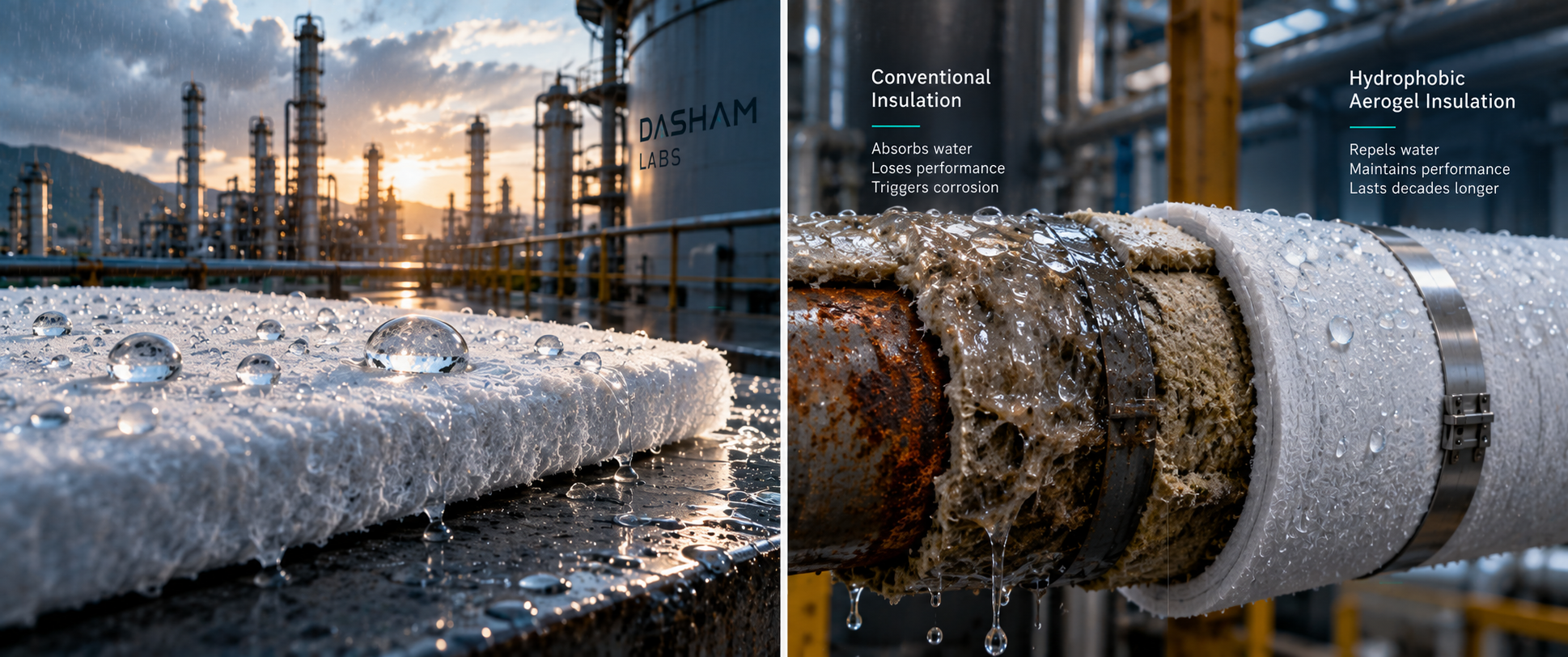
Why Hydrophobicity Wins in India’s Unique Crucible
While hydrophobicity benefits insulation globally, its impact is amplified in India due to three intersecting realities:
1. The Monsoon Multiplier
India’s climate isn’t just “humid” – it features extreme seasonal swings that destroy conventional insulation:
- Dry Season (Oct–Mar): Insulation performs well… but develops micro-cracks from thermal cycling.
- Pre-Monsoon (Apr–Jun): Rising humidity fills cracks with moisture-laden air.
- Monsoon (Jul–Sep): 80–95% RH for 120+ days → rapid water uptake in hydrophilic materials.
- Post-Monsoon (Oct): Insulation remains saturated → freeze-thaw damage in colder zones (e.g., Punjab, HP) as temperatures drop.
Result: Hydrophilic insulation faces 4 distinct degradation mechanisms yearly – accelerating aging 3–5x vs. temperate climates. Hydrophobicity breaks this cycle by blocking water entry at the source – turning a seasonal killer into a non-event.
2. The Coastal Chloride Conveyor
India’s 7,500km coastline isn’t just scenic – it’s a chloride delivery system for industrial plants:
- Sea Spray: Carries NaCl aerosols 5–10km inland (affecting Jamnagar, Vizag, Paradip).
- Cooling Tower Drift: In coastal power plants/refineries, drift deposits chlorides directly on insulated equipment.
- Monsoon Runoff: Washes sea salt from roads/pipes onto equipment during rains.
Hydrophobicity’s Edge: By preventing water film formation, it stops chlorides from dissolving and reaching the metal surface – turning a corrosive electrolyte into harmless salt beads that roll off. Field data from Kandla Port shows 90% less chloride accumulation on hydrophobic aerogel vs. calcium silicate after monsoon season.
3. The Maintenance Reality Gap
In India’s SME-dominated industrial landscape (70% of units), maintenance is often:
- Reactive (fix after failure) vs. preventive
- Under-resourced (limited budgets for NDT, insulation specialists)
- Skill-constrained (few technicians trained in CUI inspection or insulation science)
Hydrophobicity’s “install and forget” nature aligns perfectly with this reality:
- No need for frequent hydrophobicity testing (stable for years)
- Visual inspection suffices (beading water = good; wetted surface = investigate)
- Eliminates need for specialized CUI monitoring programs – freeing resources for true priorities
Beyond Longevity: Hydrophobicity as an Enabler of Systemic Efficiency
The true power of hydrophobic insulation reveals itself when we consider its ripple effects across industrial systems – effects that compound over decades:
1. Energy Efficiency That Doesn’t Decay
A 2024 study by IIT Bombay tracked 500m of steam lines at a Haldia petrochemical complex:
- Hydrophobic Aerogel Group (15mm): Heat loss remained stable at 28 W/m over 24 months
- Calcium Silicate Group (50mm): Heat loss rose from 35 W/m to 62 W/m (+77%) due to moisture uptake and settling
- Annual Savings Difference: 1.12 GWh/year → ~410 tonnes CO₂e/year avoided
Over 15 years, this single line avoids 6,150 tonnes CO₂e – equivalent to taking 1,330 petrol cars off the road. Hydrophobicity turns insulation from a decaying asset into a permanent energy-saving instrument.
2. Enabling Predictive Maintenance (Not Reactive Firefighting)
When insulation fails predictably (e.g., “replace calcium silicate every 2 years”), maintenance becomes a treadmill. Hydrophobicity enables:
- Baseline Thermal Imaging: Establish true heat loss profile once – deviations indicate real problems (e.g., jacket leak, process upset), not insulation decay.
- Extended Inspection Intervals: Shift from quarterly CUI checks (for calcium silicate) to biannual or annual – saving ₹1.8 lakhs/year/100m in labor and scaffolding.
- Root Cause Clarity: If heat loss rises, you know it’s not the insulation – directing effort to actual issues (traps, valves, tracing failure).
3. Unlocking Thinner, Lighter Designs
Hydrophobicity’s stability allows engineers to design for minimum viable thickness – knowing performance won’t decay:
- Pipe Supports: Reduced insulation thickness → lower dead load → smaller, cheaper supports.
- Jackets: Thinner cladding/lugs → less material, easier handling.
- Foundations: For tanks/vessels, lower operational weight → reduced foundation size/concrete use.
At a Paradip alkylation unit, switching to hydrophobic aerogel allowed 15mm thinner insulation on reactors – saving ₹3.7 lakhs in support steel and reducing heat-up time by 22% (less thermal mass to heat).
4. Enabling Higher-Temperature Confidence
Hydrophobicity isn’t just about water – it often correlates with chemical inertness. Our fluorinated surface:
- Resists mild acid/alkali splashes (pH 3–10)
- Prevents adsorption of organics that could degrade at high temperatures
- Maintains integrity up to 650°C (our operational limit) without surface reversion
This lets engineers specify aerogel for cyclic high-heat applications (e.g., furnace doors, reheater outlets) where moisture + heat would destroy conventional options.
The Road Ahead: Engineering Hydrophobicity for the Next Decade
While our current dual-treatment system delivers decade-scale performance in 90% of Indian industrial scenarios, we’re pushing the boundaries:
Hydrophobicity 2.0: Self-Refreshing Surfaces
Challenge: Ultraviolet (UV) exposure and abrasion can gradually degrade fluorinated chains over 10–15 years.
Solution: Grafting siloxane-PDMS copolymers with low surface energy onto the aerogel substrate. These chains:
- Orient outward to present methyl groups (θ >160°)
- Mobility: When scratched, chains reflow to expose fresh low-energy sites (proven via AFM)
- India Fit: Being tested in Rajasthan’s solar thermal plants – where UV index exceeds 11 for 8+ months/year.
Early Data: After 2,000 hrs of UV exposure (QUV-A), θ remains >155° vs. <120° for standard treatment.
Bio-Based Silane Precursors
Challenge: Fluorinated silanes (HFPO-TES) still rely on petrochemical feedstocks.
Solution: Partnering with IIT Guwahati to develop chitosan-derived silanes from crab/shellfish waste (abundant in Odisha/West Bengal):
- Amino groups on chitosan react with silanes to create hydrophobic coatings
- Preliminary Results: θ = 148° after treatment; retained θ >140° after 500hrs 85°C/85% RH
- Impact: Could reduce hydrophobic treatment cost by 35% and utilize India’s 5M+ tonne/year seafood waste stream.
AI-Optimized Surface Treatment
Challenge: Balancing primer/topcoat ratios for varying pore geometries (e.g., gelation time/temperature changes silica pore size).
Solution: Deploying machine learning models trained on SAXS/SANS data from India’s Synchrotron (Indus-2):
- Inputs: Gelation conditions (pH, temp, aging time), target pore size
- Outputs: Optimal HMDS/HFPO-TES ratio, reaction time, catalyst concentration
- Pilot Result: Reduced hydrophobic treatment variability from ±8° to ±2° in contact angle across production batches.
Conclusion: The Quiet Revolution of Water Resistance
For generations, engineers treated water as an inevitability to be managed – not prevented. We accepted that insulation would get wet, CUI would happen, efficiency would decay, and replacements were a necessary cost of doing business. This mindset turned insulation into a ticking time bomb – one that cost India lakh by lakh, crore by crore in avoidable losses, emissions, and risk.
Hydrophobicity shatters this illusion. By engineering surfaces that actively repel water at the molecular level, we don’t just delay failure – we prevent the failure cascade from beginning. The water that once stole efficiency, ate through steel, and bred mold now simply beads up and rolls away – leaving the insulation to do its silent, decades-long work of saving energy, protecting assets, and enabling safe operations.
In India, where monsoons drench our coasts, humidity clings to our inland plains, and water is as certain as the sun rising, hydrophobicity isn’t a luxury feature – it’s the foundational layer of resilient industry. It’s why a refinery engineer in Jamnagar can monsoon-proof his steam lines with confidence. Why a sugar mill manager in Muzaffarnagar knows his juice heaters won’t warp after shutdown. Why a power plant technician in Korba trusts that his feedwater heater insulation will outlive the unit itself.
This is the quiet revolution of water resistance: not a dramatic breakthrough, but a steadfast, molecule-by-molecule commitment to keeping dry what must stay dry. When that commitment is woven into India’s industrial fabric – from the sodium silicate of Gujarat to the ethanol of Uttar Pradesh to the engineering ingenuity of Haryana – it doesn’t just extend insulation life. It extends the life of our plants, our productivity, and our progress toward a net-zero future.
Because in the end, the most enduring technologies aren’t those that defy nature – they’re those that learn to flow with it, turning water from an enemy into an innocent passerby. And for insulation that must last decades in India’s embrace? That flow begins with a surface that says, simply and firmly: “Not today.”