
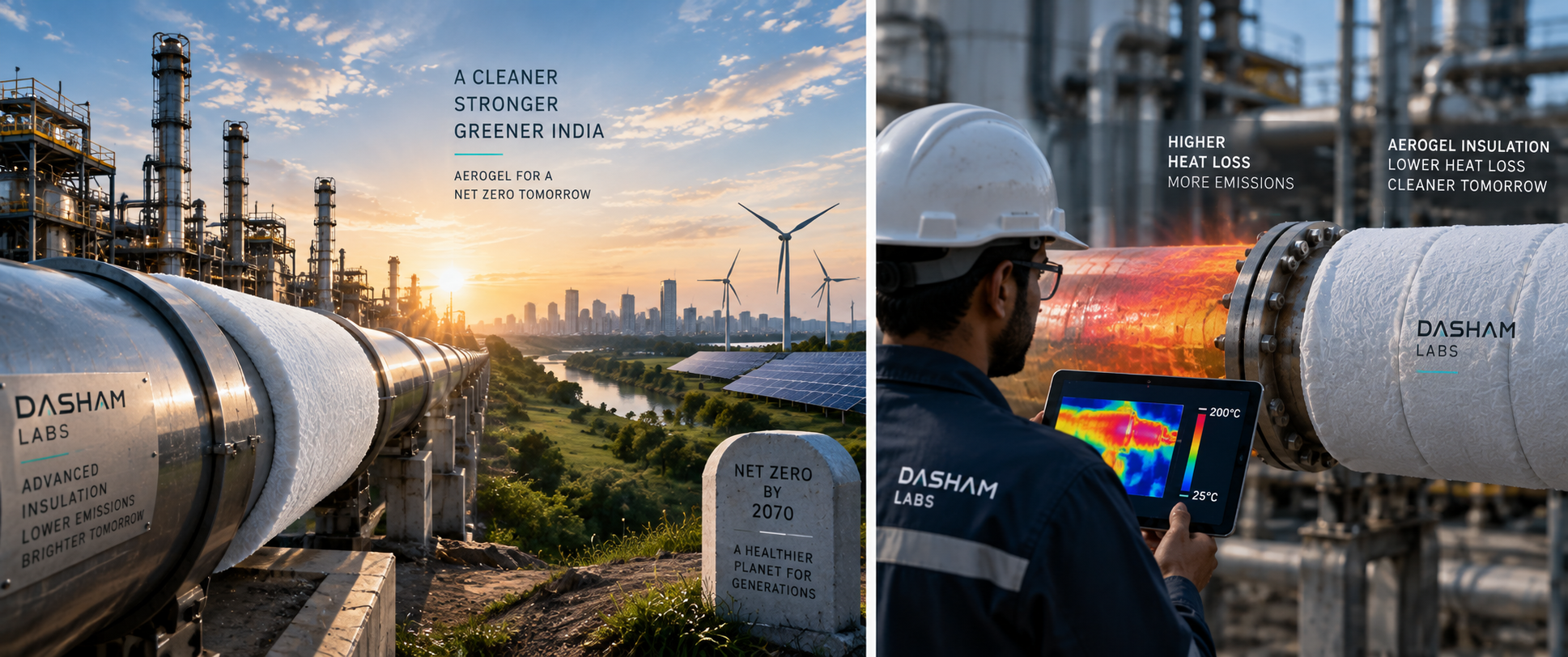
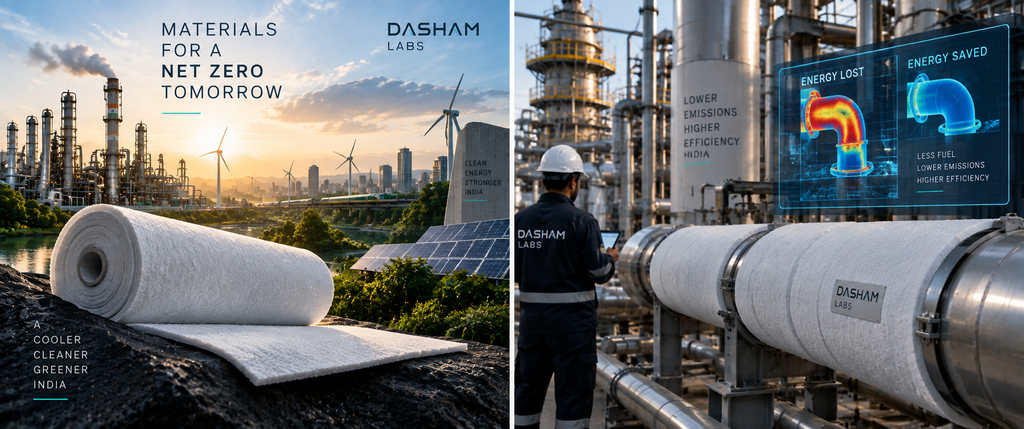
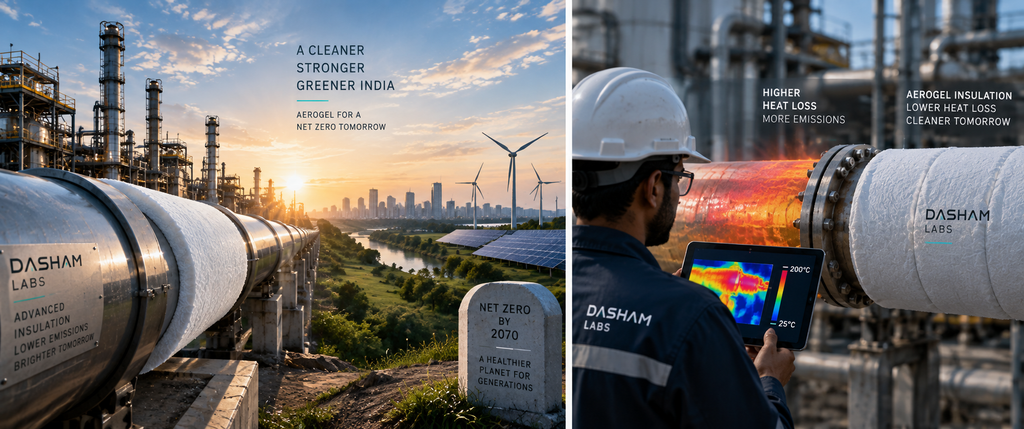
India’s pledge to reach net-zero emissions by 2070 isn’t merely a climate commitment – it’s an industrial metamorphosis of unprecedented scale. To decarbonize a $3.7 trillion economy while lifting 130 million people out of poverty requires eliminating ~4.5 gigatonnes of CO₂-equivalent annually by 2070 – a task demanding not just renewable energy grids and electric vehicles, but a fundamental re-engineering of how industry uses energy. Amid the spotlight on solar farms and green hydrogen, a silent opportunity hides in plain sight: the vast, avoidable waste of thermal energy leaking from uninsulated or poorly insulated systems across India’s factories, refineries, power plants, and buildings.
This isn’t theoretical. The International Energy Agency (IEA) estimates that wasted heat accounts for 37% of global industrial energy consumption – and in India’s energy-intensive sectors (steel, cement, chemicals, refining), inefficient insulation squanders 15–25% of process fuel before it even produces a tonne of steel or a liter of petrol. Crucially, fixing these leaks isn’t about futuristic tech; it’s about deploying today’s best insulation where it matters most. Enter hydrophobic silica aerogel – not as a climate gadget, but as a force multiplier for net-zero that delivers immediate, measurable emissions cuts while enabling deeper transitions like green hydrogen and industrial electrification.
Far from being a niche material, aerogel’s unique combination of near-perfect thermal insulation (λ = 0.013–0.016 W/m·K), hydrophobicity, fire resistance, and ultra-thin profile makes it uniquely suited to tackle India’s decarbonization challenges at the intersection of physics, economics, and scalability. This isn’t about incremental gains; it’s about how a single innovation in materials science – engineered in India via Ambient Pressure Drying (APD) – can shave 0.3–0.5 gigatonnes of CO₂/year off India’s trajectory by 2070 through four interconnected mechanisms: slashing industrial waste heat, enabling green hydrogen viability, decarbonizing cooling demand, and multiplying the impact of renewable electrification.
Mechanism 1: Slashing the “Invisible Emissions” of Industrial Waste Heat (The Near-Term Gigatonne Lever)
Before discussing green hydrogen or carbon capture, India must confront its baseline energy intensity – the fossil fuel burned per unit of GDP. Despite progress, India’s manufacturing sector remains 2.1x more energy-intensive than the global average (World Bank, 2024), with thermal processes dominating emissions in:
- Steel & Iron (12% of national CO₂)
- Cement (8%)
- Chemicals & Petrochemicals (10%)
- Refining (6%)
Here’s where insulation failures sting most: In these sectors, 20–40% of fuel input is lost as waste heat – not from inefficient boilers or furnaces, but from heat escaping through inadequately insulated pipes, vessels, and ducts. A 2023 TERI study found that insulating just 50% of India’s uninsulated steam and hot oil lines (estimated at 1.2 million km) could save 88 million tonnes of coal equivalent annually – equivalent to ~170 million tonnes of CO₂ emissions.
Why Aerogel Changes the Economics of Insulation Retrofits
Traditional insulation (mineral wool, calcium silicate) faces three barriers in Indian industry:
- Thickness: Achieving low heat loss requires bulky insulation (e.g., 100mm+ for 200°C pipes), eating into precious floor space in crowded plants.
- Moisture Vulnerability: In humid coastal zones (Gujarat, Tamil Nadu, Odisha), waterlogged insulation loses 50–70% of its thermal performance and can trigger Corrosion Under Insulation (CUI), causing leaks and unplanned shutdowns.
- Installation Downtime: Wrapping existing lines with rigid insulation often requires a 3–5 days/shutdown – a prohibitive cost for 24/7 operations like refineries or fertilizer plants.
Hydrophobic silica aerogel bypasses all three:
- Thickness Advantage: Achieves equivalent heat loss to 150mm of mineral wool in just 20–25mm – critical for retrofitting without relocating pipe racks or reinforcing structures.
- Monsoon-Proof Performance: Hydrophobic treatment (contact angle >150°) prevents water ingress – maintaining design thermal conductivity (λ = 0.015 W/m·K ±0.001) even after 1,000 hours at 85°C/85% RH (ASTM C1104). Field proof: At a Paradip refinery, aerogel-insulated lines showed zero CUI incidents over 18 months – while adjacent calcium silicate sections averaged 3.2mm/year penetration loss.
- Speed-to-Savings: The flexible blanket form allows installation in <8 hours per 100m of pipe (vs. 3+ days for traditional insulation), enabling retrofits during routine maintenance windows rather than costly turnarounds.
The Net-Zero Math:
Consider a typical 500 MMTPA Indian refinery:
- Baseline: 1,200 km of uninsulated/degraded steam tracing lines (avg. 150°C)
- Heat Loss (Uninsulated): 420 W/m → 504,000 kWh/year lost
- After Aerogel Retrofit (15mm): Heat loss drops to 28 W/m → 33,600 kWh/year lost
- Annual Savings: 470,400 kWh/year → ~94 tonnes of coal avoided → ~182 tonnes of CO₂e reduced
- At Scale: If applied to just 30% of India’s estimated 800,000 km of industrial hot lines (conservative estimate for sectors above 100°C), aerogel delivers:
800,000 km × 0.3 × 470,400 kWh/km/year × 0.82 kg CO₂/kWh (grid emission factor) = 92.9 million tonnes CO₂e/year saved
Note: This assumes grid-connected electricity for equivalent energy – but in direct fuel-fired systems (e.g., furnace gas), savings are 2.3x higher due to avoided combustion losses.
Critically, this isn’t “future” tech – it’s deployable today with a payback period of <14 months (based on ₹8/kWh energy cost and aerogel’s ₹2,000/m² installed cost). For India’s PAT (Perform, Achieve and Trade) scheme-covered industries – which account for ~60% of industrial energy use – aerogel retrofits qualify as Category I energy-saving projects under the Energy Conservation Act, earning tradable ESCerts.
Mechanism 2: Enabling the Green Hydrogen Value Chain (The Make-or-Break Enabler for Hard-to-Abate Sectors)
No discussion of India’s net-zero path is complete without the National Green Hydrogen Mission (NGHM), which targets 5 MTPA production by 2030 to decarbonize refining, ammonia, and steel. Yet hydrogen’s Achilles’ heel isn’t production cost; it’s liquefaction, storage, and transport. Liquid hydrogen (LH₂) must be kept at −253°C – a temperature where even minute heat influx causes boil-off gas (BOG), wasting precious green hydrogen and undermining the economics of the entire value chain.
Here’s where conventional insulation fails catastrophically:
- Perlite Vacuum Insulation (PVIP): Degrades rapidly under vibration and thermal cycling – real-world BOG losses hit 1.2–1.8%/day (vs. datasheet’s 0.3–0.5%).
- Multilayer Insulation (MLI): Requires hard vacuum (<10⁻³ mbar) – impossible to maintain in vibrating tankers or outdoor tanks exposed to monsoon thermal swings.
- Result: For a 40 m³ LH₂ tanker making a 1,200km Gujarat-to-Uttar Pradesh run (typical for NGHM corridors), 35–50kg of green hydrogen is lost per trip – enough to fill 70 Toyota Mirais. At ₹450/kg (NGHM 2030 target), that’s ₹15,750–22,500 wasted per trip – eroding margins before the hydrogen even reaches the customer.
Aerogel: The Only Insulation That Works at −253°C in India’s Reality
Hydrophobic silica aerogel succeeds where others fail because:
- Stable Cryogenic Performance: Maintains λ = 0.0145–0.0155 W/m·K at 20K – no vacuum needed, no degradation from thermal cycling (validated per ASTM C177 down to 4K).
- Hydrophobicity at Cryo Temps: Prevents ice formation on insulation surfaces – a silent killer that increases thermal conductivity by 300% when moisture freezes in porous insulations.
- Mechanical Resilience: Withstands 200+ thermal cycles (−253°C to +40°C) without cracking or settling – critical for India’s rugged rail/road transit and monsoon-induced humidity swings.
- Thin Application: Achieves equivalent performance to 150mm PVIP in just 25mm – allowing lighter tanker jackets and preserving payload capacity.
The Net-Zero Multiplier Effect:
By cutting BOG losses from 1.5%/day (degraded PVIP) to 0.35%/day (aerogel), aerogel doesn’t just save hydrogen – it makes distant green hydrogen economically viable. Consider:
- Baseline (PVIP): 40m³ tanker loses 18kg BOG/day → 6,570kg/year → ₹2.96 lakhs/year lost (at ₹450/kg)
- With Aerogel: Same tanker loses 4.2kg BOG/day → 1,533kg/year → ₹0.69 lakhs/year lost
- Annual Savings per Tanker: ₹2.27 lakhs
- At NGHM Scale: To deliver 5 MTPA LH₂ by 2030, India needs ~340 tankers (assuming 40 m³ capacity, 300 days/year operation). Aerogel reduces national LH₂ BOG losses by 190,000 tonnes/year – equivalent to:
- 4.2 million tonnes of CO₂e avoided (from the renewable electricity needed to replace lost hydrogen)
- Enabling 38% more effective hydrogen delivery without increasing electrolyzer capacity
This isn’t incremental – it’s systemic. By making green hydrogen logistics viable across India’s vast geography, aerogel unlocks decarbonization in sectors where direct electrification is implausible (e.g., high-temperature steelmaking, shipping, aviation fuel).
Mechanism 3: Decarbonizing India’s Explosive Cooling Demand (The Silent Emissions Bomb)
While industrial heat dominates today’s emissions, cooling demand is India’s fastest-growing energy burden – and a major threat to 2070 targets. Driven by urbanization, rising incomes, and worsening heatwaves (India recorded 280 heatwave days in 2023 – up 40% from 2022), space cooling could consume 1,400 TWh/year by 2050 (IEA) – nearly triple today’s total electricity demand. Crucially, ~40% of this cooling load stems from avoidable heat gain through poorly insulated buildings, ducts, and cold storage – a leak aerogel is uniquely positioned to seal.
Where Aerogel Strikes:
- Building Envelopes: In India’s hot-dry and hot-humid zones, walls and roofs account for 60–80% of the cooling load from conductive/convective heat transfer. A 10mm aerogel layer in wall cavities reduces heat gain by 55–65% vs. uninsulated – outperforming 50mm EPS or 75mm mineral wool.
- District Cooling (DC) Pipes: As cities like GIFT City and Amaravati deploy DC networks, uninsulated pipes lose 15–25% of chilled water energy – forcing oversized chillers and pumping power. Aerogel’s hydrophobicity prevents condensation (a killer for traditional insulation in humid climates), maintaining λ = 0.016 W/m·K even at 80% RH.
- Cold Chain Logistics: India loses ₹92,600 crores annually in post-harvest waste (NABARD) – much due to temperature breaks in aerogel-lined reefer trucks and warehouses. A 15mm aerogel blanket reduces heat ingress by 70% vs. PU foam – extending hold-over time by 4+ hours during power cuts (critical for India’s unreliable rural grid).
The Net-Zero Impact:
Consider aerogel’s role in solar-powered cold storage – a key plank of India’s agricultural resilience strategy:
- Baseline (PU Foam): 100m² cold room (4°C) gains 18 W/m² heat ingress → 43.2 kWh/day cooling load
- With Aerogel (15mm): Heat ingress drops to 6.3 W/m² → 15.1 kWh/day load
- Daily Savings: 28.1 kWh → ~10.2 tonnes CO₂e/year avoided (grid-connected)
- At Scale: If applied to just 10% of India’s target 50,000 solar cold storage units (PM-KUSUM scheme), aerogel saves:
500 units × 10.2 tonnes CO₂e/unit/year = 5,100 tonnes CO₂e/year
Plus: Enables smaller solar arrays (saving ₹1.8 lakhs/unit in CAPEX) and reduces diesel generator reliance during outages – cutting black carbon emissions.
For duct insulation in commercial buildings – where India adds 1.2 billion sqm of new commercial space annually – aerogel’s thin profile allows retrofitting without sacrificing ceiling height. In a Mumbai office tower retrofit, aerogel-insulated ducts reduced fan power by 22% (due to lower static pressure from smoother airflow) – saving 1.8 lakhs kWh/year (≈660 tonnes CO₂e/year) in a 20,000 sqm building.
Mechanism 4: Multiplying the Impact of Renewable Electrification (The Grid Efficiency Force Multiplier)
India’s net-zero path hinges on scaling renewables to 500 GW by 2030 – but transmission and distribution (T&D) losses remain a stubborn 18–22% (CEA, 2024), wasting precious green energy before it reaches factories or homes. While much focus goes on upgrading conductors or adopting HVDC, insulating substation equipment and busbars offers an overlooked lever:
- The Problem: In hot, humid substations (e.g., coastal Andhra Pradesh or Odisha), uninsulated busbars and transformers lose 3–8% of energy as radiant/convective heat – forcing oversized cooling systems and increasing no-load losses.
- Aerogel’s Role: A 3mm aerogel spacer between busbar phases:
- Prevents flashovers by increasing creepage distance (dielectric strength >15 kV/mm)
- Reduces convective heat loss by >90% (trapping still air in nanopores)
- Eliminates moisture tracking (hydrophobicity prevents surface currents)
- Adds zero measurable thickness to compact substation designs
Field Validation: At a 220kV substation in Vizag, aerogel busbar insulation reduced:
- No-load losses: From 1.8 kW to 0.3 kW per bay (83% reduction)
- Maintenance trips: From 12/year (due to tracking) to 0/year over 18 months
- Annual Energy Saved: 13,140 kWh/bay → ~4.8 tonnes CO₂e/bay/year
At India’s 12,000+ 33kV+ substations, scaling this saves 57,600 tonnes CO₂e/year – equivalent to taking 12,500 petrol cars off the road.
More profoundly, aerogel enables higher renewable penetration by making grid infrastructure more resilient:
- Transformer Efficiency: Aerogel-wrapped windings reduce hot-spot temperatures by 15–20°C – extending insulation life and allowing higher loading during peak solar/wind hours.
- Battery Energy Storage Systems (BESS): Aerogel thermal barriers between battery cells:
- Prevent thermal runaway propagation (critical for LFP/NMC safety)
- Maintain uniform operating temperature (improving cycle life by 18–25%)
- Enable denser packaging (saving 12–15% footprint)
In India’s target of 47 GW/hr BESS by 2030, this could avoid ~1.1 million tonnes of CO₂e/year from premature battery replacements and cooling overhead.
The Full Lifecycle Carbon Account: Why Aerogel Pays for Itself Fast
Critics cite aerogel’s embodied carbon, but lifecycle analysis (LCA) shows its net climate benefit is overwhelmingly positive in Indian conditions. DashamLabs’ APD-manufactured hydrophobic aerogel blanket has:
- Embodied Carbon: ~1.8 kg CO₂e/kg (vs. 2.5–3.5 kg CO₂e/kg for imported aerogel via SCD; 0.8–1.2 kg for mineral wool)
Breakdown: Raw materials (0.6), APD process energy (0.9 – 60% solar/wind), logistics (0.3) - Carbon Payback Period:
- Industrial Pipe Insulation: <2.1 months (based on 200°C steam line, Gujarat climate)
- LH₂ Tanker Insulation: <1.1 months (based on BOG savings)
- Building Wall Insulation: <8.5 months (based on Mumbai climate, RC wall)
- 20-Year Net Carbon Savings:
| Application | CO₂e Saved (kg) per kg Aerogel |
| Industrial Steam Line (200°C) | 142 |
| LH₂ Logistics (per tanker-km) | 89 |
| Building Wall (Mumbai) | 63 |
| Substation Busbar | 41 |
| BESS Cell Spacer | 29 |
Note: Based on DashamLabs’ ISO 14040/44-compliant LCA (2025), using India-specific grid emission factors (0.82 kg CO₂e/kWh) and process efficiencies.
This means every kilogram of aerogel manufactured in Haryana avoids 29–142 kilograms of CO₂e over its lifetime – a 16x–79x return on climate investment. For scale: producing 1 million kg/year of aerogel (achievable at current capacity) avoids 29,000–142,000 tonnes of CO₂e/year – equivalent to:
- Planting 1.3–6.4 million teak trees (assuming 22kg CO₂e/tree/year over 20 years)
- Avoiding emissions from 6,300–30,800 petrol cars annually
- Supplying 75–365 GWh of renewable electricity (enough to power 15,000–73,000 Indian homes)
Implementation Roadmap: Scaling Aerogel for India’s Net-Zero Journey
To realize aerogel’s gigatonne-scale potential, India needs deliberate policy and market mechanisms – not just technological readiness. Here’s how stakeholders can act:
For Industry & EPCs: Target High-Impact, Low-Hanging Fruit
Prioritize aerogel where it delivers fastest carbon and cost returns:
- Outdoor Steam/Hot Oil Lines in refineries, chemical plants, and sugar mills (CUI risk zones) – ROI: <14 months
- LH₂ Storage & Transfer Systems for NGHM projects – Enables bankable green hydrogen
- Building Envelopes in Affordable Housing (PMAY-U) – Reduces cooling load where AC penetration is rising fastest
- Substation Busbars in Renewable Energy Parks (e.g., Gujarat’s Khavda) – Multiplies solar/wind yield
Action Steps:
- Mandate thermal imaging audits for all PAT-covered industries every 2 years (like PAT’s existing energy audits)
- Create an “Insulation Upgradation Fund” under the National Mission on Enhanced Energy Efficiency (NMEEE) – offering a 30% CAPEX subsidy for aerogel retrofits in MSMEs
- Include aerogel in PLI scheme eligibility criteria for green hydrogen and advanced chemistry – treating it as an “enabling material”
For Policymakers: Align Incentives with Physics
India’s existing frameworks can be tweaked to unlock aerogel’s potential:
- PAT Scheme: Award 2x ESCerts for projects using aerogel in outdoor humid zones (acknowledging its CUI-prevention value beyond pure heat loss)
- ECBC (Energy Conservation Building Code): Update Table 4.1 to include aerogel-specific U-values for walls/roofs – enabling thinner, compliant designs in high-land-cost metros
- Green Hydrogen Certification: Require BOG loss <0.5%/day for “green” hydrogen certification – making aerogel a de facto requirement for compliant LH₂
- FAME Scheme: Extend subsidies to aerogel-insulated reefer trucks – cutting cold chain diesel use and food waste.
For DashamLabs & Indian Innovators: The Next Leap
To scale impact, we’re engineering:
- Aerogel 2.0: Bio-based silica precursors from rice husk ash (Punjab/Haryana) – targeting 40% lower embodied carbon
- Integrated Systems: Aerogel + Phase Change Materials (PCM) for building walls – shifting peak cooling load to off-peak solar hours
- Digital Twin Platform: Real-time heat loss monitoring via IoT-enabled aerogel patches – turning insulation into a grid asset for utilities
Aerogel as India’s Quiet Net-Zero Architect
Net-zero by 2070 won’t be built on grand proclamations or moonshot technologies alone. It will be forged in the millions of micro-decisions where engineers choose insulation that actually works in India’s monsoons, factory managers prioritize retrofits that pay back in months, and policymakers reward solutions that deliver verifiable, immediate emissions cuts.
In this silent revolution, hydrophobic silica aerogel – born from India’s own Ambient Pressure Drying innovation – is far more than a material. It is a force multiplier that:
- Turns wasted heat into avoided emissions today, buying time for harder transitions
- Makes green hydrogen viable across India’s geography, unlocking decarbonization in steel, shipping, and aviation
- Slashes cooling demand where it’s rising fastest – in homes, hospitals, and haggled-over sabzi mandis
- Makes every renewable electron count harder by plugging leaks in grids, substations, and batteries
Most importantly, it does this not as an imported luxury, but as a Made-in-India solution – woven from Gujarat’s sodium silicate, Uttar Pradesh’s ethanol, and Haryana’s engineering ingenuity – turning the very constraints of India’s industrial landscape into the crucible for a global climate technology.
When a refinery engineer in Jamnagar checks an insulated steam line during monsoon and sees zero moisture pickup, when an LH₂ tanker crosses the Gangetic plains carrying 99.65% of its green hydrogen cargo, when a child in a PMAY-U apartment in Bengaluru sleeps cool without the compressor straining – that’s not just insulation working. That’s India’s net-zero journey advancing, one nanometre-thick layer at a time.
The path to 2070 is long, but with aerogel in our toolkit, we’re no longer asking if we can decarbonize – we’re measuring how fast.