
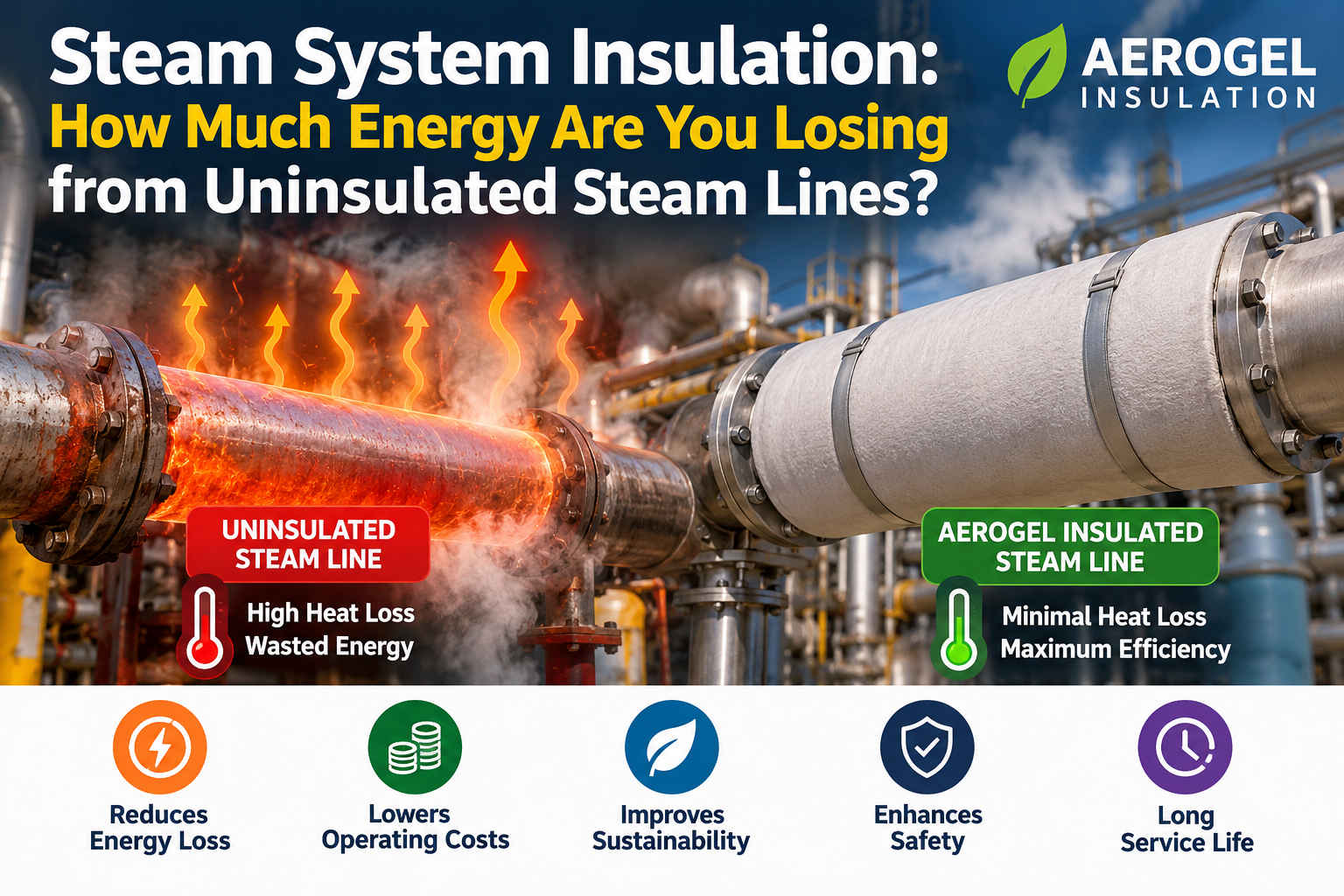
Walk through almost any plant that runs on steam, and you’ll find them: a bare section of header where the cladding was cut away for a repair and never replaced, an uninsulated valve station, a condensate return line nobody thought worth wrapping. They look harmless. They are, in fact, running costs that never switch off. Heat you paid to generate in the boiler leaves through the pipe wall every hour the system is live, whether the plant is at full load or idling.
This article answers the question in the title with numbers: how much heat a bare steam line loses, how to turn that into fuel and steam figures for your own plant, where hidden losses sit, and where modern insulation such as silica aerogel fits in.
The Short Answer
A bare steam line typically loses somewhere between a few hundred watts and several kilowatts per meter, continuously, depending on pipe size and steam pressure. The U.S. Department of Energy says that insulation can typically cut these losses by about 90% while helping maintain proper steam pressure at the equipment. In most plants, bare steam piping is one of the clearest and fastest-payback energy fixes available.
What the Numbers Look Like
The most widely used reference for bare-pipe losses is the DOE’s Steam Tip Sheet #2, which tabulates annual heat loss per 100 feet of uninsulated steam line. Those figures assume horizontal steel pipe in still air at 75 °F (about 24 °C), running 8,760 hours a year. Converted to metric continuous heat loss, the figures look like this:
| Nominal pipe size | ~1 barg (15 psig) | ~10 barg (150 psig) | ~21 barg (300 psig) |
| 1 inch (25 NB) | ~150 W/m | ~310 W/m | ~410 W/m |
| 2 inch (50 NB) | ~260 W/m | ~530 W/m | ~690 W/m |
| 4 inch (100 NB) | ~460 W/m | ~930 W/m | ~1,230 W/m |
| 8 inch (200 NB) | ~810 W/m | ~1,690 W/m | ~2,230 W/m |
| 12 inch (300 NB) | ~1,160 W/m | ~2,410 W/m | ~3,190 W/m |
Converted from the DOE table (MMBtu/yr per 100 ft) to watts per meter of pipe; values rounded.
Two patterns stand out. Loss scales with diameter because a bigger pipe has more surface. It also roughly doubles between low-pressure and medium-pressure steam, because hotter steam means a hotter pipe wall and a larger temperature difference with the surrounding air.
India’s Bureau of Energy Efficiency (BEE) gives a quick estimate that engineers can apply on site. Surface heat loss in kcal/h per m² is approximated as [10 + (Ts – Ta)/20] × (Ts – Ta), where Ts is the hot surface temperature, and Ta is the ambient temperature, both in °C. Multiply the result by the surface area to get total heat loss. For a bare 4-inch line carrying saturated steam at about 10 barg (around 184 °C) in 30 °C ambient air, this formula gives roughly 1.1 kW per meter. That’s in the same range as the DOE figure, even though the two methods use different assumptions. Either way, the answer is about 1 kW per meter of bare 4-inch pipe.
Real plants vary. Outdoor lines exposed to wind lose more than the still-air figures. Warmer ambient air slightly reduces the loss. Painted or oxidized surfaces radiate differently from clean steel. Treat the table as a reliable order-of-magnitude guide and measure your own surface temperatures for anything that feeds a business case.
Turning Watts into Fuel, Steam and Money
A worked example shows the scale. Take 100 meters of bare 4-inch line running year-round at about 10 barg.
The line loses about 93 kW continuously. Over 8,760 hours, that adds up to roughly 815 MWh of heat a year. The boiler must replace every unit of that heat, and at 80% boiler efficiency, the fuel energy burned to cover the loss comes to about 1,020 MWh a year.
The same loss can be expressed as steam. At around 10 barg, each kilogram of steam gives up roughly 2,000 kJ of latent heat when it condenses. A 93 kW loss therefore condenses about 167 kg of steam an hour inside that 100-meter stretch, or close to 1,500 tonnes of steam a year that never reaches a process.
Insulating the line to the DOE’s typical 90% reduction recovers about 735 MWh of heat a year, which is roughly 920 MWh of boiler fuel at 80% efficiency.
To put a rupee figure on it for your own plant, use the same method as the DOE example. Annual savings equal the fraction of loss eliminated multiplied by fuel cost per unit of energy and annual heat loss, divided by boiler efficiency. Plug in your fuel price, boiler efficiency, and operating hours. If a plant runs two shifts rather than 24/7, scale the hours accordingly.
For a deeper look at the fuel side of this equation, see our article on how better insulation reduces India’s industrial fuel bill.
The Losses You Don’t See on the Pipe Run
Straight pipe is only part of the picture. Several less obvious sources often add up to a significant share of the total.
Valves, flanges, and fittings. They have far more surface area than their pipe size suggests. The DOE points out that a single 6-inch gate valve can have more than 6 square feet (over 0.5 m²) of radiating surface. Because maintenance requires access, fittings are often left bare. Removable insulating jackets for valves, flanges, steam traps, and other fittings solve this without blocking access. Fit jackets on steam traps according to the trap manufacturer’s instructions so the trap still operates correctly.
Insulation that was removed and never replaced. The DOE notes that insulation is often damaged or removed during steam system repairs and not put back. Every shutdown creates new bare sections unless the work order includes reinstatement.
Wet insulation. Repair or replace damaged or wet insulation immediately, because moisture undermines its insulating value. Eliminate the moisture source first: leaking valves, external pipe leaks, tube leaks, or leaks from nearby equipment. Wet insulation on a steam line also creates conditions for corrosion under insulation (CUI), which we cover in our article on CUI and asset life.
Condensate return lines and boiler surfaces. The DOE’s guideline is that any surface above 120 °F (about 49 °C) should be insulated, including boiler surfaces, steam and condensate return piping, and fittings. Condensate carries valuable sensible heat back to the boiler, and a bare return line loses much of it.
One more consequence: insulating the lines changes heat flows elsewhere in the steam system. Less condensation in the distribution network can affect trap loading and downstream steam balance, so it’s worth reviewing the system after a major insulation project.
How Much Insulation Is Enough?
More insulation always means less heat loss, but not always better economics. The BEE defines economic thickness of insulation using factors including fuel cost, annual operating hours, fuel heat content, boiler efficiency, surface temperature, pipe diameter, insulation cost, and average still-air ambient temperature. The optimum is the thickness where installed insulation cost plus the cost of remaining heat loss is lowest over the evaluation period.
For practical sizing, the DOE points engineers to 3E Plus, a free program from the North American Insulation Manufacturers Association. It calculates optimum thickness for many insulating materials and reports simple payback, surface heat loss, and surface temperature for each thickness. Surface temperature matters for personnel protection too: an insulated line that’s still hot to the touch is both a burn risk and a sign of underperforming insulation.
Where Aerogel Fits on Steam Lines
Conventional materials such as mineral wool and calcium silicate have insulated steam lines for decades and will continue to do so. Silica aerogel adds most value where those materials struggle, typically because of space, geometry, or moisture.
Space. DashamLabs’ flexible silica aerogel sheet has a thermal conductivity of about 0.016 W/m·K at room temperature, and DashamLabs rates it as 70% thinner than traditional insulation. On congested pipe racks, closely spaced lines, and runs next to structures or other equipment, a thinner jacket can be the difference between insulating a line properly and leaving it bare because conventional insulation won’t fit.
Geometry. Because the material is supplied as a flexible blanket, it can be wrapped around bends, tees, valve bodies, and flanges, exactly the fittings that tend to stay uninsulated. It also suits fabricated removable jackets for components that need regular access.
Moisture and CUI. Steam systems see leaks, washdowns,s and outdoor weather, and intermittently operated lines cycle through wet and dry conditions. DashamLabs describes its aerogel as fully hydrophobic and designed to prevent corrosion under insulation. For lines where wet insulation has been a recurring problem, that property can matter as much as thermal performance.
Temperature range. DashamLabs rates its sheet for continuous operation from –50 °C to 650 °C, which covers saturated steam and most superheated steam distribution. One point for designers: like all insulation materials, aerogel’s thermal conductivity rises with temperature. DashamLabs publishes a λ range of 0.016–0.030 W/m·K, and thickness calculations for steam service should use the value at the insulation’s mean operating temperature, not the room-temperature figure. Performance curves are available on request in the technical data sheet.
Aerogel costs more per square meter than conventional insulation, so it’s rarely the right choice for every meter of a long, unobstructed run with plenty of space. It pays off where thin walls, conformability, or moisture resistance solve a specific problem, and it can be combined with conventional materials in a hybrid system. For the economics, see our articles on total cost of ownership and aerogel in industrial piping systems.
A Practical Survey Plan
The DOE’s recommended first step is simple: survey your steam distribution and condensate return piping and insulate what’s bare. In practice, a survey that produces a usable action list looks like this.
Walk the full steam and condensate network with the P&IDs and an infrared camera or surface thermometer, and tag every bare or damaged section, including valves, flanges, and traps. Record the pipe size, steam pressure or surface temperature, length, and annual operating hours for each item. Estimate the loss for each one using the table above or the BEE formula, and rank them by annual energy lost. Before reinsulating any wet section, fix the moisture source. Choose materials to suit each location: conventional insulation for open runs, removable jackets for fittings that need access, and thin-profile or hydrophobic insulation where space or moisture is the constraint. Finally, make insulation reinstatement a sign-off item on every maintenance permit so today’s savings don’t disappear at the next shutdown.
The Bottom Line
An uninsulated steam line is a continuous leak of energy you’ve already paid for. For typical plant piping, that leak runs to hundreds of watts or several kilowatts per meter of bare pipe, every hour the system runs. The DOE’s guidance is that insulation typically recovers about 90% of that loss. The fix is well understood: find the bare and damaged sections, prioritize by energy lost, stop moisture at its source, and choose the insulation that fits each location. For space-constrained runs, awkward fittings,s and moisture-prone lines, flexible aerogel insulation lets you insulate places conventional materials couldn’t reach.
To test DashamLabs’ aerogel on your own steam lines, request a sample or review the full technical specifications.