
Most industrial insulation specifications in India were written for mineral wool, calcium silicate, or polyurethane. When a project team considers silica aerogel, the first question is rarely “does it insulate well?” It’s “which standard does it comply with, and how do we show that in the specification?”
That question is harder than it sounds. Aerogel is a newer material class, and the standards framework around it differs across the American (ASTM), European (EN), and Indian (IS) systems. This guide explains how each system treats aerogel insulation, which standards apply to which properties, and what documents a buyer should request before approving a product. It ends with a checklist you can use in procurement.
Why Aerogel Compliance Needs Extra Care
Insulation standards are usually organized by material. Each common insulation type has its own product specification, setting out the properties it must meet and the test methods used to check them. Indian project specifications follow the same pattern. A typical hot and cold insulation specification calls up IS 14164 for application, and IS 8183 and IS 9842 for the insulation materials themselves, all of which were written around mineral fiber products.
When a project wants to use aerogel, there’s often no direct material-level clause to point to. The buyer has to work out which aerogel-specific standard applies, which general test methods prove each property, and how to document the change from the original specification. The three systems handle this differently.
The ASTM Framework
The ASTM system is the most developed for aerogel, because it includes a product specification written specifically for it.
ASTM C1728: the core product specification
ASTM C1728, Standard Specification for Flexible Aerogel Insulation, covers the classification and performance of flexible aerogel thermal insulation for continuous operating temperatures from –196 °C up to 649 °C. It sets mechanical, chemical, and physical requirements, including thickness, density, and flexibility; lists performance requirements for Types I, II, and III; and specifies sheet dimensions and tolerances.
The specification also includes an important condition for cold service. Below ambient temperature, use a properly installed vapor retarder or barrier to limit moisture movement toward the cold surface. Without one, the insulation system may fail to perform, regardless of how good the insulation material is.
C1728 has been revised several times; the current edition at the time of writing is C1728-25a when a supplier claims C1728 compliance, ask which type, which edition, and for the test reports behind the claim.
Test methods behind the specification
A product specification sets the requirements. Separate ASTM test methods verify them. For an aerogel buyer, the most relevant are:
- Thermal conductivity: ASTM C177 (guarded hot plate) and ASTM C518 (heat flow meter) for flat specimens, and ASTM C335 for pipe insulation. The guarded-end pipe test is a primary method and is comparable to the international standard ISO 8497.
- Temperature performance: ASTM C411 for hot-surface performance and ASTM C447 for estimating maximum use temperature.
- Fire: ASTM E84 for surface burning characteristics and ASTM E136 for non-combustibility, depending on project or code requirements.
Stainless steel compatibility: ASTM C795
This requirement is often missed. Insulation installed directly on austenitic stainless steel piping or equipment can contribute to external stress corrosion cracking if it contains leachable chlorides. ASTM C795 covers non-metallic thermal insulation for use in contact with austenitic stainless steel. Qualifying insulation must pass the stress corrosion test in ASTM C692 and meet the chemical requirements for leachable chloride, fluoride, silicate, and sodium when tested under ASTM C871.
The ASTM C795 approach is also used in safety-critical sectors. U.S. Nuclear Regulatory Commission guidance on thermal insulation in contact with stainless steel refers to C692 and C871 testing against the C795 acceptance criteria.
The companion standard ASTM C929 covers how such insulation should be handled, transported, stored,d and applied so that it isn’t contaminated before installation. If your plant has stainless steel lines in chemical, pharmaceutical, food, od or LNG service, C795 should be in your purchase specification.
The European (EN) Framework
European standards cover common insulation materials in a family of harmonized product standards. Aerogel isn’t one of the materials those standards address, so it reaches the EU market by a different route.
EAD and ETA: the route to CE marking
A European Assessment Document (EAD) is a harmonized technical specification developed by EOTA (the European Organization for Technical Assessment) as the basis for European Technical Assessments (ETAs). Together, an EAD and an ETA give manufacturers a route to CE marking for construction products not fully covered by a harmonized European standard under the Construction Products Regulation.
For aerogel, the relevant document is EAD 040643-00-1201, Fiber-reinforced silica aerogel thermal insulation. It covers fiber-reinforced products with embedded silica aerogel. The scope has an important limitation: the assessment only applies when the product isn’t exposed to wetting or weathering. An ETA under this EAD is therefore a building-product assessment, not proof of suitability for outdoor industrial piping.
The framework is also changing. Under the new Construction Products Regulation, once a new harmonized technical specification covers a product, it becomes the only way to market that product, and the related EAD and ETAs can no longer be used for CE marking. Buyers relying on CE marking should check the current status at the time of purchase.
Reaction to fire: EN 13501-1
For fire performance, the European reference is EN 13501-1, which classifies construction products from A1 (highest performance) to F (lowest). Class A1 requires both the non-combustibility test (EN ISO 1182) and the heat of combustion test (EN ISO 1716), or that the product be made only of materials already listed as A1 without testing. Class A2 requires either EN ISO 1182 or EN ISO 1716, plus the single burning item test (EN 13823).
EN 13501-1 also has a separate set of classes for linear pipe thermal insulation, marked with an “L” suffix (A1L, A2L and so on). For pipe insulation, check that the classification on the report is the pipe insulation class, not the flat-product class.
A Euroclass rating applies to the product as tested, in the configuration tested. Different facing, adhesive, or thickness can change the result.
The Indian (IS) Framework
The Bureau of Indian Standards (BIS) covers thermal insulation through its Thermal Insulation Sectional Committee, CHD 27. Its standards include a code of practice for applying insulation, material specifications, and test methods.
IS 14164: the application code
IS 14164:2008 is the code of practice for industrial application and finishing of thermal insulation at temperatures above –80 °C and up to 750 °C. It applies to external insulation of surfaces such as vessels and piping, and it requires insulation materials to conform to the relevant Indian Standards. For aerogel buyers, this code still governs good practice for application, finishing and weatherproofing, even though most of its material references are to conventional insulation.
Material specifications and test methods
The most widely cited material specification is IS 8183 for bonded mineral wool, revised in 2024. It covers requirements such as bulk density, recovery after compression, moisture absorption, incombustibility, thermal conductivity, and dimensional tolerances. IS 3346 determines thermal conductivity for insulation materials using the two-slab guarded hot plate method, reaffirmed in 2022.
At the time of writing, we couldn’t identify a BIS product specification written specifically for aerogel insulation. Buyers should check the current BIS catalog, since standards are added and revised. In the meantime, the practical route on Indian projects is usually:
- Use IS 14164 for application and finishing.
- Use ASTM C1728 as the product specification.
- Use recognized test methods (IS 3346 or ASTM C177/C518/C335) for thermal conductivity, and the relevant ASTM or EN methods for fire and corrosion properties.
- Record the substitution as an approved deviation or technical query with the owner or consultant, especially where the project specification names IS 8183 or IS 9842.
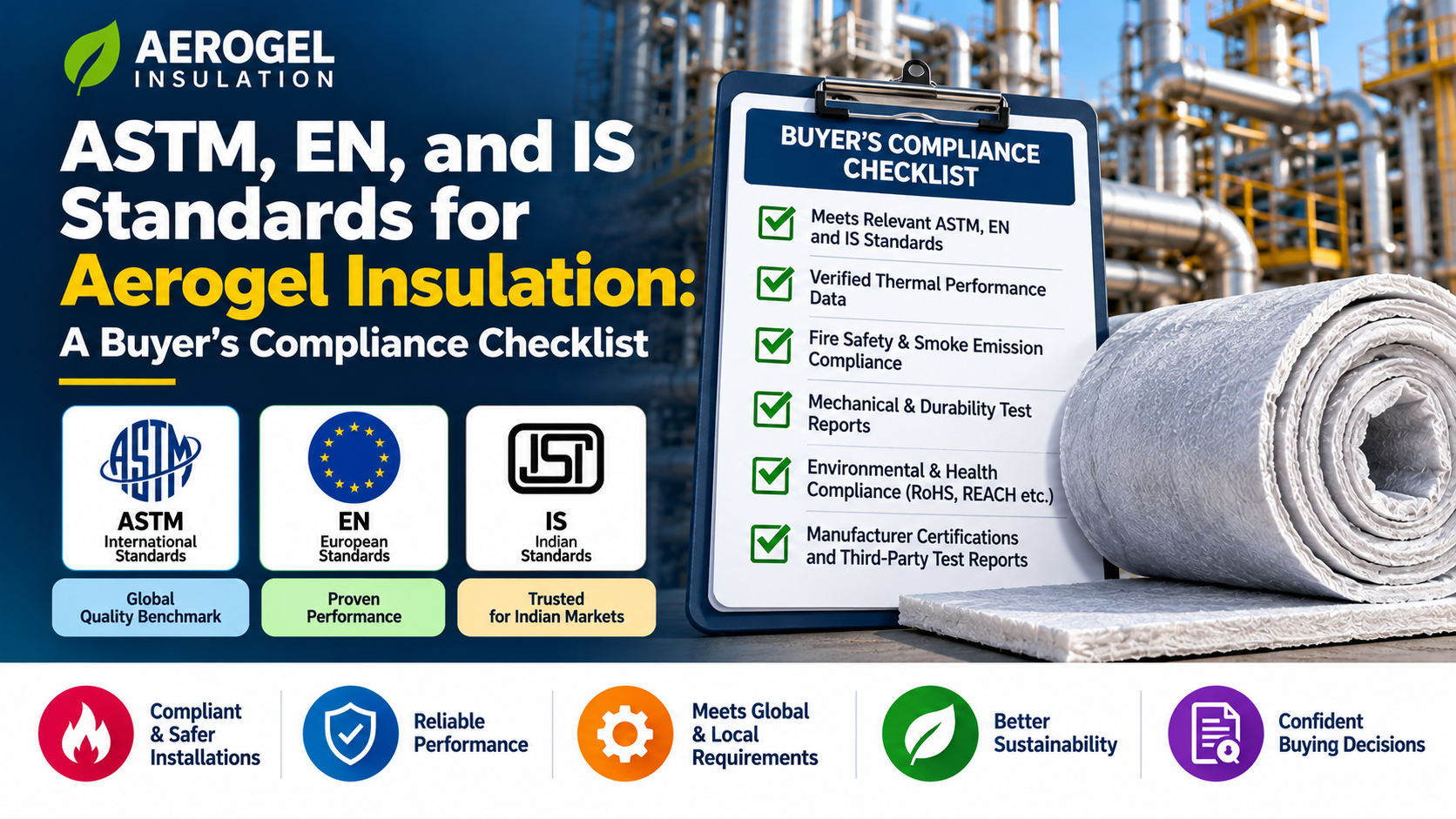
The Buyer’s Compliance Checklist
Use these questions when evaluating any aerogel insulation product, whatever its origin.
- Product specification. Which edition and type of ASTM C1728 does the product meet? Is the claim supported by test reports, not just a statement on the datasheet?
- Thermal conductivity. Which test method was used, at which mean temperatures, and by which laboratory? For hot or cold service, ask for values across the operating range, not a single room-temperature figure. In India, check whether the testing laboratory is accredited for that method, for example by NABL.
- Temperature limits. What evidence supports the stated maximum and minimum service temperatures? Ask for hot-surface performance or maximum-use-temperature test results for high-temperature service.
- Fire performance. Which classification does the project require: ASTM E84/E136, an EN 13501-1 Euroclass, or a local requirement? Does the report cover the same thickness, facing, and configuration you’ll install? For pipe insulation under EN 13501-1, is it the “L” classification?
- Stainless steel compatibility. If the insulation will touch austenitic stainless steel, does it meet ASTM C795, with C692 and C871 test results? Will it be handled and stored under C929 practices?
- Moisture behavior. What evidence supports claims of hydrophobicity or low water retention? For cold service, what vapor retarder system do you recommend, as required by ASTM C1728?
- Physical properties. Are thickness, density, and dimensional tolerances stated, and does each batch meet them?
- Quality and traceability. Does each delivery come with batch test certificates? Is there an agreed sampling and acceptance procedure for incoming lots, such as ASTM C390?
- Regulatory marking. For building products sold in the EU, do you have a valid ETA and CE marking, and does its scope match your use, including the EAD’s exclusion of wetting and weathering?
- Project specification alignment. Where the project specification names a different material standard, has the substitution been approved in writing by the owner or consultant?
- Installation. Does the installation method follow IS 14164 or the equivalent code, and do the supplier’s instructions cover compression, cladding, fittings and weatherproofing?
- Health and safety. Is a current safety data sheet available, with handling and personal protective equipment guidance for installers?
Red Flags in Compliance Documents
A few patterns should prompt more questions. A datasheet that says “meets ASTM C1728” with no type, edition, or test report. Thermal conductivity with no mean temperature or test method stated. A fire classification for a different thickness, facing, or product variant than the one being supplied. Test reports from laboratories without accreditation for the specific method. CE marking or an ETA presented as evidence for outdoor industrial use when the assessment scope excludes weathering. None of these automatically disqualifies a product, but each is a gap to close before approval.
Where DashamLabs Fits
DashamLabs publishes its core product data openly: a thermal conductivity of about 0.016 W/m·K at room temperature, a continuous operating range of –50 °C to 650 °C, and a fully hydrophobic flexible silica aerogel sheet. Use the checklist above when evaluating DashamLabs aerogel the same way you would any other product: ask for the test reports, mean-temperature conductivity data, and any certifications relevant to your application. The technical specifications are a starting point, and you can request a sample for your own qualification testing.
The Bottom Line
Aerogel insulation compliance is less about finding a single certificate and more about building a complete evidence file. ASTM C1728 provides the product specification. ASTM, EN, and IS test methods verify thermal, temperature, fire,e and corrosion performance. In Europe, building products reach the market through an EAD and ETA, with scope limits. In India, IS 14164 governs application practice, while a BIS material specification for aerogel has yet to be identified. A buyer who works through the checklist, asking for edition, type, test method, temperature, configuration, and accreditation, will end up with a specification that stands up to an owner’s engineer, an auditor, or a fire inspector.