
When ordinary insulation is too thick for the available space, engineers usually consider two high-performance options: silica aerogel and vacuum insulated panels (VIPs). Both deliver far more thermal resistance per millimeter than foam or mineral wool. Both cost more than conventional insulation. Beyond that, they’re very different materials, and choosing the wrong one for an application can waste money, damage panels, or deliver poor performance in service.
This article compares how each material works, how they perform on paper and in practice, where each one is clearly the better choice, and where they can work together.
How Each Material Works
A vacuum insulated panel is a rigid core, usually pressed fumed silica, sealed inside a gas-tight barrier film and evacuated. Removing the air almost eliminates gas conduction, which is why VIPs achieve exceptionally low thermal conductivity. That performance depends entirely on the vacuum. The barrier film is what keeps air and moisture out.
Silica aerogel insulation works at normal atmospheric pressure. Its pores are so small that air molecules collide with pore walls more often than with each other, suppressing gas conduction without a vacuum. Industrial aerogel products combine aerogel with a fiber reinforcement to make flexible blankets. Nothing is sealed, so there’s no vacuum to lose.
That basic difference, sealed vacuum versus open nanoporous structure, explains almost every other difference between them.
Thermal Performance: Read the Right Number
VIPs win on headline thermal conductivity, but the figure that matters for design isn’t the one in the brochure.
A new fumed-silica VIP has a center-of-panel thermal conductivity of about 0.004 W/m·K. Work under the International Energy Agency’s Annex 39 project on VIPs concluded that designers shouldn’t use that as-produced figure, but a higher value of about 0.006–0.008 W/m·K. Two effects account for the difference:
- Edge losses. The barrier film creates a thermal bridge around the panel edges. One analysis found that adding thermal bridging raised the panel’s effective conductivity from about 0.0042 to about 0.0063 W/m·K.
- Ageing. Air and water vapor slowly permeate the barrier over time, raising the internal pressure. Published data show the effective conductivity of fumed-silica VIPs over a 25-year service life ranging from 0.007 to 0.009 W/m·K. Moisture also matters: one study found conductivity rises by about 0.0005 W/m·K for each 1% increase in the core’s water content.
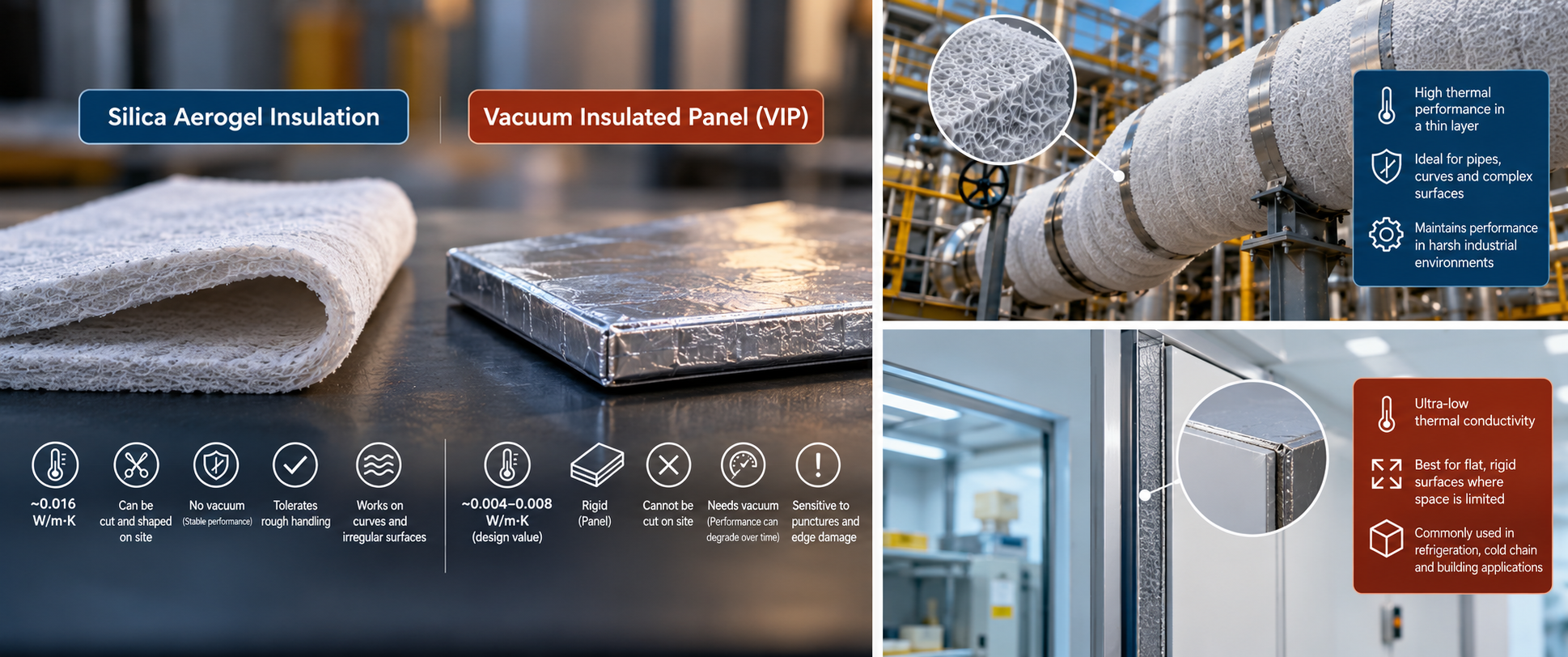
DashamLabs’ flexible silica aerogel sheet has a thermal conductivity of about 0.016 W/m·K at room temperature. Because aerogel doesn’t rely on a vacuum, it avoids edge-seal bridging and vacuum-loss aging.
When you compare design values rather than brochure values, a VIP at 0.007 W/m·K still insulates better than aerogel at 0.016 W/m·K by roughly a factor of two, not the four suggested by headline numbers. To match the thermal resistance of 10 mm of aerogel, you’d need roughly 4–5 mm of VIP at its design value. That’s a real advantage when every millimeter counts, and you need the panels to stay intact.
What Happens When Things Go Wrong
This is the most important practical difference between the two.
A punctured VIP loses most of its advantage. If the barrier film is punctured or cut, air and water vapor enter the core, the vacuum is lost, and the panel’s thermal conductivity rises to that of foam and fibrous insulation. The Annex 39 data shows the effect: fumed silica’s conductivity rises from around 0.004 W/m·K under vacuum to about 0.018 W/m·K at atmospheric pressure. The panel still insulates, but only to about the level of good conventional insulation, and you paid VIP prices for it. Damage can happen during handling, installation, or service, and it isn’t always visible.
Damaged aerogel blanket loses insulation only where it’s damaged. A cut, tear, or puncture in an aerogel blanket reduces insulation only at that spot, while the rest of the blanket continues to perform as before. There’s no vacuum to lose, so the whole layer doesn’t fail.
Where insulation is exposed to fixings, impacts, abrasion, rough handling, or maintenance work, aerogel is far more forgiving.
Installation and Geometry
VIPs must be made to size. VIPs can’t be cut to size on site, so the design must include exact parts lists and laying plans early on. Panels are flat and rigid, and making non-standard sizes or shapes adds cost. Because VIPs can’t be trimmed to fit irregular areas, conventional foam often fills gaps around openings and edges, reducing the assembly’s overall performance. Fixings can’t pass through a VIP without destroying it.
Aerogel blanket is cut and shaped on site. You can trim it with standard tools, wrap it around pipes, bend it around corners, layer it to the required thickness, and fit it around fixings and penetrations. It suits curved, irregular, and complex surfaces, which VIPs can’t handle.
Temperature Range
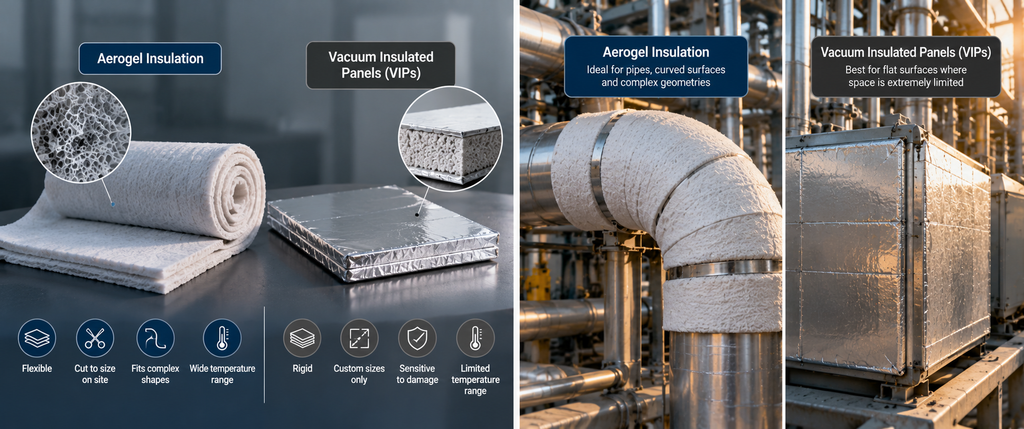
VIPs are mostly limited to moderate temperatures. IEA Annex 39 guidance says VIP barrier materials must be protected from temperatures above their approved maximum service temperatures, given as 60 °C to 80 °C. A review of high-temperature VIP research also notes that film envelopes can’t be used for VIPs above 70 °C. Specialized high-temperature vacuum insulation exists, but it uses different construction and isn’t a standard VIP.
Aerogel covers a much wider range. DashamLabs rates its sheet for continuous operation from –50 °C to 650 °C. That covers cold service, ambient applications, and industrial hot service, including steam lines, process piping, exhaust systems, and hot equipment.
For anything running hotter than roughly 70–80 °C, standard VIPs are generally ruled out, and aerogel or other high-temperature insulation is the practical choice.
Moisture
Moisture affects both materials, but in different ways. In VIPs, water vapor permeating the barrier gradually degrades performance over time, a key aging mechanism. In aerogel, hydrophobic treatment repels liquid water; DashamLabs describes its aerogel as hydrophobic. As with any insulation, high humidity and cold surfaces still require proper vapor control.
Side-by-Side Comparison
| Property | Vacuum insulated panels | Silica aerogel blanket |
| Design thermal conductivity | ~0.006–0.008 W/m·K (allowing for edges and aging) | ~0.016 W/m·K at room temperature (DashamLabs) |
| If damaged | Vacuum lost; conductivity rises to near conventional insulation | Only the damaged area is affected |
| Form | Rigid, flat panels | Flexible blanket |
| On-site cutting | Not possible | Cut with standard tools |
| Curved and irregular surfaces | Unsuitable | Well suited |
| Temperature limit | Typically 60–80 °C (barrier film) | –50 °C to 650 °C (DashamLabs) |
| Fixings through insulation | Not possible | Possible |
| Main aging mechanism | Gas and moisture permeation through barrier | No vacuum to lose |
Where VIPs Are the Better Choice
VIPs are the right answer when maximum thermal resistance per millimeter is the top priority, and the application can protect the panels. Typical examples:
- Refrigerators, freezers, and cold storage appliances, where manufacturers build panels into protected cavities.
- Cold-chain shippers and transport containers, where flat panels fit regular box shapes, and wall thickness directly reduces payload space.
- Building retrofits with severe space constraints, where flat, protected surfaces can be laid out in advance with precise panel plans.
In all of these, the panels are flat, sized in advance, puncture-protected, and operate near ambient temperature.
Where Aerogel Is the Better Choice
Aerogel is the right answer when the application rules VIPs out, or when the risk of losing a VIP’s vacuum is too high:
- Pipes, valves, flanges, and vessels, where insulation must wrap curved, irregular shapes.
- Hot service above about 70 °C, including steam, process heat, exhaust, and waste heat recovery.
- Industrial environments with vibration, impacts, maintenance access, and insulation that must be removed and refitted.
- Retrofits and field installations where insulation must be cut and fitted on site.
- Applications needing fixings or penetrations through the insulation layer.
- Thermal bridges and gaps, where a thin, flexible layer can be fitted around frames, joints and openings.
Using Both Together
The two materials can complement each other. In flat-panel assemblies such as cold rooms, refrigerated bodies, containers, and building elements, VIPs can cover large flat areas while thin, flexible aerogel fills the edges, corners, openings, and gaps VIPs can’t cover. Aerogel performs better than the conventional foam often used in those gaps, so the overall assembly performs closer to the VIPs. In designs where VIPs are near warmer surfaces, an aerogel layer can also help keep the VIP below its maximum service temperature.
A Simple Decision Guide
Work through these questions in order:
- Is the operating temperature above about 70 °C? If yes, standard VIPs are ruled out. Consider aerogel.
- Is the surface curved, irregular, or full of penetrations? If yes, VIPs are impractical. Consider aerogel.
- Must the insulation be cut, adjusted, or removed on site? If yes, choose aerogel.
- Is there a significant risk of puncture or impact in service? If yes, aerogel is the lower-risk option. If VIPs are still preferred, protect them carefully.
- Is the application flat, protected, near ambient temperature, and extremely space-limited? If so, VIPs may give the best thermal performance, with aerogel at the edges and in gaps.
The Bottom Line
VIPs offer the lowest thermal conductivity available in a practical panel, but only as long as the vacuum stays intact, the panel stays flat and uncut, and temperatures stay moderate. Aerogel insulates less well than an intact VIP, but it works at atmospheric pressure, tolerates damage, can be cut and wrapped on site, and covers a much wider temperature range. For protected, flat, ambient-temperature applications where every millimeter counts, VIPs are hard to beat. For pipes, hot service, industrial environments, and anything irregular, aerogel is usually the right choice, and in many assemblies the two work best together.
To evaluate aerogel for your application, review the DashamLabs technical specifications or request a sample.