
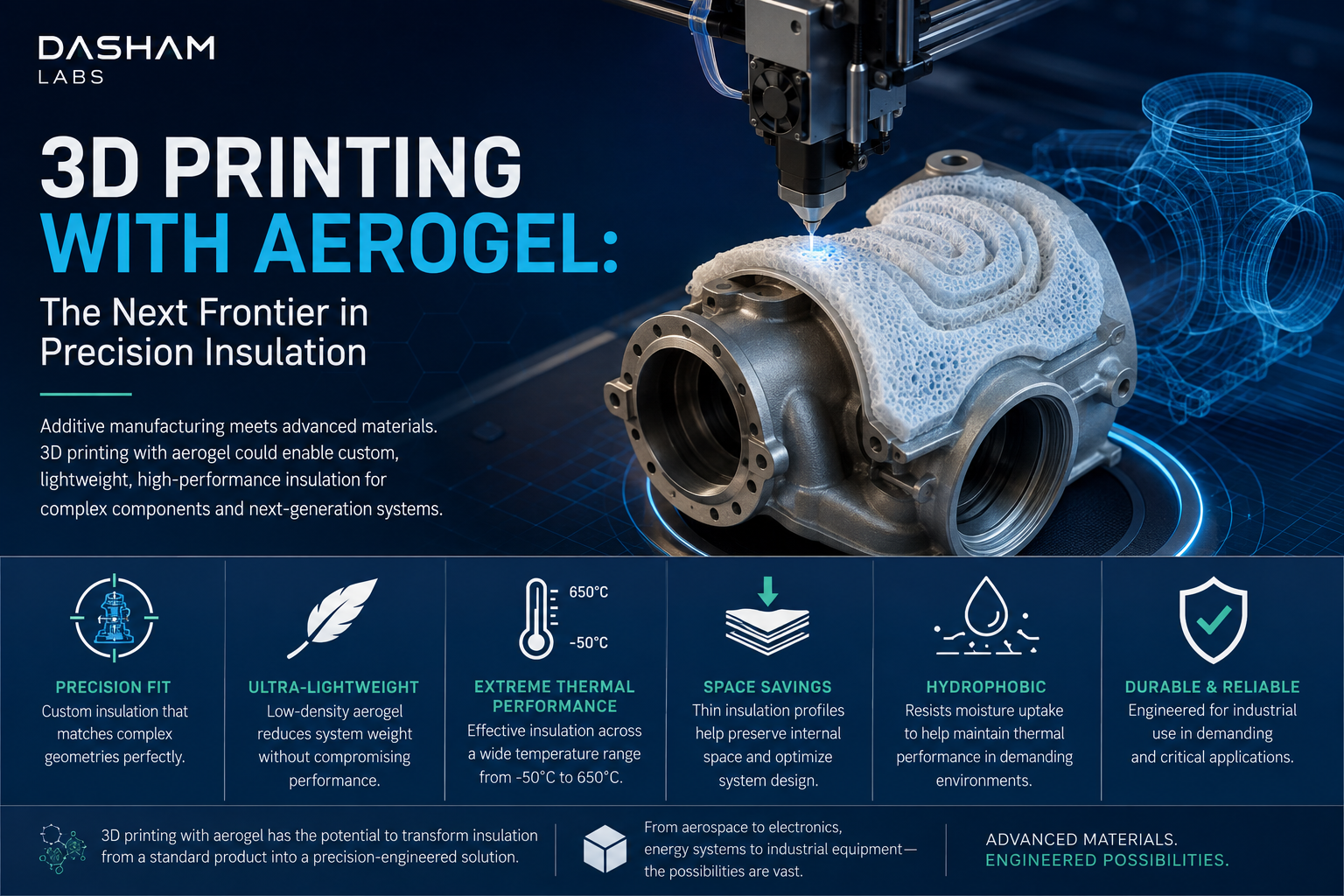
Insulation has traditionally been manufactured in standard shapes such as boards, pipes, panels, and flexible blankets. These formats work well for many applications, but they are not always suitable for components with complex geometries, narrow spaces, curved surfaces, or highly specific thermal requirements.
This is where 3D printing with aerogel could change the way advanced insulation is designed and manufactured.
Aerogels are known for their extremely low density, high porosity, and very low thermal conductivity. Their internal structure contains a large volume of air-filled pores, which restrict heat transfer while keeping the material lightweight. When aerogel technology is combined with additive manufacturing, insulation can potentially be produced in shapes and structures that are difficult to achieve with conventional methods.
The result could be a new generation of insulation designed not only to reduce heat transfer, but also to fit precisely around the component it protects.
What Is 3D Printing with Aerogel?
3D printing, also known as additive manufacturing, creates objects layer by layer from a digital design. Instead of cutting a final shape from a larger block, the manufacturing system deposits or forms material only where it is required.
3D printing with aerogel refers to the use of additive manufacturing techniques to create aerogel-based structures or components. Depending on the process, this may involve:
- Printing an aerogel-forming gel into a predefined shape
- Depositing a silica-based or polymer-based aerogel mixture layer by layer
- Printing a supporting structure and filling it with aerogel
- Creating a complex porous architecture before drying and strengthening the material
The exact process depends on the type of aerogel, the binder system, the required mechanical strength, and the final application.
Unlike ordinary plastic printing, aerogel printing must preserve the material’s porous structure. This is a major technical challenge because the drying process can cause shrinkage, cracking, or distortion.
Why Aerogel Is Suitable for Precision Insulation
Aerogel is already valued for applications where high thermal performance is required in a limited space. Its key properties include:
Very low thermal conductivity
Silica aerogel can provide strong thermal resistance in a thin layer. This is useful when conventional insulation would be too thick or would interfere with nearby components.
Low weight
Aerogel contains a high percentage of air. This gives it a much lower density than many traditional insulation materials, making it attractive for applications where weight reduction is important.
Thin insulation profiles
A thinner insulation layer can help designers preserve internal space, reduce equipment size, and improve packaging efficiency.
Hydrophobic behaviour
Many silica-aerogel products are designed to resist water absorption. This can help maintain insulation performance in humid or moisture-prone environments, depending on the product construction and installation conditions.
Temperature resistance
Aerogel insulation can be engineered for demanding temperature conditions. Dasham Labs’ insulation products are presented for industrial use across a wide temperature range, including applications involving hot equipment and thermal systems.
These properties make aerogel a strong candidate for advanced manufacturing methods that require both material efficiency and geometric accuracy.
How the 3D-Printing Process May Work
Although different approaches are being studied, a typical aerogel-printing process may include the following stages.
1. Creating the digital design
The first step is to scan or model the component that requires insulation. The design may include:
- Curved surfaces
- Mounting points
- Cable channels
- Ventilation paths
- Sensor openings
- Different insulation thicknesses across one component
This allows the insulation to be designed around the actual equipment rather than selected from a standard shape.
2. Preparing the aerogel-based material
The aerogel precursor is mixed with suitable solvents, binders, fibres, or additives. The mixture must have the right flow properties for printing while retaining the chemical structure needed to produce aerogel.
The material must be stable enough to hold its shape after deposition. At the same time, it must remain workable during printing.
3. Printing the structure
The material is deposited layer by layer according to the digital design. The printer may produce a solid-looking component, a lattice, or a graded structure with different densities.
Internal channels can also be incorporated into the design. These may be used for weight reduction, controlled heat flow, or the integration of sensors.
4. Drying and forming the aerogel
After printing, the wet structure must be dried carefully. This stage is critical. If drying occurs too quickly or unevenly, the component may shrink or develop cracks.
Methods such as supercritical drying, ambient-pressure drying, or carefully controlled thermal drying may be used depending on the material and production requirements.
5. Adding reinforcement or protective layers
Aerogel can be fragile in its pure form. For practical use, the printed part may need reinforcement through:
- Fibres
- Flexible coatings
- Mesh structures
- Protective films
- Composite layers
- Outer jackets or casings
This is similar to the role of reinforcement in aerogel blankets, where the aerogel is combined with a flexible support layer to improve handling and installation.
Precision Insulation for Complex Components
Conventional insulation is commonly cut, wrapped, or assembled around equipment. This can leave small gaps, seams, or compressed areas. These weak points may create thermal bridges where heat travels more easily.
A 3D-printed insulation component could be produced to match the exact dimensions of a part. This may reduce:
- Unwanted gaps
- Excessive overlap
- Uneven thickness
- Difficult cutting work
- Installation waste
- Thermal bridges around joints and fittings
For example, a printed insulation shell could be designed around a complex valve body with openings for handles, bolts, pipes, and instrumentation. Instead of assembling several pieces on-site, the insulation could arrive as a fitted component.
This type of design may be particularly useful where access is limited or where repeated removal and reinstallation are required.
Applications of 3D-Printed Aerogel
Aerospace and space systems
Aerospace components must manage heat while keeping mass as low as possible. Insulation may be required around fuel systems, propulsion components, cryogenic tanks, electronics, and sensitive instruments.
3D printing could allow insulation to follow unusual curves and fit into compact areas where standard blankets or panels are difficult to install.
For space applications, the material would also need to withstand vibration, launch loads, vacuum conditions, and severe temperature changes. These requirements make material testing essential.
Electric vehicles and battery systems
Battery packs require thermal control to maintain performance and reduce the risk of overheating. Aerogel-based barriers are already being studied and used in thermal protection systems.
A printed aerogel structure could potentially be designed around individual cells, modules, busbars, or cooling channels. The design could include controlled spacing and protective barriers without adding unnecessary weight.
However, the insulation must not prevent the battery from releasing heat under normal operating conditions. It must be engineered for the complete thermal-management system rather than used as a simple blanket.
Electronics and data centres
Electronic systems generate heat in compact spaces. As components become smaller and more powerful, thermal management becomes increasingly important.
3D-printed aerogel structures could be designed around heat-sensitive components, connectors, or high-temperature zones. In some cases, the material could provide local insulation while leaving dedicated routes for heat removal.
This could help separate hot and cold zones inside equipment without using thick conventional insulation.
Cryogenic storage
Liquid hydrogen, liquefied natural gas, and other cryogenic fluids must be kept at extremely low temperatures. Heat entering the storage system can increase evaporation and product loss.
Aerogel insulation is already relevant to cryogenic applications because of its low thermal conductivity and thin profile. A printed design could potentially fit around tanks, pipes, valves, and irregular fittings with greater precision.
The final system would still require careful attention to moisture control, mechanical durability, contraction, joints, and vapour barriers.
Industrial equipment
Industrial plants contain many components that are difficult to insulate using standard products. These include:
- Pumps
- Valves
- Flanges
- Heat exchangers
- Turbine components
- Instrumentation points
- Complex pipe networks
A custom-printed insulation part could reduce the number of separate pieces needed during installation. This may shorten installation time and make future maintenance easier.
For larger industrial systems, flexible silica-aerogel blankets remain a practical option because they can be cut and fitted on-site. 3D printing may be most useful for specialised components that require a custom shape.
3D-Printed Aerogel Versus Aerogel Blankets
3D-printed aerogel is not necessarily a replacement for flexible aerogel blankets. The two formats may serve different purposes.
| Feature | 3D-printed aerogel | Aerogel blanket |
| Shape | Custom-designed | Flexible and cut to fit |
| Best suited for | Complex, repeatable components | Pipes, tanks, equipment, and large surfaces |
| Production | Digital and additive | Continuous or sheet-based manufacturing |
| On-site adjustment | Limited after production | Easy to trim and install |
| Scalability | Useful for specialised parts | Suitable for broad industrial coverage |
| Installation | Potentially faster for fitted parts | Familiar and adaptable |
Dasham Labs’ silica-aerogel blankets and sheets are designed for practical industrial insulation. Their flexible format supports installation on equipment with curves, joints, and varying surface conditions.
3D printing may complement this approach by producing custom parts for areas where a blanket is difficult to apply. A future insulation system could therefore combine printed components with flexible aerogel blankets.
Advantages of 3D Printing with Aerogel
Better geometric accuracy
The insulation can be designed to match the shape of the protected component.
Reduced material waste
Additive manufacturing places material where it is needed, which may reduce cutting waste compared with subtractive production.
Integrated features
Channels, cavities, fastening points, and openings can potentially be included in the original design.
Repeatable production
Once a validated digital design is created, identical insulation components can be manufactured for multiple units.
Reduced installation work
A fitted component may require less cutting, joining, and adjustment at the worksite.
Functionally graded insulation
Different regions of the same printed part could potentially have different densities or thermal properties. This may allow insulation to be concentrated in high-priority areas while reducing material elsewhere.
Current Challenges
Despite its potential, 3D printing with aerogel is still associated with several technical and commercial challenges.
Fragility
Pure aerogel structures can be brittle. Reinforcement is often required to withstand handling, vibration, compression, and installation forces.
Drying-related shrinkage
The drying stage can change the dimensions of the printed part. Controlling shrinkage is necessary for accurate fitting.
Production speed
Printing a large insulation component may take longer than producing a standard blanket or sheet.
Cost
Specialised equipment, drying systems, material preparation, and quality testing may increase the initial cost.
Moisture and surface protection
Even hydrophobic aerogel systems need appropriate protection in demanding environments. The complete insulation assembly must be designed to prevent moisture ingress and maintain performance.
Quality control
Each printed component must be checked for:
- Dimensions
- Density
- Thermal conductivity
- Cracks
- Shrinkage
- Mechanical strength
- Surface finish
- Long-term stability
For industrial use, testing must be conducted under conditions that represent actual operation.
The Role of Digital Design in Future Insulation
One of the most important benefits of additive manufacturing is the connection between design and production.
Engineers can create a three-dimensional model of a component, identify areas of heat loss, and design insulation around those zones. Simulation software may then be used to study:
- Temperature distribution
- Heat flow
- Contact resistance
- Thermal bridges
- Material thickness
- Structural stress
The final design can be adjusted before manufacturing begins. This can reduce repeated trial-and-error fitting and improve the relationship between insulation performance and equipment geometry.
In the future, digital files could allow replacement insulation parts to be manufactured on demand. This would be valuable for specialised equipment where conventional replacement parts are difficult to source.
How Dasham Labs Fits into the Insulation Landscape
Dasham Labs focuses on silica-aerogel insulation products for industrial applications, including flexible sheets and blankets. These products address a current and practical need: delivering high thermal resistance in a thin, lightweight, and adaptable format.
While 3D-printed aerogel is an emerging direction, the same underlying material advantages remain relevant:
- Low thermal conductivity
- Thin insulation profiles
- Lightweight construction
- Adaptability to demanding applications
- Suitability for industrial thermal management
For many projects today, flexible aerogel blankets are likely to remain the more practical choice because they can be supplied in roll form, cut on-site, and installed across a wide range of surfaces.
As additive manufacturing develops, future aerogel products may combine printed shapes with reinforced blanket technology. This could create a broader set of insulation solutions, from standard flexible rolls to custom-fitted components.
What the Future May Look Like
The future of aerogel insulation may not depend on one product format. Instead, different manufacturing methods may be used for different requirements.
Flexible blankets may continue to serve large areas, pipes, tanks, and industrial equipment. Printed aerogel components may be used for precision parts, complex geometries, and applications where every millimetre matters.
The combination of:
- Advanced aerogel chemistry
- Digital design
- Thermal simulation
- Additive manufacturing
- Fibre reinforcement
- Automated quality control
could make insulation more accurate, lighter, and easier to integrate into modern equipment.
This is especially relevant as industries work to reduce energy consumption, improve equipment efficiency, protect sensitive components, and make better use of limited space.
Conclusion
3D printing with aerogel represents a promising direction for high-performance insulation. By combining the low thermal conductivity and lightweight structure of aerogel with the design freedom of additive manufacturing, engineers may be able to create insulation that fits complex components with far greater accuracy.
The technology still faces challenges related to drying, strength, cost, production speed, and quality control. It is also not a universal replacement for established products such as flexible silica-aerogel blankets.
For current industrial projects, aerogel sheets and blankets provide a practical way to achieve strong insulation performance in a thin, flexible format. As 3D-printing methods mature, they may extend these benefits into custom-shaped insulation for aerospace, batteries, cryogenic systems, electronics, and specialised industrial equipment.
The next stage of insulation may not simply involve using better materials. It may involve designing those materials around the exact shape, temperature, and performance requirements of every component.
Frequently Asked Questions
What is 3D printing with aerogel?
3D printing with aerogel is an additive manufacturing approach in which an aerogel-based material or aerogel-forming mixture is shaped layer by layer to produce a customised insulation structure.
Is 3D-printed aerogel commercially available?
Some aerogel-based 3D-printing methods are being researched and developed, but availability depends on the material, application, and manufacturer. Conventional silica-aerogel blankets and sheets are currently more widely used for industrial insulation.
Is 3D-printed aerogel stronger than an aerogel blanket?
Not necessarily. Strength depends on the aerogel composition, reinforcement, density, drying process, and protective layers. Aerogel blankets are reinforced for flexibility and handling, while printed parts may be designed for specific shapes and functions.
Can aerogel be used for battery insulation?
Aerogel-based materials can be used in battery thermal-management and protection systems, but the design must balance insulation with heat dissipation, fire safety, mechanical strength, and electrical requirements.
What is the main advantage of 3D-printed aerogel?
The main advantage is geometric freedom. The insulation can potentially be manufactured to fit complex shapes, narrow spaces, openings, and component-specific thermal requirements.