
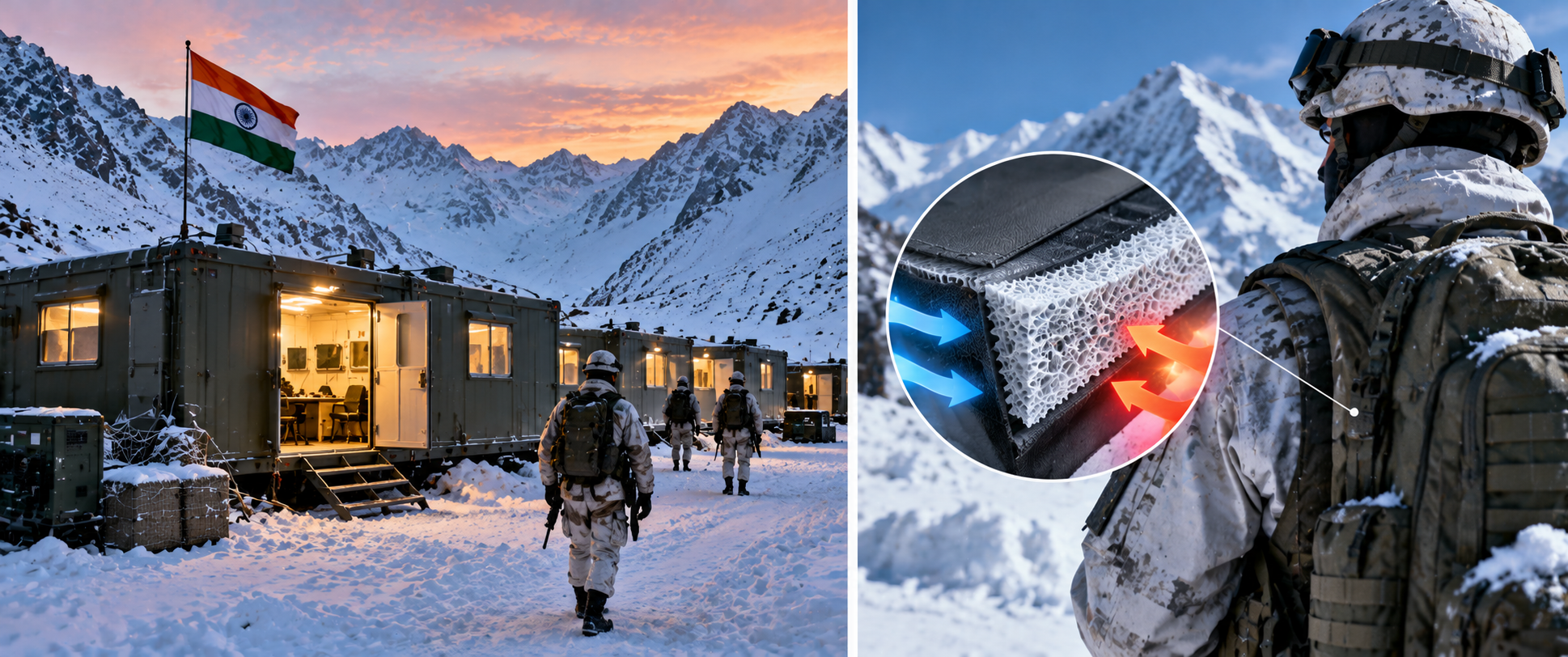
Along India’s northern frontier, cold is an adversary in its own right. In Ladakh and on the Siachen Glacier, troops live and work at altitudes where winter temperatures fall far below freezing, winds strip heat from every exposed surface, and everything from kerosene to shelters has to be carried up by road, mule, porter, or helicopter. Every watt of heat a shelter loses must be replaced with fuel someone transported, and every extra kilogram of insulation in a soldier’s kit must be carried uphill.
Insulation for these environments must solve several problems at once: thermal performance in extreme cold, minimal bulk, resistance to moisture and ice, fire safety in heated spaces, and durability under rough handling. This article examines where silica aerogel fits in high-altitude defense applications (shelters, personal gear, and vehicles), where it doesn’t, and what defense buyers should test before adopting it.
The Operating Environment
The conditions are well documented. During the 2020 deployment in eastern Ladakh, official sources quoted in news reports said winter temperatures in the region drop to between –30 °C and –40 °C, made worse by wind chill. Frontline troops were housed in heated tents, and the Army set up habitats with integrated electricity, water and heating.
Higher up, conditions were even harsher. A Parliamentary Public Accounts Committee report on high-altitude clothing, equipment and housing noted that troops in super high-altitude areas above 12,000 feet face temperatures between –20 °C and –50 °C. The same report said the Army was seeking replacement Arctic tents rated for –50 °C, up from –20 °C for the existing design, and that the Committee had found no military-grade equipment manufactured anywhere in the world for these exact conditions. On the Siachen Glacier, soldiers are deployed at heights from about 16,000 to 20,000 feet.
Logistics compound the cold. During winter deployments, troops must move large quantities of kerosene, along with canned food, medical supplies, and repair equipment, to forward locations. At Siachen, troops live in temperature-controlled fiberglass-reinforced plastic (FRP) shelters, snow tents, and fiberglass huts, heated by systems including kerosene heaters. Whatever reduces heat loss in those structures also reduces the fuel they must carry up.
Why Aerogel Is Relevant at Altitude
Silica aerogel’s core advantage is high thermal resistance in a thin layer. DashamLabs’ flexible silica aerogel sheet has a thermal conductivity of about 0.016 W/m·K at room temperature and is 70% thinner than traditional insulation. Several other properties matter specifically in high-altitude defense work:
- Temperature range. DashamLabs rates its sheet for continuous operation from –50 °C to 650 °C. The lower limit matches the –50 °C rating the Army seeks for its new Arctic tents. The upper limit covers hot zones in heaters, engine compartments, and exhaust systems.
- Hydrophobicity. DashamLabs describes its aerogel as hydrophobic. Snow, meltwater, and condensation are constant problems in high-altitude shelters and clothing, and water-absorbing insulation loses value and can freeze solid.
- Compression resistance. Unlike down or loose fibrefill, which lose most of their insulating value when compressed, aerogel blankets keep their performance under load. Independent research found that after 20 compression-and-release cycles, aerogel blanket thermal conductivity changed by 5% or less, and permanent deformation stayed at or below 6%. That matters wherever insulation is pressed flat: under a sleeping soldier, in a boot sole, or under a pack strap.
- Flexibility. Blanket-form aerogel wraps around curved surfaces, fits into irregular cavities, and can be cut to shape on site.
Shelters: Cutting the Fuel Bill at the Front Line
Insulated shelters are the most direct application. For example, the Indian Air Force has sought 200 environment-controlled operational shelters for air-defense systems and personnel in extreme conditions. Its specification called for vehicle- or trolley-mounted, containerized, insulated shelters at least 20 feet long and 10 feet wide.
A worked example
The following is an illustrative calculation with deliberately simplified assumptions. Take a containerized shelter roughly 6 m × 3 m × 2.5 m, with about 81 m² of envelope area. It’s held at +15 °C inside while the outside air is at –30 °C, a 45 K temperature difference. The calculation ignores air leakage, thermal bridges, surface films, and solar gain, all of which matter in real designs.
| Wall insulation | Approximate U-value (W/m²·K) | Conduction heat loss (kW) |
| 50 mm conventional insulation (λ ≈ 0.035) | ~0.70 | ~2.6 |
| 50 mm aerogel (λ ≈ 0.016, room-temperature value) | ~0.32 | ~1.2 |
In this example, the aerogel wall cuts conduction losses by roughly half, about 1.4 kW of continuous heating. Kerosene contains roughly 34 MJ per liter, so that saving equals about 3.5 liters of fuel per shelter per day, before accounting for heater efficiency. Over a long winter, that’s hundreds of liters per shelter that don’t need to be moved forward. Multiply that across a sector’s shelters, and the logistics impact becomes significant.
The same thermal improvement can be traded in other ways. A designer can keep heat loss unchanged and thin the walls, which helps when transport limits fix shelter dimensions. Or the same heater can hold a warmer interior temperature on the coldest nights.
Design points for high-altitude shelters
Vapor control. Warm, moist air inside a heated shelter meets very cold walls. Without a continuous vapor barrier on the warm side, moisture migrates into the insulation and freezes there. Hydrophobic insulation resists liquid water but doesn’t remove the need for vapor control.
Thermal bridges. In containerized and panel shelters, steel frames, door surrounds, and fixings bypass the insulation. Thin, flexible aerogel can line these bridges where panels can’t be made thicker.
Fire safety. Shelters heated by kerosene stoves need insulation with known fire behavior. Defense buyers should ask for fire test reports on the exact product and configuration they plan to use, not just a material description.
Mass for airlift. Many forward posts are supplied by helicopter, and helicopter payload falls with altitude. Compare the mass per unit of thermal resistance of aerogel against alternatives, because for air-maintained posts the lighter option that meets the thermal target may be the better choice.
Soldier Gear: Insulation That Doesn’t Collapse
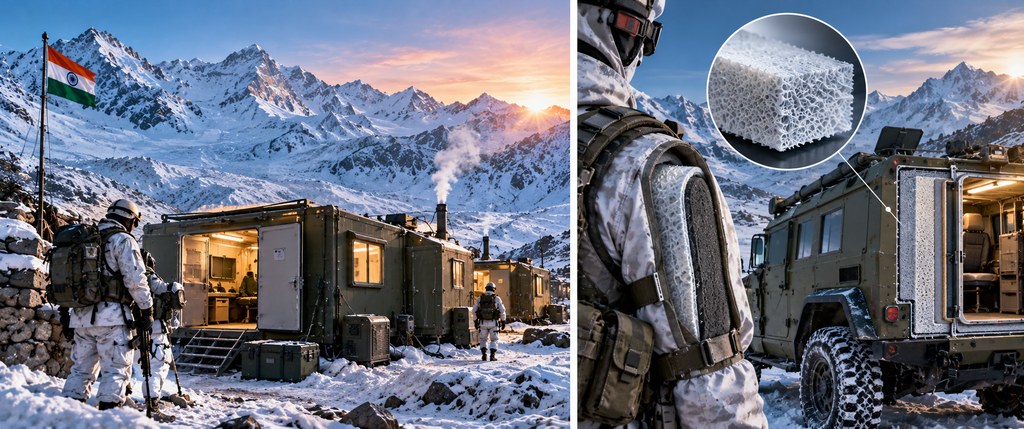
Personal equipment is where the compression advantage counts most. The Army issues Special Clothing and Mountaineering Equipment (SCME) to troops in super high-altitude areas, and India has historically imported much of this gear. 2018 reports put annual imports of extreme cold-weather clothing and mountaineering kits for Siachen troops at around ₹800 crore.
Aerogel is most promising in components where conventional insulation fails because it gets compressed or wet:
- Boot insoles and footbed liners. Body weight flattens foam and fiber, and cold-related foot injuries are a constant risk at altitude. A thin aerogel layer keeps its insulating value under load.
- Sleeping mats and bivouac underlays. Heat lost to snow or ice beneath a sleeping soldier is often the largest loss. Aerogel can provide high ground insulation in a thin, packable layer.
- Glove and mitten palm inserts. Gripping compresses insulation in the palm, which is exactly where conventional fill thins out.
- Knee and seat pads. Kneeling or sitting on snow and ice puts sustained pressure on a small area.
- Battery and electronics pouches. Severe cold reduces the capacity of radios, night-vision devices, and other battery-powered equipment. Insulated pouches help keep them functional.
There are limits. Aerogel blankets aren’t as breathable as layered clothing systems need to be, so they’re unsuitable as a full garment insulation layer where body moisture has to escape. Aerogel shouldn’t be in direct contact with skin either, and in garments it needs to be encapsulated to control dust and withstand repeated flexing, abrasion, and washing. Clothing manufacturers would need to solve and validate these integration challenges in field trials.
Vehicles: Cold Crews, Hot Engines
Military vehicles operating in Ladakh and similar terrain face both extremes at once. Crew compartments need protection from bitter cold, while engine bays, exhausts, and heaters run hot. Aerogel’s rated range of –50 °C to 650 °C lets one material family serve both roles, in thin layers that fit tightly packaged vehicles.
Crew compartments. Insulating the floor, roof,f and doors reduces heater load and keeps crews and electronics warmer when vehicles are stationary or running with the engine off.
Batteries and cold starts. Cold reduces battery performance and makes engines harder to start. Insulated battery boxes and engine-bay blankets help vehicles hold heat overnight.
Heat shields. Near exhausts and heaters, thin aerogel layers protect nearby components, wiring, and fuel lines from heat in confined spaces.
Fluid lines. Water, fuel, and hydraulic lines exposed to extreme cold can thicken or freeze. Aerogel wraps help keep them operational.
Vehicle applications bring their own demands: resistance to vibration, fuel and oil contamination, and fire safety in crew compartments. DashamLabs says its flexible aerogel blanket is designed to withstand handling, vibration, and thermal cycling, but each vehicle installation still needs its own qualification.
What Defense Buyers Should Test
Defense applications need more rigorous validation than most civilian uses. Before adopting aerogel for high-altitude work, buyers and system integrators should test the following:
- Low-temperature thermal performance. Get thermal conductivity data at the actual operating temperatures, down to –50 °C, not just room-temperature values.
- Freeze-thaw and moisture cycling. Repeated freezing, thawing, and condensation are part of high-altitude life. Confirm the insulation maintains performance and structure through these cycles.
- Compression and flexing durability. For gear applications, test performance after thousands of compression and flexing cycles that match real use, not just laboratory cycles.
- Fire performance. Ask for fire test reports on the exact construction, especially for shelters with combustion heaters and for vehicle crew spaces.
- Mass and packed volume. Compare insulation options by mass and volume per unit of thermal resistance, since these factors determine what can be carried or airlifted.
- Field trials. Laboratory results need confirmation in actual high-altitude deployments, with feedback from troops.
Where DashamLabs Fits
DashamLabs develops and manufactures silica aerogel insulation in India and lists aerospace and defense among its target applications. For defense programs, Indian manufacturing matters given the long-standing reliance on imported high-altitude gear. DashamLabs supplies sample sheets in 3, 5, and 10 mm thicknesses for evaluation and prototyping. You can request a sample or review the full technical specifications.
The Bottom Line
In Ladakh and Siachen, the cost of cold is measured in fuel carried forward, kit carried uphill, and soldiers’ health and effectiveness. Aerogel’s high thermal resistance in a thin layer, its resistance to compression and water, and its wide temperature range make it a strong candidate for shelter walls and thermal bridges, compressed points in personal gear, and dual-temperature vehicle insulation. It’s not a universal answer: breathability limits its use in clothing, mass matters for airlift, and fire and durability behavior must be proven for each application. Tested properly, aerogel can help shelters use less fuel, keep soldiers warmer in gear, and keep vehicles operational through the high-altitude winter.