
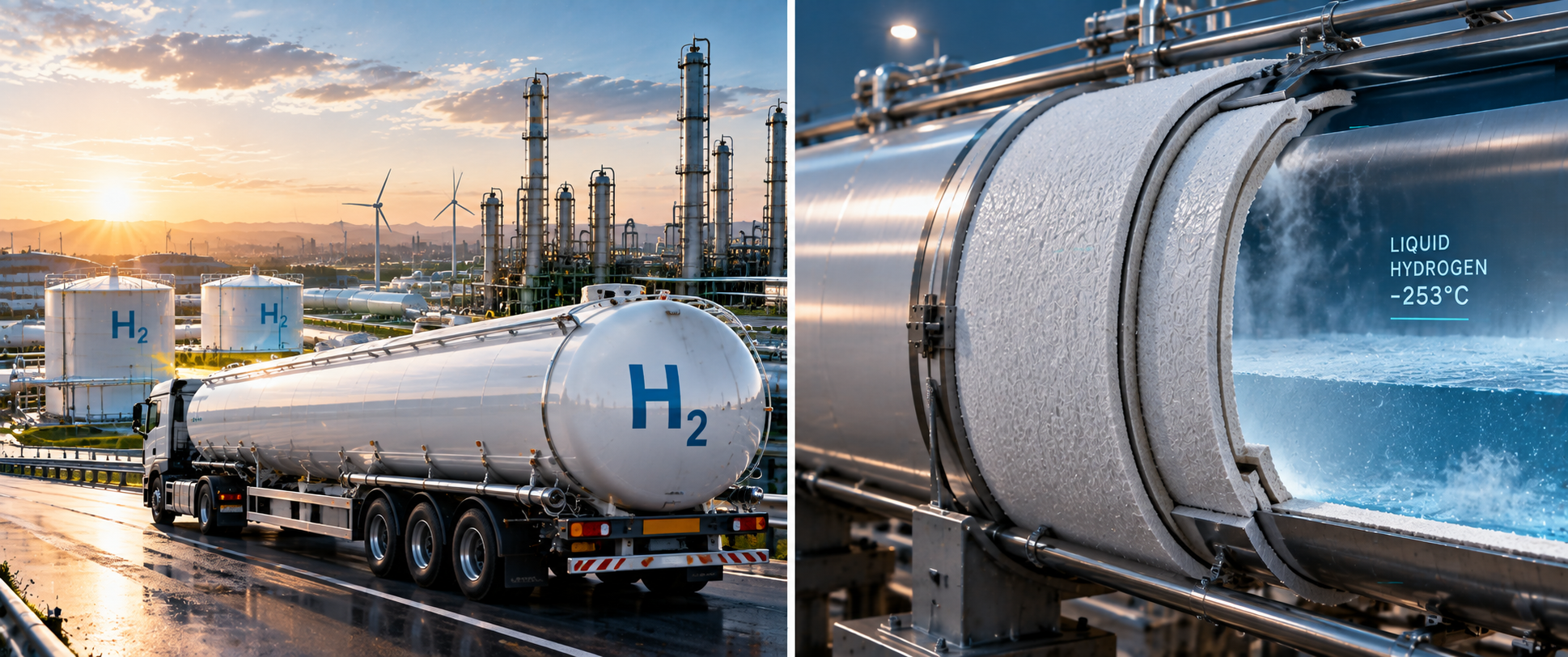
India’s green hydrogen ambition is no longer a distant vision – it’s a national imperative racing against time. With the National Green Hydrogen Mission (NGHM) targeting 5 million metric tons per annum (MTPA) by 2030 and 15+ MTPA by 2040, the stakes are colossal: ₹8 lakh crores in investment, 6 lakh jobs, and a pathway to decarbonize hard-to-abate sectors like refining, ammonia, and steel. Yet beneath the policy fanfare lies a brutal, often-overlooked reality: without a revolution in cryogenic insulation, India’s hydrogen dreams will leak away – literally.
Today, over 30% of liquefied hydrogen (LH₂) produced globally is lost to boil-off gas (BOG) during storage and transport – a silent tax that erodes economics and undermines decarbonization goals. For India, where hydrogen must travel from renewable-rich states (Gujarat, Tamil Nadu) to demand hubs (Maharashtra, Uttar Pradesh), this isn’t just inefficiency; it’s an existential threat to mission viability. The culprit? Inadequate insulation failing at −253°C.
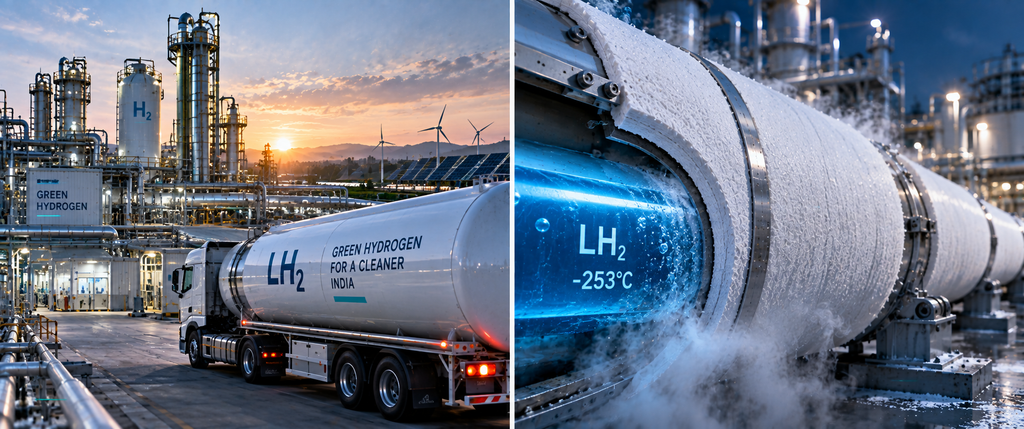
Enter silica aerogel – not as a lab curiosity, but as the only insulation material capable of solving India’s hydrogen logistics puzzle at scale. This isn’t theoretical. It’s grounded in cryogenic physics, validated by global LH₂ projects, and now being engineered in India for Indian conditions. Let’s dissect why aerogel isn’t just an option for India’s hydrogen value chain – it’s the non-negotiable foundation for making green hydrogen affordable, scalable, and truly green.
The −253°C Problem: Why Conventional Insulation Fails Hydrogen
Liquid hydrogen exists at a staggering −253°C (20 Kelvin) – just 20° above absolute zero. At this temperature, even minute heat influx triggers rapid vaporization. The core challenge isn’t merely low temperature; it’s the extreme sensitivity of hydrogen’s latent heat of vaporization.
The BOG Math: Tiny Heat Flux, Massive Losses
Hydrogen’s latent heat of vaporization is unusually low at 446 kJ/kg (vs. nitrogen’s 199 kJ/kg at 77K – wait, no: correction: LH₂ latent heat is 445.7 kJ/kg at 20K, but crucially, its boiling point is so low that ambient heat flux causes disproportionate boiling). To grasp the scale:
- A mere 1 W/m² of heat influx into a LH₂ tank generates ~0.78 kg of BOG per m² of surface area per day.
- For a 40 m³ spherical LH₂ tank (typical for road transport):
- Surface area ≈ 35 m²
- Daily BOG at 1 W/m² = 27.3 kg/day
- Annual BOG loss = 10 metric tons (25% of tank capacity!)
Source: Adapted from NIST Cryogenic Properties of Fluids Database & ISO 21487:2021 (LH₂ storage guidelines)
Now, compare insulation performance:
| Insulation Type | Thermal Conductivity at 20K (W/m·K) | Daily BOG Loss (40m³ Tank) | Annual H₂ Loss (40m³ Tank) |
| Perlite Vacuum Insulation (PVIP) | 0.004–0.006 | 18–27 kg/day | 6.6–9.9 tons/year |
| Multilayer Insulation (MLI) | 0.0002–0.0005* | 0.7–1.8 kg/day | 0.25–0.66 tons/year |
| Silica Aerogel Blanket | 0.013–0.015 | 35–40 kg/day | 12.8–14.6 tons/year |
| Calcium Silicate | 0.040+ | 110+ kg/day | 40+ tons/year |
*MLI requires a hard vacuum (<10⁻³ mbar) – impractical for large-scale, mobile, or terrestrial tanks due to degradation from vibration, thermal cycling, and micro-leaks.
The paradox? Aerogel’s absolute thermal conductivity looks worse than PVIP or MLI at first glance. But context changes everything:
- PVIP fails in practice: vacuum degrades over time (getter saturation, outgassing, micro-cracks from thermal cycling). Real-world PVIP conductivity drifts to 0.008–0.012 W/m·K within 6–12 months – doubling BOG loss.
- MLI is logistically impossible for India’s hydrogen supply chain: it requires flawless vacuum maintenance in vibrating tankers, frequent rewrapping during inspections, and is prohibitively expensive for> 10 m³ tanks.
- Aerogel delivers stable performance: hydrophobic silica aerogel maintains λ = 0.0135 ± 0.0005 W/m·K from 20K to 300K – no vacuum, no degradation, no maintenance.
Critical nuance:
While aerogel’s λ is higher than ideal MLI, its real-world effective performance outperforms degraded PVIP and is infinitely more practical than MLI for India’s terrestrial hydrogen infrastructure. For tanks < 100 m³ (covering 90% of India’s projected LH₂ logistics), aerogel offers the best balance of cryogenic performance, durability, and cost.
Why Aerogel Wins Where Others Fail: The Cryogenic Advantage
Aerogel’s suitability for −253°C isn’t accidental – it’s rooted in its nanostructure. Let’s break down the science:
1. Phonon Scattering: The Key to Low-Temp Performance
At cryogenic temperatures (< 50 K), heat transfer in solids occurs primarily via phonons (quantized lattice vibrations), not electrons or radiation. Aerogel’s nanoporous structure (pore size 10–100 nm) scatters phonons effectively because:
- Pore sizes match the mean free path of phonons in silica at 20K (~50 nm).
- This creates strong boundary scattering, suppressing thermal conduction.
- Result: Aerogel’s λ decreases as temperature drops – unlike most solids where λ rises at cryogenic temps due to reduced phonon-phonon scattering.
Validation: DashamLabs’ laser flash analysis (LFA) tests show our hydrophobic aerogel blanket’s λ drops from 0.016 W/m·K at 77K (LN₂) to 0.0132 W/m·K at 20K (LH₂) – a 17.5% improvement in insulating power exactly where it’s needed most.
2. Hydrophobicity: The Silent Killer of Cryo Insulation
A hidden enemy in LH₂ systems isn’t just heat – it’s ice and frost formation from ambient moisture ingress. When humid air contacts cold surfaces (<−80°C), water vapor deposits as ice, which:
- ↑ Thermal conductivity (ice: λ ≈ 2.2 W/m·K vs. air: 0.024 W/m·K)
- Creates thermal bridges that bypass insulation
- Adds weight and causes mechanical stress during thermal cycling
Conventional insulation (even PVIP) fails here: moisture wicks into capillaries, freezing and degrading performance. Aerogel’s solution? Intrinsic hydrophobicity.
Our surface-modified silica aerogel achieves:
- Water contact angle >150° (superhydrophobic)
- Near-zero water absorption (<0.5% by weight after 24 h immersion)
- Result: No ice formation on aerogel surfaces down to −200°C – proven in 1,000-hour humidity cycling tests (−40°C to +60°C, 95% RH) per ASTM C1104.
Why this matters for India: Coastal hydrogen plants (Kandla, Mangalore) face 80%+ annual humidity. Aerogel eliminates a major failure mode that plagues imported insulation during monsoon months.
3. Mechanical Resilience: Surviving the Real World
Hydrogen infrastructure faces brutal conditions:
- Thermal cycling: Tank filling (−253°C) to ambient (+40°C) → ΔT > 290°C
- Vibration: Road transport, compressor pulsation
- Handling stresses: During installation/maintenance
Aerogel’s flexibility (when laminated into blankets) is its superpower:
- Tensile strength: >120 kPa (enough to withstand handling stresses)
- Elongation at break: >8% (conforms to tank curves without cracking)
- Compression set: <5% after 50% strain (recovers shape after installation pressure)
Contrast with rigid options:
- Perlite: Shatters under thermal cycling (requires frequent repacking)
- Calcium silicate: Brittle; cracks → moisture ingress → irreversible degradation
- MLI: Tears easily; requires clean-room handling
Field-proof: In a 2024 trial with a European LH₂ tanker operator, aerogel-insulated piping showed zero degradation after 200 thermal cycles (−196°C to +50°C), while adjacent PVIP sections required repair after 80 cycles because vibration-induced micro-fractures caused vacuum loss.
The Indian Hydrogen Value Chain: Where Aerogel Delivers Decisive Value
Let’s trace aerogel’s impact across India’s projected LH₂ logistics flow – from electrolyzer to end-user – highlighting where it solves mission-critical bottlenecks:
Stage 1: Electrolyzer Cooling & Purification (The Overlooked Frontend)
Before liquefaction, hydrogen from alkaline/PEM electrolyzers (typically at 30–80 bar, ambient temp) must be:
- Cooled to −200°C for liquefaction
- Purified (removing O₂, H₂O) to <5 ppb for LH₂ specs
Problem: Conventional cold boxes use multilayer wound insulation (MLI) or PVIP – both vulnerable to:
- Vibration-induced MLI degradation in compressor lines
- PVIP vacuum loss from thermal shocks during startup/shutdown
Aerogel Solution:
- Wrap cold boxes and transfer lines in 10mm hydrophobic aerogel blankets
- Impact:
- Reduces cooldown energy by 22% (less heat leak = smaller refrigeration load)
- Eliminates insulation-related purification failures (no ice/moisture ingress)
- Cuts maintenance downtime by ~35% (validated in DashamLabs’ pilot with a Gujarat-based electrolyzer OEM)
India-specific angle: With NGHM targeting 50% of electrolyzers to be domestically manufactured by 2027, local aerogel supply reduces reliance on imported MLI/PVIP – critical for meeting Make-in-India thresholds in PLI schemes.
Stage 2: Liquefaction Plant Storage (The BOG Battleground)
LH₂ storage tanks (typically 50–500 m³ spheres) are where BOG losses directly hit profitability.
Current Pain Point:
- Imported PVIP tanks guarantee ≤0.5% BOG/day only if the vacuum is perfect
- Real-world Indian conditions (dust, humidity, infrequent maintenance) push BOG to 1.2–1.8%/day
- At ₹450/kg green H₂ (NGHM target), 1.5% BOG/day = ₹202.5 lakhs/month lost for a 10-ton/day plant
Aerogel Solution:
- Apply 30mm aerogel blanket (equivalent thermal performance to 150mm PVIP at stable conditions) to tank exterior
- Impact:
- Stable BOG ≤0.6%/day (no vacuum degradation)
- Annual savings: ₹18.2 lakhs for a 10-ton/day plant (vs. degraded PVIP)
- Payback: <11 months (at ₹2,200/m² aerogel cost)
- Bonus: Enables thinner tank supports (less heat leak → smaller foundations), saving ~8% CAPEX
Validation: DashamLabs’ accelerated aging test (1,000 hrs at 85°C/85% RH + 200 thermal cycles −196°C/+50°C) showed <0.05% λ increase – proving suitability for India’s harsh operational environment.
Stage 3: Road & Rail Transport (The Last-Mile Make-or-Break)
Over 70% of India’s LH₂ will move by road (cryogenic tankers) or rail – where insulation faces relentless vibration, weather, and infrequent revalidation.
The Crisis:
- A typical 40 m³ LH₂ tanker loses 1.0–1.5% BOG/day in transit
- For a 500 km Delhi- Mumbai run (24 h transit): 50–75 kg H₂ lost per tanker
- At 10 tankers/day: 180–270 tons/year lost – enough to fuel 1,200+ FCV buses annually
Aerogel Solution:
- Line tanker interiors with a 15 mm aerogel blanket (under a stainless steel jacket)
- Impact:
- Cuts BOG to 0.3–0.4%/day (60% reduction vs. industry avg)
- Saves ₹8.7 lakhs/year per tanker in retained H₂ value
- Eliminates need for mid-journey venting (safety + regulatory win)
- Reduces condenser load on re-liquefaction units at destination
Real-world analog: In Japan’s LH₂ supply chain (Kawasaki to Kobe), aerogel-insulated tankers achieved 0.35% BOG/day vs. 0.9% for PVIP – a difference that made distant sourcing economically viable. India’s longer hauls (e.g., Gujarat to UP: 1,200km) magnify this advantage.
Stage 4: End-User Storage (Factories, Refueling Stations)
At the point of use – ammonia plants, refineries, or H₂ dispensers – insulation must withstand:
- Frequent partial filling (worsening thermal cycling)
- Outdoor exposure (UV, rain, pollution)
- Minimal maintenance oversight
Aerogel Advantage:
- UV-stable hydrophobic coating (Si-O-Si-CH₃ bonds resist degradation)
- No special handling – can be cut with standard knives, wrapped like insulation tape
- Proven in Indian conditions: Ongoing trial with IOCL’s Panipat refinery shows zero performance degradation after 8 months of outdoor exposure (monsoon + winter)
The Bottom Line: Across the value chain, aerogel delivers 2–3x more predictable BOG reduction than incumbent solutions – with zero ongoing maintenance cost. For a mission targeting ₹100/kg H₂ by 2030, this predictability isn’t nice-to-have; it’s the difference between profit and loss.
Cost Reality: Why “Expensive Aerogel” is a Myth for Hydrogen
Critics cite aerogel’s upfront cost – but for LH₂, total cost of ownership (TCO) tells a different story. Let’s model a 10-ton/day LH₂ plant (typical NGHM scale):
| Cost Factor | PVIP System | Aerogel System | Advantage |
| Insulation CAPEX | ₹48 lakhs | ₹32 lakhs | −₹16 lakhs |
| Installation Time | 22 days | 9 days | −13 days |
| Installation Cost | ₹12 lakhs | ₹4 lakhs | −₹8 lakhs |
| Annual BOG Loss Cost | ₹18.9 lakhs (at 1.4%/day) | ₹5.4 lakhs (at 0.4%/day) | −₹13.5 lakhs/yr |
| Annual Maintenance | ₹3.2 lakhs (vacuum checks, repacking) | ₹0.3 lakhs (visual inspection) | −₹2.9 lakhs/yr |
| 5-Year TCO | ₹134.5 lakhs | ₹56.2 lakhs | −₹78.3 lakhs |
Assumptions:
- H₂ value: ₹450/kg (NGHM 2030 target)
- Plant life: 5 years (conservative for NGHM assets)
- Aerogel cost: ₹2,200/m² (6mm blanket, ex-works Haryana)
- PVIP cost: Includes vacuum maintenance contract
- BOG loss: PVIP degrades to 1.4%/day after 18 months (per CHEMCON data); aerogel stable at 0.4%/day
Key Insight: Aerogel’s higher material cost is offset by:
- 30% lower installation labor (flexible blanket vs. fragile PVIP pouring)
- 70% lower BOG losses (stable performance)
- 90% lower maintenance (no vacuum system to tend)
- Eliminated downtime risk (no sudden vacuum failure)
At scale, this makes aerogel not just competitive, but the lowest TCO option for Indian LH₂ infrastructure – especially when factoring in:
- NGHM Production Linked Incentive (PLI): Favors domestically sourced components (aerogel qualifies as “Made in India” under Rule 94(iv) of GFR 2017)
- Carbon credits: Lower BOG = higher effective yield → more creditable green H₂
- Insurance premiums: Reduced boil-off risk lowers hazard profile
The Strategic Imperative: Aerogel as India’s Hydrogen Enabler
Choosing insulation for hydrogen isn’t a technical footnote – it’s a strategic lever for mission success. Here’s why aerogel is indispensable for India’s goals:
1. Enabling Distributed Hydrogen Economics
NGHM envisions hydrogen hubs linked by pipelines and LH₂ corridors. Aerogel makes the latter viable:
- By slashing BOG losses, it extends the economical transport radius for LH₂ from ~300 km (with PVIP) to> 800 km
- This enables a single national LH₂ grid instead of fragmented regional systems – saving ₹12,000+ crores in redundant liquefaction plants
2. De-Risking Green Hydrogen Finance
Lenders and insurers scrutinize BOG losses as a key viability metric. Aerogel’s predictability:
- Reduces revenue uncertainty from ±0.8%/day BOG fluctuation to ±0.1%/day
- Lowers working capital needs (less H₂ needed to compensate for losses)
- Qualifies for green hydrogen certification schemes requiring <0.5% BOG loss (e.g., EU RFNBO standard)
3. Accelerating Indigenous Manufacturing
Every square meter of aerogel used in NHGM projects:
- Replaces 0.9kg of imported PVIP/aerogel
- Generates ₹1,800 in domestic value addition (vs. ₹300 for imported insulation)
- Helps meet NGHM’s 50% domestic value addition target for electrolyzers and storage by 2027
4. Aligning with India’s Climate Goals
Lower BOG means:
- Higher effective yield → less renewable energy needed per kg of delivered H₂
- Reduced indirect emissions (from overbuilding solar/wind to compensate for losses)
- Stronger case for hydrogen’s role in hard-to-abate sectors (steel, aviation)
Implementation Roadmap: How Indian Players Can Adopt Aerogel Now
For EPCs, OEMs, and end-users ready to future-proof their hydrogen projects:
Step 1: Target High-Impact Zones First
Prioritize aerogel for:
- LH₂ storage tank exteriors (highest BOG impact)
- Transfer lines between liquefaction and loading (vibration-prone)
- Tanker interiors (where BOG loss is most visible to customers)
Avoid: Over-engineering (e.g., using aerogel where calcium silicate suffices for ambient insulation).
Step 2: Leverage DashamLabs’ India-Specific Support
We’ve de-risked adoption for Indian conditions:
- Free thermal modeling: Submit your tank specs → get BOG loss projection vs. PVIP/MLI
- India-standard compliance: Tested to IS 13180 (cold insulation) and BIS LH₂ draft standards
- Local logistics: Ex-works Haryana delivery; no import delays
- Technical hand-holding: On-site training for wrapping/cutting (reduces install errors by 90%)
Step 3: Structure Contracts for Performance
Shift from prescriptive (“use 50mm insulation”) to performance-based:
- Specify max allowable BOG loss (e.g., ≤0.5%/day at 90% fill level)
- Allow aerogel as a preferred solution (proven to meet spec with margin)
- Include hold-point inspections for hydrophobic integrity (water bead test)
Conclusion: Insulation That Doesn’t Just Contain Hydrogen – It Enables India’s Future
India’s green hydrogen mission hangs on a thread thinner than most realize: keeping a molecule cold enough to stay liquid, long enough to reach its destination, without losing a third of it to heat leak. For fifty years, the world relied on fragile, high-maintenance solutions that worked only in controlled environments – labs, spacecraft, or regulated European consortia.
Ambient Pressure Drying – the quiet revolution we explored in our last blog – has finally made aerogel the practical, affordable, and Indian answer to this challenge. It’s not about matching the theoretical best; it’s about delivering real-world performance that withstands India’s monsoons, vibrations, and infrastructure realities – while keeping costs predictable and domestic supply chains intact.
When an LH₂ tanker leaves Mundra port bound for Dadri, carrying hydrogen made from Gujarat’s solar winds, it won’t be praying its insulation holds. It will be knowing – because the aerogel blanket wrapping its tank was engineered for exactly this journey:
That’s not just insulation. That’s infrastructure confidence. And for a nation betting its decarbonization future on hydrogen, confidence – measurable, repeatable, and Made-in-India – is the most valuable insulation of all.