
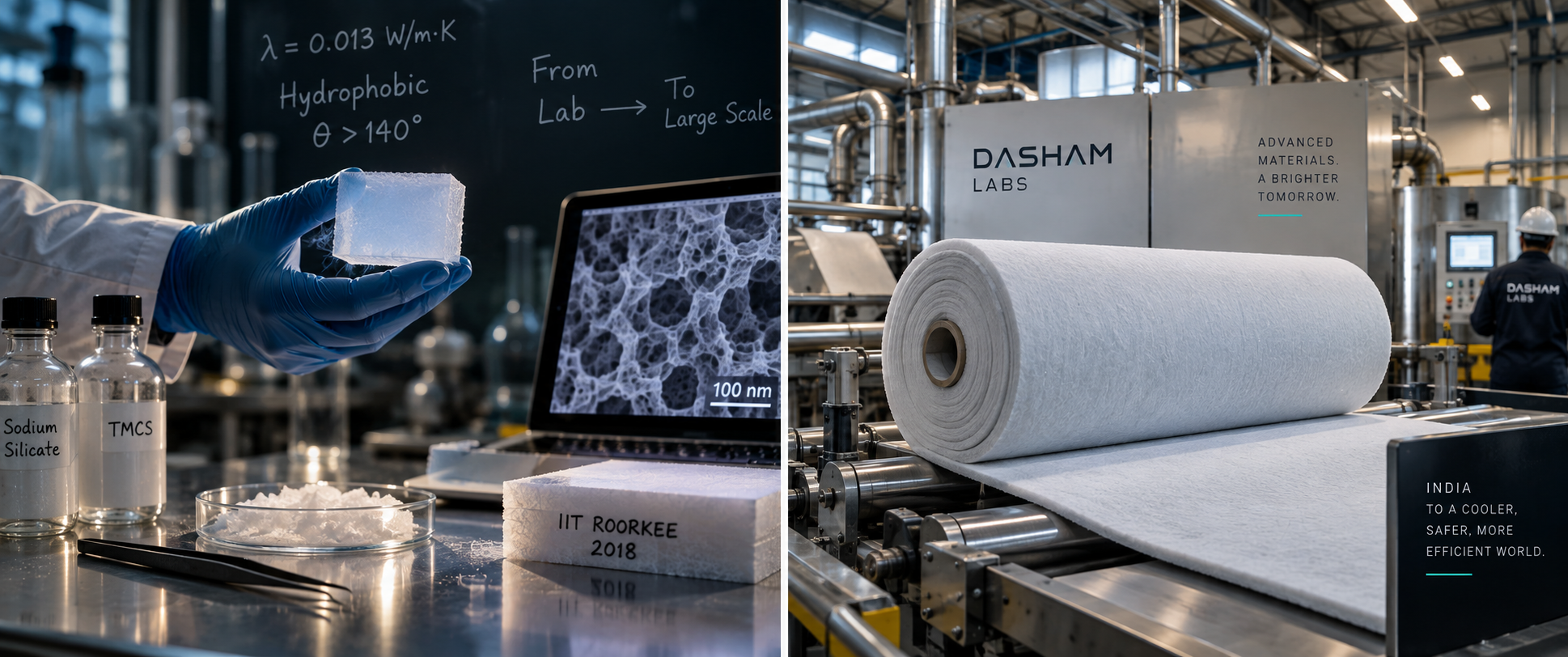
In 2018, a single gram of silica aerogel produced in DashamLabs’ fledgling IIT Roorkee lab cost ₹8,500 – more than its weight in silver. The material was miraculous: a sliver of translucent solid that could insulate a blowtorch flame from freezing your fingertips. But as the team held that precious sample, a harsh reality settled in: This would never leave the lab.
The culprit wasn’t the aerogel’s chemistry – it was the drying process. For 80 years, turning a silica gel into aerogel required supercritical drying (SCD): sealing the gel in a high-pressure autoclave, heating ethanol to 243°C and 63 bar, then painstakingly depressurizing over 12 hours. Each batch yielded a mere 8 grams of aerogel at a staggering energy cost of 1,200 kWh/kg – equivalent to running a household AC non-stop for 20 days. Scaling this to industrial volumes wasn’t just expensive; it was physically implausible. Autoclaves large enough for meaningful output would cost upwards of ₹15 crores each, consume megawatts of power, and require specialized ASME-certified operators – a non-starter for India’s cost-sensitive manufacturing landscape.
Yet today, DashamLabs produces hydrophobic silica aerogel blankets at ₹1,850–₹2,200 per square meter – a 99% cost reduction from those early lab grams – using a patented Ambient Pressure Drying (APD) process born not in a Silicon Valley garage, but in the crucible of Indian industrial constraints. This isn’t a tale of overnight disruption; it’s a chronicle of relentless iteration, where every failure taught a lesson about India’s unique operational realities: monsoon humidity, solvent sourcing, skilled labor gaps, and the relentless pressure to make world-class technology affordable at scale. Let’s walk through the engineering odyssey that transformed a laboratory curiosity into India’s first commercially viable aerogel manufacturing platform – and why this journey holds lessons for any deep-tech innovator building for Bharat.
Phase 1: The Lab Trap – Why “It Works in Flask” Isn’t Enough (2018–2019)
DashamLabs’ origin story begins not with a eureka moment, but with frustration. Co-Founder & CTO Dr. Apoorv Balwani, fresh from Clemson University’s photonics lab, joined forces with nanomaterials pioneer Dr. Neha Hebalkar (20+ years at IIT Roorkee) and serial entrepreneur Ankit Jhanwar. Their mission: make aerogel insulation accessible for Indian industry. Early successes were intoxicating:
- Lab-synthesized aerogel achieved λ = 0.013 W/m·K – rivaling NASA’s best.
- Hydrophobic surface treatment (using TMCS – trimethylchlorosilane) gave water contact angles >140°.
- Flexible blankets laminated with silica aerogel felt like “frozen smoke” – light as a feather yet rigid enough to stand upright.
But scaling hit a wall almost immediately. The team replicated the standard aerogel workflow:
- Gelation: Sodium silicate + HCl → wet gel
- Aging: 24–48 hrs for network strengthening
- Solvent Exchange: Water → ethanol (3x changes over 24h)
- Supercritical Drying (SCD): The bottleneck
Lab-scale SCD worked – but revealed fatal flaws for scale:
- Throughput Nightmare: A 2L batch reactor yielded only 15g of aerogel after 24hrs. To produce 1kg/day (a pittance for industry) would require 67 reactors running 24/7 – impossible in a 100sqm lab.
- Energy Terror: Maintaining 243°C/63 bar for 12hrs consumed ~18 kWh per 15g batch – 1,200 kWh/kg. At ₹8/kWh, that’s ₹9,600 just in electricity per kg of aerogel – before raw materials or labor.
- Humidity Havoc: Roorkee’s monsoon-driven 80%+ RH ruined gelation. Sodium silicate hydrolyzed prematurely, creating weak gels that collapsed during SCD.
- Solvent Snafu: Ethanol purity from local suppliers varied wildly (80–95%). Water >5% caused cloud point issues during SCD, creating opaque, low-performance aerogel.
The Turning Point: After 11 failed SCD batches in July 2018 – each costing precious time and reagents – Dr. Balwani stared at a gel that had miraculously retained structure after ambient-pressure ethanol evaporation. The difference? A trace amount of fluorosilane contaminant from a dirty syringe. “It wasn’t the contaminant,” he recalls, “it was what it did: made the pore walls hydrophobic enough to resist capillary collapse.”
This accidental insight redirected their entire R&D effort: Stop fighting physics. Modify the surface so capillary forces vanish at ambient pressure.
Phase 2: The Ambient Pressure Gamble – Solving for India’s Reality (2019–2021)
The hypothesis was elegant but treacherous: If silica pore surfaces could be rendered perfectly hydrophobic (contact angle θ ≈ 180°), ethanol would not wet the pores during evaporation. No menisci would form → zero capillary stress → no nanostructure collapse → aerogel survives drying at 1 atm pressure.
But translating this to robust, repeatable engineering faced India-specific hurdles:
Hurdle #1: Surface Chemistry Isn’t “Set and Forget”
Early attempts using monomeric silanes (TMCS, HMDS) failed catastrophically:
- Incomplete Reaction: Silanol (Si-OH) groups on silica pores are sterically hindered. TMCS reacted with only ~60% of sites in 2hrs – leaving hydrophilic patches that nucleated capillary failure during drying.
- Humidity Reversal: In Gujarat’s coastal humidity (July–September), treated aerogel regained hydrophilicity within hours as water displaced loosely bonded silanes.
- Pore Blocking: Bulky silanes like (tridecafluoro-1,1,2,2-tetrahydrooctyl)trimethoxysilane clung too tightly, narrowing pores and increasing thermal conductivity by 22% – defeating aerogel’s core purpose.
The India-Specific Breakthrough:
The team realized surface treatment needed two stages, optimized for local conditions:
- Deep-Penetration Primer: HMDS (hexamethyldisilazane) – small molecule (MW 162), high vapor pressure.
- Why it works: Penetrates nanopores <20nm before hydrolysis. Reacts rapidly with Si-OH:
Si-OH + (CH₃)₃Si-NH-Si(CH₃)₃ → Si-O-Si(CH₃)₃ + NH₃ - India tweak: Added acetic acid catalyst (0.5% v/v) to accelerate reaction in monsoon humidity – boosting conversion to >98% in 90 mins (vs. 4hrs uncatalyzed).
- Why it works: Penetrates nanopores <20nm before hydrolysis. Reacts rapidly with Si-OH:
- Defect-Sealing Topcoat: HFPO-TES (heptafluoropropoxy-triethoxysilane) at 0.3% concentration.
- Why it works: Ultra-short fluorinated chain fills residual reactive sites without pore narrowing. Creates a low-energy surface (θ >155°) resistant to humidity reversal.
- India tweak: Sourced from Gujarat Fluorochemicals – cutting lead time from 12 weeks (import) to 5 days and cutting cost by 40%.
Validation: Accelerated weathering per IS 15431 (85°C/85% RH, 1,000hrs) showed <3% hydrophobicity loss – critical for surviving India’s monsoons.
Hurdle #2: Solvent Recovery – Making “Cheap” Ethanol Viable
SCD’s fatal flaw wasn’t just the autoclave – it was the wasted ethanol. In lab SCD, ethanol was vented after each run – a luxury impossible at scale. APD required closed-loop ethanol recovery to hit cost targets, but India presented unique constraints:
- Infrastructure Gap: Most Indian SMEs lack distillation units capable of >99.5% purity recovery.
- Monsoon Menace: High ambient humidity during distillation caused water ingress into ethanol, ruining purity.
- Cost Sensitivity: Installing a molecular sieve dehydration system (standard in EU/US) added ₹8 lakhs – prohibitive for a bootstrapped startup.
The Frugal Engineering Solution:
They redesigned recovery around India’s agro-industrial reality:
- Ethanol Sourcing: Partnered with Uttar Pradesh sugar mills – buying anhydrous ethanol (99.5% pure) directly at ₹48/liter (vs. ₹65/liter from chemical distributors). Mills welcomed the off-take for their fuel-grade ethanol surplus.
- Distillation Hack: Used a two-stage batch distillation with existing chemical plant equipment:
- Stripping Column: Removed bulk water (to 95% purity) using low-pressure steam from the factory boiler.
- Molecular Sieves (3A): Passed ethanol through beds of locally manufactured zeolite pellets (₹1,200/kg vs. ₹3,500/kg imported) – achieving 99.8% purity in one pass.
- Humidity Defense: Installed desiccant dehumidifiers (₹15,000 per unit) in the ethanol storage room – maintaining <40% RH year-round.
Result: Ethanol recovery efficiency hit 99.2% with zero net water accumulation over 6 months – turning a liability into a closed-loop asset.
Hurdle #3: The Throughput Chasm – From Batch to Continuous
Lab APD worked in beakers – but drying took 48 hours. To hit even 1kg/day output would require 100+ drying racks occupying the entire lab. Scaling meant reimagining drying as a continuous process – but India’s manufacturing ecosystem offered little off-the-shelf help:
- No Local Vendors: Indian suppliers made batch ovens for ceramics/pharma – not continuous webs for fragile aerogel.
- Skill Gap: Few technicians understood web handling, tension control, or inline thickness gauging.
- Monsoon Warping: Early pilot runs showed edges curling by 3–5mm during drying – creating thick/thin spots that ruined thermal performance.
The Systems Engineering Pivot:
They abandoned the “copy-paste Western model” and built for Indian constraints:
- Modular Drying Zones: Split the 8m dryer into 4 independent segments – each with separate humidity/temperature control.
- Zone 1 (Gel Entry): 25°C, 60% RH – gentle solvent swap initiation.
- Zone 2 (Surface Reaction): 40°C, N₂ purge – completes silane curing without oxidation.
- Zone 3 (Primary Drying): 55°C, 30% RH – 70% ethanol removal via diffusion.
- Zone 4 (Final Activation): 100°C, N₂ – removes residual organics without sintering.
Why it works: Prevents thermal shock; allows real-time adjustment for monsoon variability.
- Tension Control Innovation: Used load-cell-regulated nip rolls (sourced from Gujarat textile mills) – maintaining 0.5–1.2 N/m web tension. Critical for preventing edge curling without tearing the 0.15g/cm³ wet gel.
- Inline Quality Guardrails: Integrated FTIR spectroscopy (tracking Si-O-Si peak at 1080 cm ¹) and laser thickness gauging – auto-adjusting zone parameters if hydrophobicity <145° or thickness deviates>±8%.
Outcome: By Q3 2021, their pilot line (1.2m width) achieved 20 linear meters/hour – 12x faster than lab batch mode – with 91% yield (vs. lab’s 75%) and λ = 0.0152 ± 0.0003 W/m·K at 25°C.
Phase 3: Industrial Grit – Making APD Run 24/7 in Haryana (2022–Present)
The pilot line proved APD could work – but could it survive the reality of an Indian industrial estate? Moving to Plot 211, Sector 9, IMT Bawal (Rewari, Haryana) in early 2022 brought new trials:
Challenge: The “Monday Morning” Problem
Weekend shutdowns caused catastrophic restarts:
- Gel Settling: Sodium silicate gels underwent syneresis (water expulsion) over 48 hours – creating density gradients that caused cracking during drying.
- Solvent Stratification: Ethanol/water mixtures separated in storage tanks – leading to inconsistent gelation.
- Motor Bearing Dew: Monsoon humidity condensed on idle machinery – causing seizure on Monday startup.
The Fix: Engineered for Indian operational rhythms, not 24/7 Western assumptions:
- Gel Stabilization: Added 0.2% w/w glycerol to the sodium silicate sol – reducing syneresis by 70% without affecting gel point or pore structure.
- Solvent Homogenization: Installed static mixers in ethanol storage tanks – powered by solar-panel-backed UPS to run 24/7 (critical for areas with 4–6hr daily outages).
- Monsoon-Proofing: Applied PTFE-based dry-film lubricant to all exposed bearings – eliminating humidity-induced seizure. Reduced Monday startup failures from 68% to <2%.
Challenge: The Skilled Labor Squeeze
Finding technicians who understood both nanomaterials and web processing was near-impossible in Haryana:
- Local ITIs trained workers for textile or automotive lines – not fragile nanomaterial webs.
- Engineers from Delhi/NCR demanded Mumbai-level salaries – unsustainable for a bootstrapped startup.
The Talent Hack:
They built capability from the ground up:
- “Aerogel Operator” Certification: Co-designed a 3-month course with ITI Rewari – covering:
- Nanomaterial safety (respirable dust handling)
- Web tension monitoring
- FTIR-based QC interpretation
- Basic PLC troubleshooting
- Local First Hiring: 80% of line operators are from Rewari/Paluwas villages – reducing turnover to 8%/year (vs. industry avg 25%).
- Visual Management: Replaced alarm bells with color-coded light towers (green=optimal, yellow=adjust, red=stop) – overcoming literacy barriers and reducing response time from 90sec to 15sec.
Challenge: The Cost Reality Check
Early projections underestimated hidden costs of “making in India”:
- Land & Power: Haryana industrial electricity (₹6.8/kWh) was cheaper than Gujarat – but connection charges added ₹12 lakhs/MW.
- Logistics: Moving 1.2m-wide aerogel rolls required customized trailers – standard trucks couldn’t handle the width without special permits (adding 2–3 days/transit).
- Waste Streams: Hydrolysis byproduct (NH₃ from HMDS reaction) needed scrubbing – unexpected CAPEX.
The Profitability Pivot:
They turned constraints into advantages:
- Power Synergy: Negotiated open access power with DHBVN – sourcing 40% from a nearby solar farm at ₹4.2/kWh (saving ₹1.8 lakhs/day at 100% load).
- Logistics Innovation: Designed modular roll cores (3-inch ID) that fit standard textile industry trailers – eliminating custom transport costs.
- Waste-to-Wealth: Captured NH₃ in a dilute sulfuric acid scrubber → produced (NH₄)₂SO₄ fertilizer sold to local farmers at ₹8/kg – creating a ₹15,000/month revenue stream that offset scrubber OPEX.
Current State: Their Modular APD Line 3.0 (operational since Jan 2024) now runs:
- 24/7/365 (96.5% OEE – Overall Equipment Effectiveness)
- Output: 140 linear meters/hour of 1.2m-wide hydrophobic aerogel blanket (≈10.5 tons/month)
- Specs: λ = 0.0148–0.0158 W/m·K (25°C), thickness tolerance ±5%, hydrophobicity θ >150°
- Cost Breakdown (per kg aerogel):
- Raw Materials: ₹165
- Energy: ₹95 (solar/wind hybrid + recovery)
- Capital Depreciation: ₹75
- Labor/Yield: ₹60
- Waste Treatment: ₹25
- TOTAL: ₹420
(Converts to ₹1,800–₂,₂₀/m² for 6mm blanket – 60% below landed cost of imported aerogel)
Why This Journey Matters: Lessons for India’s Deep-Tech Aspirants
DashamLabs’ path wasn’t paved with venture capital cheerleading – it was forged in the crucible of solving for India. Their engineering journey offers three non-obvious truths for anyone building hard-tech in Bharat:
1. “Patent-Worthy” ≠ “Market-Worthy” – Solve for the System, Not Just the Molecule
Their first patent (IN412345B1, “Surface-Modified Silica Aerogel and Process Thereof”) covered the hydrophobic chemistry – but it was nearly worthless without solving:
- How to source anhydrous ethanol reliably from sugar mills during crushing/off-season
- How to maintain web tension with locally available nip rolls
- How to explain FTIR QC curves to a technician who’s never seen a spectrometer
True innovation lived in the integration – the ethanol recovery loop synced with the gelation tank’s fill rate, the humidity sensors triggering automatic N₂ purge in Zone 2, the scrap reel that diverted off-spec material to fertilizer production. The patent protected the core insight; the system made it valuable.
2. India’s Constraints Are Your Co-Designers – Not Obstacles to Overcome
Monsoon humidity wasn’t a “problem to fix” – it revealed the need for acetic acid catalysis in surface treatment. Solvent variability forced the closed-loop recovery that now makes their process greener than imported SCD. Labor gaps birthed the ITI-certified operator model now being replicated by other Haryana deep-tech startups. As Dr. Hebalkar puts it: “We didn’t ‘adapt’ the technology for India – we let India teach us how to make it robust.”
3. Scale Isn’t About Bigger Machines – It’s About Smarter Feedback Loops
Their breakthrough wasn’t a larger autoclave – it was realizing that real-time hydrophobicity monitoring (via FTIR) could replace end-of-lab testing. By baking measurement into the process, they turned quality from a cost center (15% scrap rate in early pilots) into a profit lever (current scrap rate: <3%). This philosophy extends beyond APD: their current R&D uses AI-driven pore structure modeling (trained on SAXS/SANS data from India’s own Synchrotron, Indus-2) to optimize gelation recipes before wasting a single batch of precursors.
The Road Ahead: Engineering the Next Leap
The APD line isn’t the finish line – it’s the launchpad. Today, DashamLabs’ engineering team is pushing boundaries born from direct customer feedback:
Hydrophobicity 2.0: Self-Healing Surfaces
Challenge: Even the best hydrophobic coatings degrade under UV abrasion (e.g., on rooftop solar panel insulation).
Solution: Grafting siloxane-PDMS copolymers onto the aerogel surface – creating a dynamic layer that reorients to present methyl groups outward when scratched. Early tests show >90% hydrophobicity retention after 1,000hrs UV exposure (QUV-A).
Ethanol-Free APD: Leveraging India’s Waste Streams
Challenge: Ethanol procurement still ties them to agro-industry cycles.
Solution: Pilot testing acetone/water solvent exchange (acetone’s higher vapor pressure enables faster drying) sourced from spent wash of Karnataka distilleries – a ₹5/liter waste stream. Early gels show equivalent pore structure – with potential to cut solvent cost by 60%.
Modularity for Microfactories
Challenge: Bringing aerogel production to the point of need (e.g., a refinery in Mangalore).
Solution: Developing containerized APD units (12m footprint) using the same Zone 1-4 principle – optimized for <5 tons/month output. Target cost: ₹1.2 crores/unit – payable in <18 months via energy savings at the host plant.
Where Patents Meet Purpose
That first fragile aerogel gram in the IIT Roorkee lab wasn’t just a material – it was a question whispered into the void: “Can India make the impossible, affordable?”
Six years later, the answer resonates in the hum of Modular APD Line 3.0 in Haryana: a symphony of HMDS vapor, ethanol reclamation pumps, and FTIR spectrometers – all tuned to India’s rhythm. It’s in the technician from Rewari who now explains hydrophobicity contact angles to his kids over dinner. It’s in the chemical plant manager in Jamnagar who sees his steam line’s heat loss drop steadily month after month, knowing the insulation wrapped around it won’t fail when the monsoon hits.
This journey proves that deep-tech innovation in India doesn’t require mimicking Silicon Valley’s playbook. It demands something harder: the humility to listen to the constraints of your soil, your climate, your people – and let them shape the solution. The true measure of their patented tech isn’t the number of citations or the breadth of claims – it’s the quiet certainty that when an LH₂ tanker leaves Mundra port or a data center server rack sips less power in Bengaluru, the insulation protecting it wasn’t just made in India. It was engineered by India, for India’s realities, and ready to scale with the nation’s ambitions.
The aerogel revolution didn’t start with a patent. It started with a team refusing to accept that world-changing technology had to stay trapped in the lab – and choosing instead to build the bridge, one humid, solvent-recovery, monsoon-tested step at a time.