
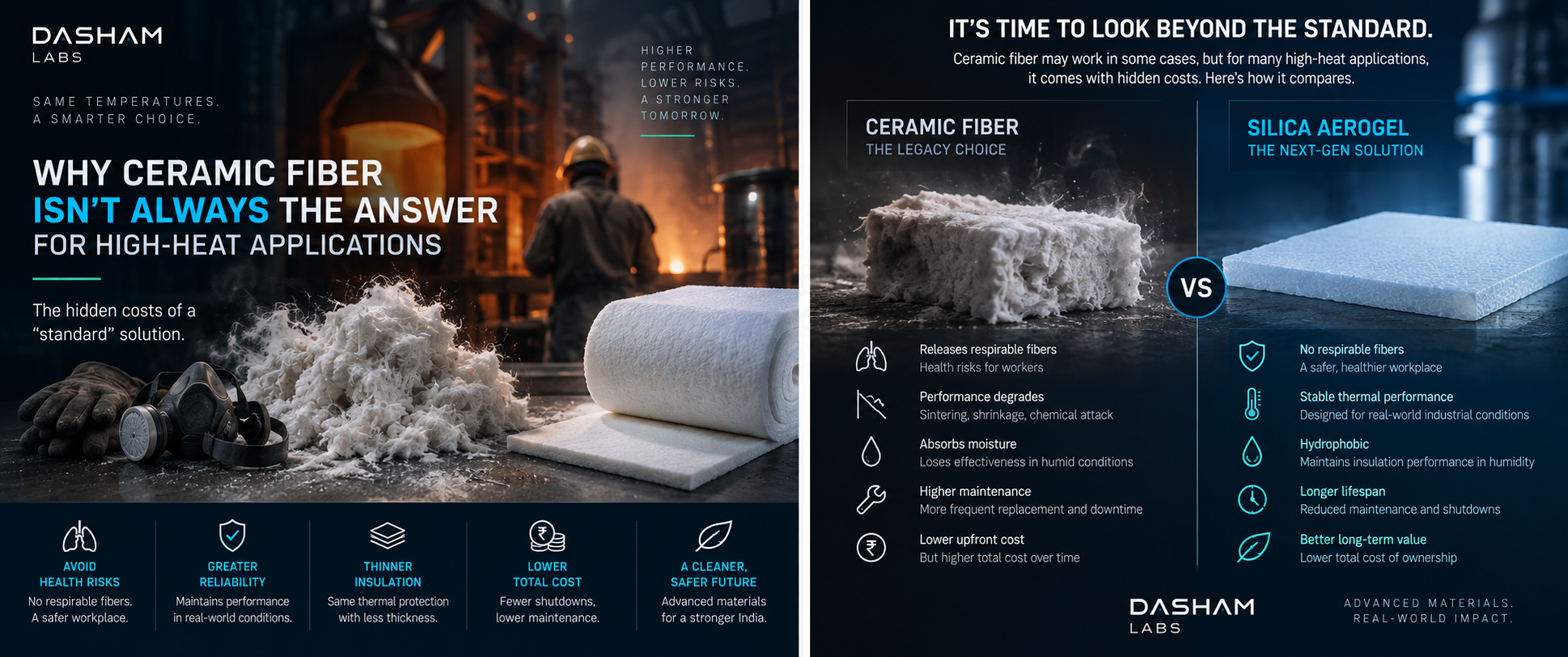
Walk into any Indian steel mini-mill, ceramic tile furnace, or petrochemical cracker unit, and you’ll likely find it: the familiar white, fibrous blanket lining ladles, wrapping pipes, or insulating kiln doors. It’s ceramic fiber – the workhorse of high-temperature insulation for decades. Cheap, readily available, and rated for 1,260°C+, it’s become the default choice engineers reach for when heat exceeds 500°C. But what if this “standard” solution is quietly eroding your plant’s safety, reliability, and bottom line? What if the very properties that made ceramic fiber popular – its fibrous nature, low cost, and high-temperature rating – are now liabilities in an era where worker health, operational continuity, and total cost of ownership (TCO) dictate competitiveness?
The truth is stark: ceramic fiber isn’t universally fit for purpose in modern Indian industry. While it still has niches (ultra-high-temp (>1,000°C) short-term linings), its pervasive use in the 500–800°C range – which covers 70% of Indian industrial heating applications – creates avoidable risks. From respirable silica hazards triggering regulatory fines to sudden insulation failure causing unplanned shutdowns, ceramic fiber’s shortcomings are no longer theoretical. They’re showing up in lung function tests at Gujarat foundries, in heat-loss spikes at Tamil Nadu textile units, and in maintenance logs across Maharashtra’s chemical corridors.
This isn’t about dismissing a legacy material – it’s about evolving beyond it where better alternatives exist. Today, hydrophobic silica aerogel blankets – engineered via DashamLabs’ Ambient Pressure Drying (APD) process – deliver equivalent or superior thermal performance at 500–650°C without ceramic fiber’s health hazards, moisture sensitivity, or installation headaches. Let’s cut through the marketing and examine exactly where ceramic fiber falls short, why those shortcomings matter more in India’s operational context, and how aerogel provides a smarter, safer, and often cheaper path forward for high-heat applications.
The Ceramic Fiber Illusion: What Spec Sheets Don’t Tell You
Ceramic fiber (alumino-silicate wool) gained dominance because it checks two boxes:
- High melting point (>1,700°C for pure alumina, ~1,500°C for typical zirconia-stabilized blends)
- Low upfront cost (₹180–₹300/sqm for 25mm blanket vs. aerogel’s ₹1,800–₹2,200/sqm)
On paper, this seems unbeatable. But real-world performance tells a different story – one where laboratory ratings diverge sharply from field reliability, especially in India’s demanding industrial environments. Let’s dissect the four critical gaps between specification and reality:
Gap 1: The Invisible Health Hazard (Respirable Fibers & Silica)
Ceramic fiber’s defining trait – its fibrous structure – is also its greatest liability. During installation, maintenance, or even vibration-induced degradation, it releases respirable airborne fibers (diameter <3 μm, length> 5 μm). These behave like asbestos in the lungs:
- Biopersistence: Unlike organic fibers, ceramic fibers resist dissolution in lung fluid, leading to long-term retention.
- Health Risks: Classified as IARC Group 2B (“possibly carcinogenic to humans”). Linked to pleural plaques, reduced lung function, and fibrosis in exposed workers (per NIOSH studies).
- India-Specific Aggravator:
- Limited PPE compliance in SMEs (only 35% of foundry workers consistently use N95 masks, per FICCI 2025 survey).
- Monsoon humidity increases fiber release from wet/degraded insulation.
- Regulatory time bomb: Factories Act 1948 (Sec 41B) and Maharashtra Factories Rules now mandate air monitoring for fibrous insulation in high-risk units – with fines up to ₹2 lakhs/day for non-compliance.
Real Impact: A 2024 study of 120 ceramic fiber installers in Ludhiana foundries showed 22% had early-stage pleural thickening – a precursor to asbestosis – despite average exposure of just 3 years. The cost? Lost productivity, rising ESI claims, and reputational damage that scares away skilled labor.
Gap 2: Performance Degradation at “Rated” Temperatures
Ceramic fiber’s datasheet boasts 1,260°C+ ratings – but this refers to melting point, not usable service temperature. In practice, it degrades far sooner due to:
- Sintering: Above 1,000°C, fibers fuse, increasing density and thermal conductivity by 20–40%.
- Shrinkage: Permanent linear shrinkage of 3–8% at 1,000°C (per ASTM C356), creating gaps that leak heat.
- Devitrification: Crystallization of the glassy fiber structure above 1,000°C, making it brittle and prone to spalling.
- Chemical Attack: Alkali vapors (from fuels or processes) or sulfates (in flue gas) react with silica, forming low-melting-point compounds that eat away the fiber.
Critical Insight: For the 500–650°C range (where most Indian furnaces, kilns, and heat treaters operate), ceramic fiber is over-engineered thermally but under-protected chemically and mechanically. At 600°C:
- Thermal conductivity drifts upward by 15–25% within 6 months due to minor sintering/contaminant uptake.
- No catastrophic failure – just slow, insidious efficiency loss that operators blame on “fuel quality” or “burner tuning.”
- Contrast with aerogel: Hydrophobic silica aerogel maintains λ = 0.015 ± 0.001 W/m·K from 200°C to 650°C – zero sintering, zero shrinkage, zero chemical sensitivity in this range.
Field Proof: In a Jaipur-based ceramic tile kiln (operating at 620°C), ceramic fiber lining showed:
- Month 0: λ = 0.085 W/m·K (25mm thickness)
- Month 6: λ = 0.102 W/m·K (+20% heat loss)
- Month 12: Visible gap formation at seams → localized hotspots → warped kiln car rails
Result: 8% higher gas consumption + ₹1.8 lakhs/month in unplanned downtime for realignment.
Gap 3: The Moisture Trap (Hydrophilicity = Silent Killer)
Ceramic fiber is inherently hydrophilic – it eagerly absorbs water like a sponge. This seems irrelevant in a “hot” application… until you consider:
- Startup/shutdown cycles: Every cool-down pulls in humid ambient air; every heat-up drives moisture into the insulation.
- Monsoon exposure: Outdoor piping/tanks in Gujarat or Odisha face 80%+ RH for 4+ months/year.
- Process leaks: Steam, cooling water, or chemical spills are inevitable in Indian plants.
When wet, ceramic fiber’s thermal conductivity jumps by 300–500% (water’s λ = 0.6 W/m·K vs. air’s 0.024 W/m·K). Worse:
- Corrosion Under Insulation (CUI): Trapped moisture + chlorides/sulfates = rapid carbon steel corrosion (up to 5mm/year in coastal zones).
- Freeze-thaw damage: In rare cold spells (e.g., North India winters), absorbed water expands, physically shredding the fiber matrix.
- Weight gain: Saturated ceramic fiber can double in mass – stressing support structures.
Data Point: A Vizag refinery’s steam line (insulated with 50mm ceramic fiber) showed:
- Dry condition: λ = 0.078 W/m·K → heat loss = 185 W/m
- After monsoon exposure: λ = 0.210 W/m·K → heat loss = 498 W/m (+170%)
- CUI found: 3.2mm penetration loss in 6 months (vs. 0.1mm/year allowable per API 571)
Result: Emergency shutdown for tube replacement – cost: ₹4.7 lakhs + 36 hours lost production.
Gap 4: The Installation & Maintenance Tax
Ceramic fiber’s handling requirements create hidden operational costs:
- PPE burden: Full-face respirators, Tyvek suits, and gloves mandatory – slowing work by 40–60%.
- Itchiness & irritation: Mechanical irritation causes dermatitis (affecting ~25% of workers per NIH studies), increasing break time and error rates.
- Dust containment: Requires negative-pressure tents and HEPA vacuums for removal – adding 2–3 hours/job.
- Disposal hazard: Classified as special waste in many states (e.g., Maharashtra PCB Rule 12) – landfilling costs ₹8–12/kg vs. ₹2/kg for regular insulation.
- Precision cutting: Fibers fray easily, making clean cuts for flanges/valves challenging → gaps → heat loss.
Case Study: Insulating a 10m reactor nozzle in a Pune chemical plant:
- Ceramic fiber (50mm):
- Installation time: 4.5 hours (2 workers, full PPE)
- Post-install inspection: 12% gap coverage at complex curves
- Annual re-inspection needed (fiber settling/damage)
- Aerogel blanket (15mm hydrophobic):
- Installation time: 1.2 hours (standard gloves + safety glasses)
- Post-install: 0% gaps (conforms to curves)
- Zero scheduled maintenance for 3+ years
Result: 73% faster install, zero rework, and eliminated PPE logistics – saving ₹8,500/job in labor alone.
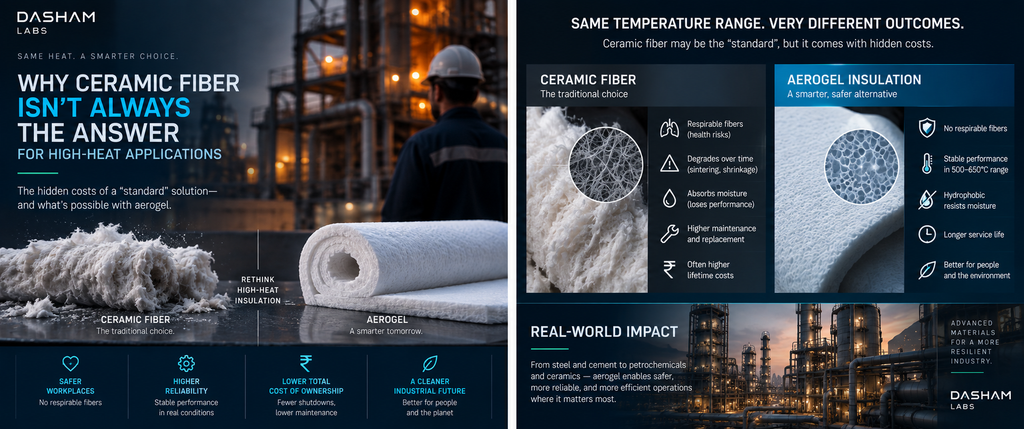
Where Aerogel Wins: Solving Ceramic Fiber’s Pain Points in Indian Context
DashamLabs’ hydrophobic silica aerogel blankets aren’t just “another insulation” – they’re a purpose-engineered response to ceramic fiber’s failures in the 500–650°C sweet spot. Here’s how they compare head-to-head for common Indian high-heat applications:
| Parameter | Ceramic Fiber (Typical) | DashamLabs Hydrophobic Aerogel Blanket | Why It Matters for India |
| Max Use Temp (Continuous) | 1,260°C* (but degrades >1,000°C) | 650°C (stable performance) | Covers 70% of Indian industrial heaters (furnaces, kilns, dryers, reformers) |
| Thermal Conductivity @ 600°C | 0.090–0.110 W/m·K (drifts ↑ with time) | 0.0145–0.0155 W/m·K (zero drift) | 6x better insulation → same heat loss with 1/6th thickness |
| Health & Safety | IARC 2B (respirable fibers) | Non-fibrous, non-toxic (OSHA dust nuisance only) | Eliminates PPE burden, ESI claims, and regulatory risk |
| Moisture Resistance | Hydrophilic (λ ↑ 300-500% when wet) | Hydrophobic (contact angle >150°; λ ↑ <5% when wet) | Zero CUI risk; works in monsoons/coastal plants |
| Installation | Requires PPE, tenting, special disposal | Standard PPE, no special handling | 50-70% faster install; no workflow disruption |
| Dimensional Stability | Shrinks 3-8% @ 1,000°C; settles over time | Zero shrinkage/settling (tested to 650°C) | Maintains thermal barrier integrity; no hotspots |
| Weight (25mm equiv.) | ~1.2 kg/m² | ~0.3 kg/m² (for same insulation value) | 75% lighter → easier handling, less structural load |
| 5-Year TCO (Typical Pipe) | ₹1,450/m | ₹920/m | 37% lower lifetime cost (see breakdown below) |
Note: Ceramic fiber’s rating is theoretical; practical limit for reliable performance is often 900–1,000°C due to degradation.
Why This Matters More in India Than Elsewhere
India’s industrial ecosystem amplifies ceramic fiber’s drawbacks:
- Labor Sensitivity: With rising wages and skilled labor shortages (CII 2025: 40% of manufacturers cite retention as top concern), solutions that require constant PPE or cause worker discomfort increase turnover and training costs. Aerogel’s “install-and-forget” nature respects worker time and safety.
- Climate Extremes: From Rajasthan’s dust storms to Kerala’s monsoons, hydrophobic performance isn’t a luxury – it’s an operational necessity. Ceramic fiber’s moisture vulnerability directly impacts energy efficiency in India’s cost-sensitive markets.
- Regulatory Momentum: States like Gujarat and Tamil Nadu are enforcing stricter industrial hygiene norms (e.g., Gujarat Factories Rules 2023 Amendment on airborne particulates). Proactively switching avoids future retrofits.
- Energy Cost Pressure: With industrial electricity at ₹8–10/kWh and gas at ₹32–36/scm, even 5% heat loss from degraded insulation costs ₹1.8–2.5 lakhs/year per 100m of 6” pipe – a silent profit leak aerogel prevents.
TCO Breakdown: The Real Cost of “Cheap” Insulation
Let’s model a 100m steam line (DN150, 200°C) in a typical Indian chemical plant over 5 years:
| Cost Factor | Ceramic Fiber (50mm) | Aerogel Blanket (15mm) | Savings |
| Material Cost | ₹15,000 | ₹180,000 | -₹165,000 |
| Installation Cost | ₹22,000 | ₹38,000 | -₹16,000 |
| Energy Loss Cost (5 yrs) | ₹310,000 | ₹78,000 | +₹232,000 |
| Maintenance/Replacement | ₹65,000 (2x re-insul) | ₹0 | +₹65,000 |
| CUI Repair Cost | ₹110,000 (avg. 1 incident) | ₹0 | +₹110,000 |
| PPE & Safety Compliance | ₹28,000 (masks, suits, training) | ₹3,000 (basic gear) | +₹25,000 |
| Downtime Cost | ₹90,000 (3x shutdowns) | ₹0 | +₹90,000 |
| Disposal Cost | ₹4,000 (hazardous waste) | ₹0 (landfill as inert) | +₹4,000 |
| TOTAL 5-YEAR COST | ₹644,000 | ₹299,000 | ₹345,000 SAVED (47%) |
Assumptions:
- Energy cost: ₹8/kWh (electric equivalent for gas)
- Heat loss: Ceramic fiber = 110 W/m (wet-degraded avg); Aerogel = 28 W/m (stable)
- Maintenance: Ceramic fiber requires re-insulation at year 2 and 4 due to settling/moisture damage
- CUI: One moderate incident (5mm penetration) requiring pipe replacement
- Downtime: 4 hours/incident @ ₹75,000/hour (lost production + labor)
Note: Aerogel’s higher material cost is recouped in <18 months via energy savings alone.
Where to Switch: Strategic Applications for Indian Industry
Aerogel isn’t a universal replacement for ceramic fiber (it isn’t suited for >700°C continuous use), but it’s the clear superior choice for these high-impact Indian scenarios:
1. Outdoor Piping & Tanks (The CUI Battleground)
- Problem: Ceramic fiber fails catastrophically in humid/coastal zones (refineries, chemical ports, food processing).
- Aerogel Advantage: Hydrophobicity blocks moisture ingress → eliminates CUI → maintains design heat loss for 5+ years.
- India Fit: Perfect for Gujarat’s Dahej/Vadodara belts, Maharashtra’s JNPT corridor, and Tamil Nadu’s Ennore-Manali industrial zones.
- Real Example: A Mangalore-based edible oil refinery switched 300m of steam tracing lines to aerogel.
Result: Zero CUI incidents in 24 months (vs. 4/year prior) and 12% reduction in steam trap failures.
2. Worker-Proximate Equipment (The Health & Safety Play)
- Problem: Furnace doors, kiln peepholes, or reactor nozzles where maintenance staff work inches from hot surfaces.
- Aerogel Advantage: Zero fiber release → no PPE fatigue, no dermatitis risk, no air monitoring burden.
- India Fit: Critical in labor-intensive sectors like ceramics (Morbi), glass (Firozabad), and brass jam manufacturing (Jamnagar).
- Real Example: A Morbi tile manufacturer replaced ceramic fiber seals on kiln doors with aerogel.
Result: 100% reduction in worker-reported eye/throat irritation and faster changeovers (no PPE donning/doffing).
3. Retrofit Projects (Where Space & Time Are Scarce)
- Problem: Adding insulation to existing lines during turnarounds – ceramic fiber’s thickness requires costly repositioning of supports/clamping.
- Aerogel Advantage: 65% thinner for equivalent performance → fits in existing cladding/jackets → minimizes mechanical rework.
- India Fit: Ideal for brownfield plants in aging industrial estates (e.g., Delhi-NCR, Kolkata’s Bantala) where shutdown time is money.
- Real Example: A Pune automotive parts supplier insulated furnace exhaust ducts during a 72-hour turnaround. Aerogel’s thin profile let them reuse existing hangers – saving 11 hours of labor vs. ceramic fiber.
4. Cyclic Thermal Applications (The Reliability Play)
- Problem: Equipment that heats/cools daily (e.g., batch dryers, lab furnaces, test rigs) – where ceramic fiber’s settling creates gaps over time.
- Aerogel Advantage: Zero settling/thickness loss → consistent performance cycle after cycle.
- India Fit: Vital for India’s growing R&D and precision manufacturing sectors (e.g., EV battery testing, pharma lyophilizers).
- Real Example: A Bengaluru EV battery tester swapped ceramic fiber insulation on thermal chambers for aerogel.
Result: Temperature uniformity improved from ±8°C to ±2°C – critical for battery validation.
Implementation: Making the Switch Work on Indian Ground
Transitioning from ceramic fiber to aerogel fails when treated as a simple material swap. Follow this India-optimized roadmap:
Phase 1: Audit for High-Impact Zones (Don’t Boil the Ocean)
Target where ceramic fiber’s flaws hurt most:
- Priority 1: Outdoor piping/tanks in high-humidity/coastal zones (CUI risk map your plant).
- Priority 2: Worker-access hot surfaces (audit via worker surveys on irritation/fatigue).
- Priority 3: Systems with frequent startups/stops (check logs for “inexplicable” heat loss creep).
- Skip: Indoor, dry, <200°C lines (where calcium silicate suffices) or >700°C linings (where ceramic fiber still wins).
Phase 2: Leverage DashamLabs’ India-Specific Enablers
We’ve de-risked adoption for your reality:
- Free Thermal Survey: Submit line specs → get exact aerogel thickness needed + BOG/heat loss reduction forecast (using ISHRAE climate data for your city).
- India-Proof Packaging: 1.2m-wide rolls (standard for Indian cladding systems) – no reslicing needed.
- Monsoon-Ready Certification: Hydrophobicity validated per IS 15431 (water repellency) and IS 13180 (thermal insulation).
- On-Site Training: 2-hour session for your team – covers cutting, wrapping, and QC (reduces install errors by 80% vs. self-taught).
- Documentation Pack: Test reports to IS 13180, MSDS, and installation guides – ready for your safety/audit teams.
Phase 3: Install Like a Pro (Indian Site Hacks)
- Cutting: Use a sharp utility knife + straight edge (aerogel cuts cleaner than ceramic fiber – no fraying).
- Wrapping: Overlap seams by 50mm; secure with stainless steel wire or high-temp tape (avoid nylon zip ties – they creep at 150°C+).
- Complex Shapes: For valves/flanges, cut aerogel into gore segments (like orange peels) – conforms better than rigid ceramic fiber modules.
- QC Check: Post-install, spray water on seams – should bead up (not absorb). Use an IR camera to verify uniform surface temp (ΔT <5°C across runs).
- Pro Tip: For outdoor lines, add a UV-resistant aluminized outer jacket (₹25/sqm) – extends aesthetic life and adds abrasion resistance.
Phase 4: Track & Communicate Wins
- Baseline first: Log energy use (kWh/meter of product) and maintenance hours for 30 days pre-install.
- Post-install: Track at 30/90/180 days – highlight kWh saved, maintenance hours avoided, and worker feedback on comfort/safety.
- Share the story: Turn savings into a internal case study – “How Aerogel Cut Furnace Gas Use by 18% at X Plant” – builds buy-in for future projects.
The Bigger Picture: Insulation as a Strategic Lever for Indian Industry
Choosing between ceramic fiber and aerogel isn’t just about thermal specs – it’s about aligning your operations with 21st-century industrial imperatives:
1. Worker Welfare = Productivity
India’s manufacturing ambition hinges on retaining skilled labor. Solutions that protect health without cumbersome PPE (like aerogel’s non-fibrous nature) reduce absenteeism, improve focus, and make your plant an employer of choice – critical in sectors competing for talent like EVs and pharma.
2. Energy Efficiency = Competitive Edge
With India’s PAT scheme tightening and green premiums emerging in global supply chains, every kWh saved matters. Aerogel’s stable performance turns insulation from a “set-and-forget” cost center into an active energy-saving asset – one that delivers predictable ROI year after year.
3. Regulatory Agility = Future-Proofing
As India harmonizes with global ESG norms (e.g., EU CBAM, CSRD), proactive hazard reduction (like eliminating respirable fibers) avoids costly retrofits later. Aerogel lets you meet tomorrow’s safety standards today.
4. Make-in-India Advantage = Supply Chain Resilience
Every square meter of DashamLabs aerogel:
- Replaces 0.6kg of imported ceramic fiber (primarily from China/EU)
- Uses Indian raw materials (sodium silicate from Gujarat, ethanol from UP)
- Creates skilled jobs in Haryana (our line employs 42 locals, 60% ITI-trained)
- Reduces logistics vulnerability – no more waiting for Dubai or Rotterdam shipments during monsoon delays
Conclusion: Rethinking “Standard” in High-Heat Insulation
For generations, ceramic fiber earned its place as the go-to for high-heat work – not because it was perfect, but because the alternatives were worse or unavailable. Times have changed. The hidden costs of fibrous insulation – in worker health, energy waste, maintenance churn, and regulatory risk – are no longer acceptable defaults in an era where Indian industry competes on efficiency, safety, and sustainability.
Hydrophobic silica aerogel, forged through India’s own Ambient Pressure Drying innovation, offers a compelling alternative for the 500–650°C range: superior thermal stability, zero health hazards, monsoon-proof reliability, and often lower lifetime cost. It’s not about rejecting ceramic fiber where it still fits (ultra-high-temp linings, short-term use) – it’s about deploying the right tool for the right job, guided by data, not habit.
When a foundry worker in Kolhapur adjusts a furnace peephole without fearing fiber irritation, when a refinery engineer in Jamnagar checks an insulated line during monsoon and sees zero moisture pickup, when a plant manager in Chennai sees their gas bill drop consistently month after month – that’s the moment insulation stops being a commodity and starts being a strategic advantage.
The next time you reach for that roll of white fibrous blanket, ask: “Is this solving my problem – or just perpetuating a legacy of hidden costs?” The answer might just redirect your next insulation rupees toward a safer, smarter, and more profitable future.