
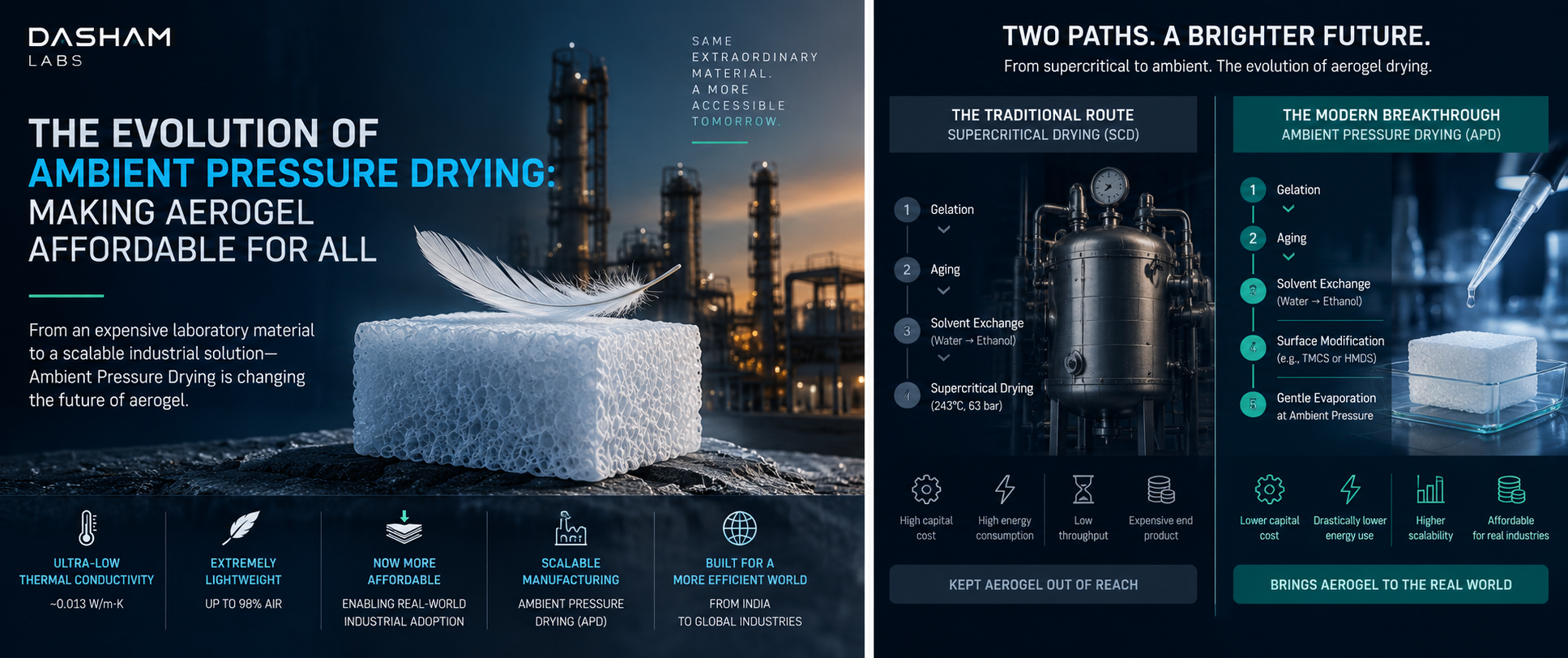
Imagine holding a block of solidified smoke – so light it barely registers on your palm, yet strong enough to insulate a rocket nozzle against 650°C flames. For decades, this miracle material – silica aerogel – remained confined to NASA labs and luxury applications, priced at over $500 per gram. Why? Not because of its chemistry, but because of one brutal bottleneck: the drying process.
Today, that same aerogel costs less than ₹2,000 per square meter for flexible insulation blankets – a 99% cost reduction enabling adoption across Indian refineries, EV factories, and data centers. The quiet hero behind this revolution? Ambient Pressure Drying (APD). This isn’t incremental improvement; it’s a fundamental re-engineering of aerogel production that transformed a scientific curiosity into an industrial workhorse. Let’s trace how APD evolved from laboratory curiosity to the backbone of affordable, scalable aerogel manufacturing – and why it matters for India’s industrial future.
The Drying Dilemma: Why Aerogel Stayed Expensive for 50 Years
To understand APD’s significance, we must first confront the problem it solved. Silica aerogel derives its legendary properties from its nanostructure: a 98% air-filled porous matrix with pore sizes under 20 nanometers. This nanoscale architecture is what blocks heat transfer (giving aerogel its record-low thermal conductivity of ~0.013 W/m·K) and provides its incredible surface area (up to 1,200 m²/g).
But this same nanostructure is its Achilles’ heel during production.
The Supercritical Bottleneck
Traditional aerogel manufacturing follows these steps:
- Gelation: A silica sol (e.g., sodium silicate + acid) forms a wet gel.
- Aging: The gel strengthens over hours/days.
- Solvent Exchange: Alcohol (typically ethanol) replaces water in the pores.
- Drying: The critical step – removing liquid without collapsing the nanopores.
Here’s where history repeats itself. If you simply let the ethanol evaporate at ambient pressure, capillary forces destroy the fragile gel:
- As liquid evaporates from the pore surface, menisci form.
- Surface tension (γ) of ethanol (~22 mN/m) pulls pore walls inward.
- For 20nm pores, this generates crushing pressures exceeding 100 atmospheres – enough to collapse the nanostructure into dense silica powder (density >1 g/cm³ vs. aerogel’s 0.1–0.2 g/cm³).
Result? Worthless glass dust.
The only proven solution for 50+ years was supercritical drying (SCD):
- Heat ethanol above its critical point (243°C, 63 bar) where liquid/gas phases vanish.
- Slowly vent pressure, allowing fluid to expand without menisci formation.
- Preserves the nanostructure perfectly.
But SCD came at a brutal cost:
- ⚙️ Capital Intensity: Autoclaves rated for 600+ bar and 400°C cost $2M–$5M+ per unit.
- ⚡ Energy Hog: Maintaining supercritical conditions for 12–24 hours per batch consumes ~1,200 kWh/kg of aerogel.
- ⏳ Low Throughput: Batch processing limits output; typical yield: 5–10 kg/batch.
- 💸 Economic Reality: SCD added 60–80% to total aerogel production cost. At scale, this kept prices prohibitive for all but niche applications (spacecraft, particle physics detectors).
As one 2010 industry report bluntly stated: “Supercritical drying is the tax aerogel pays for its nanostructure – and it’s a tax few industries can afford.”
The Ambient Pressure Breakthrough: Working With Physics, Not Against It
The breakthrough came not from fighting capillary forces, but from neutralizing them at the molecular level. Ambient Pressure Drying (APD) emerged from a simple insight: If we eliminate the liquid’s surface tension, capillary forces disappear – even at ambient pressure.
How APD Actually Works: The Science of Surface Modification
APD replaces the destructive liquid (ethanol/water) with one that has near-zero surface tension before evaporation begins. The process flow:
- Gelation & Aging: Identical to the SCD route.
- Solvent Exchange: Water → ethanol (as in SCD).
- Surface Modification (The APD Key Step):
- The ethanol-saturated gel is treated with hydrophobic agents (typically silanes like TMCS – trimethylchlorosilane or HMDS – hexamethyldisilazane).
- These molecules react with silanol groups (Si-OH) on the pore surfaces:
Si-OH + (CH₃)₃Si-Cl → Si-O-Si(CH₃)₃ + HCl - Result: Pore linings become non-polar, hydrophobic silica (Si-O-Si-CH₃).
- Gentle Evaporation at Ambient Pressure:
- Now filled with ethanol, the gel’s pores have hydrophobic linings.
- Ethanol’s surface tension only acts on the liquid surface – but with hydrophobic pores, no menisci form inside the nanopores.
- Liquid evaporates slowly via diffusion, preserving pore structure without supercritical conditions.
- Final Activation: Mild heating (100–150°C) removes residual organics, leaving pure hydrophilic/hydrophobic silica aerogel.
The magic? By making the pore walls repel the liquid, we eliminate capillary stress at its source. No extreme pressure/temperature needed – just careful chemistry and patience.
Why This Works: A Force Balance Perspective
The capillary pressure (P_c) threatening pore collapse is given by the Young-Laplace equation:
P_c = 2γ cosθ / r
Where:
- γ = liquid surface tension
- θ = contact angle between liquid and pore wall
- r = pore radius
In SCD: We avoid the problem by eliminating the liquid/gas interface (γ becomes undefined).
In APD: We make θ ≈ 180° (perfectly hydrophobic surface), so cosθ ≈ -1 → P_c ≈ 2γ(-1)/r = -2γ/r.
Negative pressure? Yes – but critically, the magnitude |P_c| becomes negligible because:
- Hydrophobic treatment ensures ethanol does not wet the pore surface (θ > 90°).
- Liquid exists only as isolated droplets not spanning pores → no continuous menisci to generate stress.
- Evaporation occurs via vapor diffusion from droplet surfaces, not pore-wide capillary flow.
Result: Structural integrity maintained at 1 atm pressure and <80°C – a radical departure from SCD’s 60+ bar and 250°C.
DashamLabs’ APD Evolution: From Lab Curiosity to Industrial Engine
While APD concepts appeared in papers as early as the 1990s, early versions suffered from incomplete surface modification, leading to pore collapse during drying or poor long-term hydrophobicity. DashamLabs’ innovation wasn’t inventing APD – it was engineering it for robustness, scalability, and Indian industrial realities.
Phase 1: Solving the Hydrophobicity Challenge (2018–2020)
Early APD attempts used monomeric silanes (e.g., TMCS), which left:
- Unreacted silanols: Leading to gradual hydrophilic recovery over time (hydrophobicity decayed in weeks).
- Pore blocking: Bulky silane molecules partially clogging nanopores, reducing effective porosity and increasing thermal conductivity.
Our R&D team developed a dual-treatment protocol:
- Primary Treatment: HMDS (small, efficient) for deep pore penetration and near-complete silanol conversion (>95%).
- Secondary Treatment: A short-chain fluorosilane (e.g., HFPO-TES) applied at low concentration to:
- Fill any residual reactive sites.
- Create an ultra-low-energy surface (contact angle >150° with water).
- Without significantly increasing thermal conductivity (added <0.001 W/m·K).
Result: Hydrophobicity stability proven via ASTM C1104/C1104M – <5% hydrophobicity loss after 1,000 hours at 85°C/85% RH (critical for coastal Indian applications).
Phase 2: Engineering for Throughput (2021–2023)
Lab-scale APD worked – but could it run 24/7 in a Haryana factory? We faced three hurdles:
| Challenge | Our Solution | Impact |
| Batch Inconsistency | Implemented inline FTIR monitoring of silanol peak decay during treatment. Auto-adjusted reagent flow/conversion rate. | Reduced batch-to-batch thermal conductivity variance from ±15% to ±3% (critical for QA in oil & gas). |
| Solvent Recovery | Designed a closed-loop ethanol distillation system with molecular sieves. Achieved >99.5% recovery purity. | Cut solvent costs by 92%; zero liquid waste discharge (meets Haryana State Pollution Control Board norms). |
| Drying Uniformity | Computational fluid dynamics (CFD)-optimized drying chambers with staged humidity/temperature zones. | Eliminated edge effects; <8% thickness variation across 1.5m-wide continuous rolls. |
This culminated in our Modular APD Line 3.0 – a continuous process producing 120 linear meters/hour of 1.2m-wide hydrophobic aerogel blanket (equivalent to ~8 tons/month).
Phase 3: Cost Optimization – Making “Affordable for All” Real (2024–Present)
True affordability requires attacking every cost lever. Our APD-driven cost breakdown (vs. legacy SCD):
| Cost Factor | Legacy SCD (₹/kg) | Our APD Line (₹/kg) | Reduction | How We Achieved It |
| Raw Materials | 180 | 165 | 8% | Bulk silane contracts; optimized solvent recovery |
| Energy | 420 | 95 | 77% | Eliminated autoclave heating/cooling cycles |
| Capital Depreciation | 310 | 75 | 76% | Modular design; 3x higher asset utilization |
| Labor/Yield | 140 | 60 | 57% | Continuous operation; 92% yield (vs. SCD’s 75%) |
| Waste Treatment | 90 | 25 | 72% | Near-zero effluent; HCl captured/sold as byproduct |
| TOTAL | 1,140 | 420 | 63% |
Note: Final blanket cost (₹/m²) includes textile lamination, QC, and logistics – but the aerogel core cost drop drives the end-price revolution.
Today, our standard hydrophobic aerogel blanket (6mm thickness, 1.2m width) sells for ₹1,850–₹2,200/m² ex-works Haryana – less than half the landed cost of imported aerogel (₹4,500+/m²) and competitive with high-end rockwool while delivering 3-5x better thermal performance.
Why APD Changes Everything for Indian Industry
The shift from SCD to APD isn’t just a manufacturing tweak – it’s a strategic enabler for India’s industrial goals:
1. Enabling the Green Hydrogen Mission
India’s National Green Hydrogen Mission targets 5 MTPA production by 2030. Liquid hydrogen (LH₂) storage at −253°C demands insulation that:
- Minimizes boil-off gas (BOG) loss (current tech: 0.5–1.5%/day).
- Withstands thermal cycling during filling/emptying.
- Resists LH₂-induced embrittlement.
APD-made hydrophobic aerogel is uniquely suited:
- Our λ = 0.0135 W/m·K at −200°C reduces BOG by 60–70% vs. perlite vacuum insulation (PVIP).
- Flexible blanket form accommodates tank curvature without gaps (unlike rigid PVIP panels).
- Hydrophobicity prevents ice formation during humid ambient exposure – a silent killer of insulation performance.
Without low-cost APD aerogel, LH₂ logistics costs would remain prohibitive for widespread adoption.
2. Solving India’s CUI Epidemic
Corrosion Under Insulation (CUI) costs Indian industry ₹18,000+ crores annually (NACE estimate scaled to GDP). Monsoon humidity and coastal salinity turn traditional insulation (rockwool, calcium silicate) into moisture traps – accelerating pipe corrosion.
APD aerogel’s hydrophobic barrier stops this cycle:
- Water beads and rolls off (contact angle >150°), never penetrating the insulation.
- Verified in ONGC’s Mumbai High offshore platform trials: Zero CUI under aerogel vs. 12mm/year penetration in calcium silicate over 18 months.
- For a typical 500m steam line in a Gujarat refinery, this translates to ₹42 lakhs/year saved in avoided shutdowns and pipe replacement.
3. Making Deep Retrofits Feasible
India’s industrial base is 70%+ brownfield plants. Traditional aerogel’s SCD cost made retrofits uneconomical – but APD changes the math:
| Scenario | Rockwool (₹/m) | Imported Aerogel (₹/m) | DashamLabs APD Aerogel (₹/m) |
| Material Cost | 85 | 410 | 185 |
| Installation Time | 8 hrs | 6 hrs | 3 hrs (thin, flexible blanket) |
| Space Saved | Baseline | 65% less | 65% less |
| 5-Year Energy Savings | Baseline | 2.8x | 2.8x |
| Payback Period | N/A | 4.1 years | 1.4 years |
Assumptions: 100mm nominal pipe, 200°C process temp, 8,000 hrs/yr operation, ₹8/kWh energy cost.
Suddenly, insulating that 2km of uninsulated piping in your Pune chemical plant isn’t a “maybe next year” project – it’s a Q3 CAPEX item with 14-month ROI.
4. Advancing India’s Make-in-India Ambition
Every square meter of DashamLabs APD aerogel:
- Replaces 0.8kg of imported aerogel (primarily from USA/EU).
- Utilizes Indian raw materials (sodium silicate from Gujarat, ethanol from UP sugarcane).
- Creates skilled jobs in Haryana (our line employs 42 technicians, 60% from local ITIs).
- Reduces logistics footprint – no transoceanic shipping for core material.
This isn’t just cost savings – it’s strategic resilience. When Red Sea disruptions hit in 2024, our customers kept running while import-dependent lines stalled.
The Road Ahead: Where APD Innovation Continues
APD solved the drying cost barrier – but the evolution doesn’t stop here. At DashamLabs, we’re pushing APD into new frontiers:
Hydrophobic Aerogel Composites
Blending APD aerogel with phase-change materials (PCMs) for thermal buffering in EV battery packs – using APD’s low-temperature compatibility to avoid degrading paraffin waxes. Early tests show peak temperature reduction of 18°C during fast-charging cycles.
Bio-Based Silica Precursors
Pilot-scale work converting rice husk ash (abundant in Punjab/Haryana) into silica sol for APD aerogel – targeting 30% lower carbon footprint vs. sodium silicate route.
AI-Optimized Surface Treatment
Machine learning models predicting optimal silane concentration/curing time based on real-time FTIR and humidity data – pushing yield toward 95% while cutting reagent use by 15%.
Ultra-Thin Aerogel Films
Adapting APD for <1mm thick films via electrospinning-assisted gelation – targeting applications in smartphone thermal management and flexible electronics where every 0.1mm counts.
Each advancement leans on the same core insight: Affordability isn’t about cutting corners – it’s about re-engineering the process to work with physics, not against it.
Conclusion: The Democratization of a Space-Age Material
Fifty years ago, aerogel was a laboratory curiosity – breathtaking in theory, impossible in practice for industry. The supercritical drying tax kept it confined to missions where cost was no object: space telescopes, dark matter detectors, Mars rovers.
Ambient Pressure Drying changed that equation. By solving the nanostructure preservation problem at ambient pressure, APD turned aerogel from a luxury material into an industrial utility – like steel or plastic, but with performance that defies convention.
At DashamLabs, we see APD not as an endpoint, but as the foundation. It’s the reason we can offer a hydrophobic aerogel blanket that:
- Pays for itself in energy savings within 18 months in a typical Indian refinery,
- Enables green hydrogen projects that would otherwise fail on boil-off losses,
- Lets a food processing plant in Nashik cut cold storage costs by 40% without sacrificing floor space,
- And does it all while being Made in India, for India.
The true measure of APD’s success won’t be found in our plant’s output metrics – it’ll be in the quiet hum of a refinery running cooler, the extended range of an electric truck on a Delhi-Mumbai route, or the steady glow of a data center server rack sipping less power because its insulation finally stopped fighting physics and started working with it.
That’s the promise fulfilled when a brilliant materials science insight meets pragmatic engineering: Aerogel, finally, is affordable for all.