
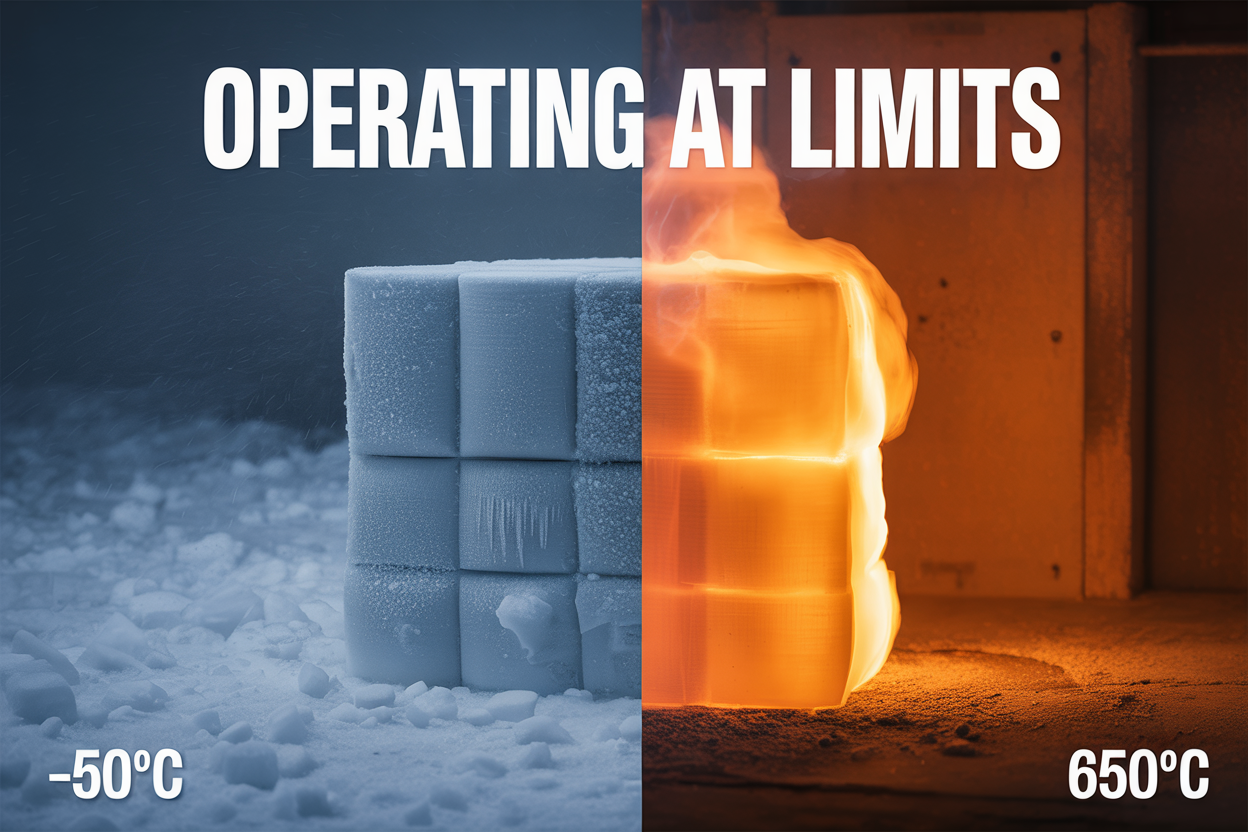
Operating at Limits: Performance of Aerogel at -50°C vs. 650°C
Not every insulation material can handle a cryogenic pipeline and an industrial furnace wall. Aerogel can — and that’s exactly what makes it worth understanding.
This guide is built for engineers, product designers, and procurement specialists who need reliable thermal insulation data across extreme temperature ranges. Whether the application runs at -50°C or pushes toward 650°C, the performance expectations are completely different, and the wrong material choice carries real consequences.
Here’s what this breakdown covers:
- What makes aerogel structurally capable of handling both ends of the temperature spectrum without compromising insulation efficiency
- How aerogel behaves at -50°C and 650°C — including thermal conductivity, structural integrity, and real-world performance differences between cold and heat applications
- A practical comparison of performance metrics to help match the right aerogel product to specific operating conditions
Aerogel’s extreme-temperature performance sounds technical at first, but the core decisions come down to simple questions: What temperature range does the application cover? What does failure look like? And which aerogel product actually holds up?
The answers are ahead.
What Makes Aerogel Uniquely Suited for Extreme Temperatures

Understanding the Porous Nanostructure Behind Aerogel’s Thermal Resistance
Aerogel’s extraordinary insulating ability comes directly from its internal architecture — a three-dimensional silica network in which up to 99.8% of the volume is open pore space. These pores are so small, typically between 20 and 50 nanometers, that air molecules trapped inside cannot move freely enough to transfer heat through convection. This effectively neutralizes one of the three main heat-transfer pathways at the structural level.
How Aerogel Outperforms Traditional Insulation Materials at Temperature Extremes
| Property | Aerogel | Fiberglass | Mineral Wool |
| Thermal Conductivity (W/m·K) | 0.012–0.020 | 0.030–0.045 | 0.033–0.045 |
| Usable Temperature Range | -50°C to 650°C+ | -20°C to 230°C | Up to 750°C (brittle) |
| Flexibility | High | Moderate | Low |
Traditional materials either lose structural integrity in deep cold or begin oxidizing under sustained heat. Aerogel maintains a stable, cross-linked silica skeleton across both extremes, making it a genuinely dual-range solution where conventional options would require layered or supplementary systems.
Key Physical and Chemical Properties That Enable Dual-Range Performance
- Low density: Typically 100–200 kg/m³, reducing thermal mass
- Hydrophobic treatment: Prevents moisture absorption that degrades cold-weather performance
- Amorphous silica composition: Resists crystallization and structural breakdown at elevated temperatures
- Fiber reinforcement: Blanket-form aerogels add mechanical resilience without sacrificing thermal performance
Aerogel Performance at -50°C: Thriving in Extreme Cold
How Aerogel Maintains Structural Integrity in Sub-Zero Environments
Aerogel’s nanoporous silica structure remains remarkably stable even when temperatures plunge to -50°C. Unlike conventional foam-based insulators that become brittle and crack under thermal contraction stress, aerogel composites flex without losing their insulating properties. The material’s open-cell nanostructure distributes mechanical stress evenly, preventing the micro-fractures that typically compromise insulation performance in deep-freeze conditions.
Thermal Conductivity Advantages Over Conventional Cold-Weather Insulators
| Insulation Material | Thermal Conductivity at -50°C (mW/m·K) |
| Aerogel Blanket | 12–15 |
| Polyurethane Foam | 28–35 |
| Mineral Wool | 38–45 |
| Fiberglass | 33–40 |
Real-World Applications in Arctic Pipelines and Cryogenic Systems
Arctic pipeline operators and cryogenic storage facilities rely heavily on aerogel blankets to maintain temperature control across extended distances. LNG transport systems, liquid nitrogen storage tanks, and subsea pipeline infrastructure all benefit from aerogel’s ability to keep thermal losses minimal without adding excessive insulation thickness — a critical factor in confined installation spaces.
Moisture and Condensation Resistance at Extremely Low Temperatures
Condensation buildup at sub-zero temperatures is a serious challenge for conventional insulators, causing corrosion and progressive performance degradation. Aerogel’s hydrophobic surface treatment actively repels moisture infiltration, keeping the insulation dry and maintaining consistent thermal performance regardless of ambient humidity levels.
Aerogel Performance at 650°C: Excelling Under Intense Heat
How Aerogel Resists Heat Transfer at Near-Combustion Temperatures
At temperatures approaching 650°C, most conventional insulation materials begin breaking down structurally and thermally. Aerogel holds its ground by leveraging an extraordinarily low solid conduction pathway through its nanoporous silica skeleton, where pore sizes smaller than the mean free path of air molecules effectively suppress gaseous conduction. Radiative heat transfer, which dominates at elevated temperatures, gets interrupted by opacifiers like titanium dioxide embedded within high-performance aerogel blankets, keeping thermal conductivity surprisingly low even as furnace walls glow red.
Silica vs. Ceramic Aerogel Performance at High-Heat Thresholds
| Property | Silica Aerogel | Ceramic Aerogel |
| Max Service Temperature | ~650°C | ~1200°C+ |
| Thermal Conductivity at 600°C | ~0.06–0.09 W/m·K | ~0.04–0.07 W/m·K |
| Structural Stability | Moderate | High |
| Cost | Lower | Higher |
Ceramic aerogels, based on alumina or zirconia frameworks, outperform silica variants when sustained high-temperature exposure is critical.
Industrial Applications in Furnaces, Aerospace, and Exhaust Systems
- Furnaces: Aerogel lining slashes heat loss through kiln and furnace walls, significantly cutting energy consumption.
- Aerospace: Thermal protection systems on re-entry vehicles and rocket engine compartments rely on aerogel’s lightweight, high-temperature resistance.
- Exhaust Systems: Pipe wraps using aerogel blankets manage surface temperatures safely while protecting surrounding components.
Head-to-Head Comparison: Cold vs. Heat Performance Metrics
Thermal Conductivity Values Across the Full Temperature Spectrum
Aerogel’s thermal conductivity tells a compelling story across both extremes. At -50°C, silica aerogel composites typically measure between 0.013–0.017 W/m·K, outperforming traditional insulation materials like mineral wool or polyurethane foam by a wide margin. At 650°C, thermal conductivity increases to approximately 0.035–0.060 W/m·K, depending on the specific product formulation and the contribution of radiative heat transfer. The table below captures the contrast clearly:
| Temperature | Thermal Conductivity (W/m·K) | Comparable Material |
| -50°C | 0.013–0.017 | Silica aerogel blanket |
| 25°C (ambient) | 0.015–0.020 | Standard aerogel composite |
| 650°C | 0.035–0.060 | High-temp aerogel board |
Compressive Strength and Flexibility Retention at Both Extremes
Cold temperatures tend to make aerogel composites slightly stiffer while generally preserving their structural integrity. Flexible aerogel blankets retain a meaningful bend radius even at -50°C without cracking or delaminating. At 650°C, compressive strength is maintained if the binder system is rated for high heat — products using ceramic fiber reinforcement significantly outperform those with organic binders.
Degradation Risks and Safe Operating Limits to Understand Before Use
- Cold side risks: Moisture condensation and ice formation within the aerogel matrix can degrade performance over extended cycling if vapor barriers aren’t properly installed.
- Hot-side risks: Sintering of the silica network begins around 650°C, reducing porosity and increasing conductivity over time.
- Always check the manufacturer’s continuous-use rating versus peak-use rating — these numbers differ meaningfully.
Cost-Effectiveness Relative to Performance Gains at Each Temperature Range
At cryogenic and sub-zero ranges, aerogel’s ultra-low conductivity means thinner insulation achieves the same result, cutting material volume and installation labor. At high heat, the reduced thickness compared to calcium silicate or ceramic fiber boards often justifies the higher material cost, especially in space-constrained pipe systems or industrial equipment where every millimeter counts.
Which Extreme Poses the Greater Engineering Challenge for Aerogel
High-heat environments at 650°C present the tougher engineering challenge. Radiative heat transfer — which aerogel’s nanoporous structure doesn’t fully suppress at elevated temperatures — becomes a real factor above 500°C. Cold performance stays relatively predictable and stable, while hot-side performance requires careful product selection, opacifier additives, and ongoing monitoring for signs of sintering or mechanical fatigue over time.
Choosing the Right Aerogel Product for Your Temperature Demands
Matching Aerogel Type and Form Factor to Your Specific Application
Silica aerogel blankets work well for cryogenic piping and cold storage applications, where flexibility and moisture resistance are most important. In high-heat industrial settings approaching 650°C, reinforced aerogel composites or rigid panels withstand mechanical stress better. Granular aerogel fills gaps and voids in irregular geometries, making it a practical choice for retrofits.
| Application | Recommended Form | Temperature Range |
| LNG Pipelines | Flexible blanket | Down to -196°C |
| Industrial Ovens | Rigid composite panel | Up to 650°C |
| Aerospace Structures | Custom-cut blanket | -50°C to 500°C |
| Retrofits/Void Fill | Granular/loose-fill | Varies |
Key Certifications and Standards to Look For
Products should carry ASTM C1728 compliance for flexible aerogel blankets and EN 13501 fire classification ratings for heat-intensive applications. Always check whether the product has been tested under real operating conditions rather than just lab benchmarks.
Common Mistakes to Avoid When Specifying Aerogel
Specifying based on ambient temperature alone, while ignoring thermal cycling stress, leads to premature material failure. Skipping vapor barrier integration in cold applications leads to moisture ingress, which significantly degrades insulation performance over time.