

AI in Materials Science: How DashamLabs Optimizes Pore Structure for Better λ (Lambda)
Thermal insulation performance comes down to one number — lambda (λ). The lower it is, the better the material blocks heat transfer. And the biggest factor controlling lambda in aerogel insulation? Pore structure.
This piece is for engineers, energy managers, procurement leads, and R&D teams looking to understand why aerogel outperforms conventional insulation — and how DashamLabs is using AI in material science to push that performance even further, at scale.
Here’s what gets covered:
- Why pore structure controls lambda — and what the science of aerogel actually reveals about heat transfer at the nanoscale
- How DashamLabs applies AI to optimize pore geometry — moving beyond trial-and-error to precision-engineered insulation
- How this translates into real-world scalability — making high-performance aerogel accessible across industries from oil & gas to cold chain logistics
DashamLabs was built on a straightforward belief: powerful solutions don’t require complexity — they require precision. That same thinking drives every layer of the aerogel development process, from the lab to the production floor.
Understanding Lambda and Why Pore Structure Determines Thermal Performance
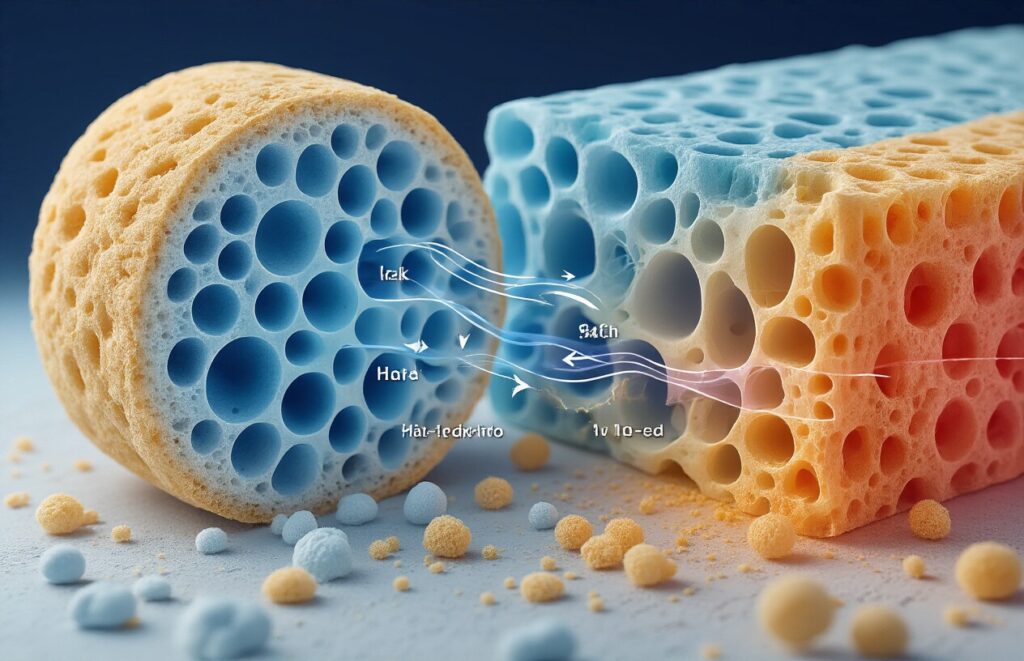
What Lambda Means for Industrial Insulation Efficiency
Lambda (λ), or thermal conductivity, measures how readily a material transfers heat, expressed in W/m·K. Lower lambda values indicate superior insulating performance. For industrial applications, even marginal reductions in λ translate into significant energy savings, reduced operational costs, and stronger compliance with thermal efficiency standards across sectors such as construction, aerospace, and cold-chain logistics.
How Pore Size and Distribution Directly Impact Heat Transfer
Pore architecture governs three primary heat transfer mechanisms within insulation materials:
- Conduction — smaller, isolated pores restrict solid-phase heat pathways
- Convection — pores below ~70 nm suppress gas-phase convective movement
- Radiation — uniform pore distribution minimizes infrared transmission
With this in mind, optimizing pore size and spatial distribution becomes the most precise lever for achieving ultra-low lambda values in advanced insulation materials.
Why Traditional Insulation Falls Short in Controlling Pore Architecture
Conventional insulation materials such as mineral wool, EPS, and fiberglass offer limited control over pore geometry during manufacturing. Their production processes yield inconsistent pore sizes and irregular distributions, resulting in higher lambda values, typically ranging from 0.030 to 0.045 W/m·K. Without precise pore-level engineering, traditional materials cannot consistently suppress all three heat-transfer mechanisms simultaneously, leaving measurable performance gaps that advanced materials science now addresses.
The Science Behind Aerogel’s Superior Insulating Properties
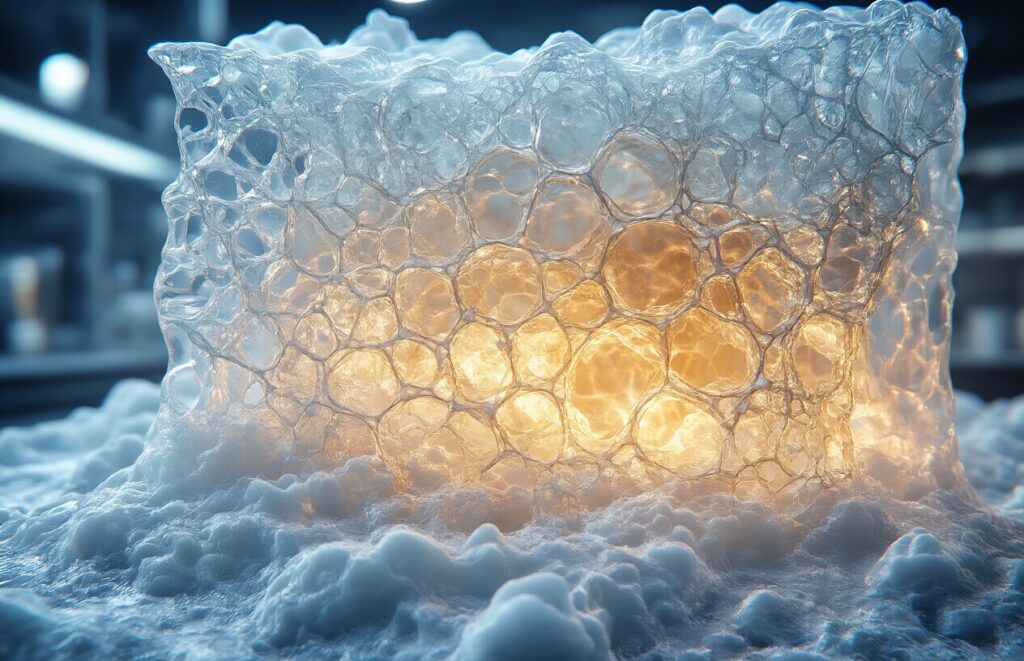
Silica Aerogel as a Breakthrough Low-Lambda Material
Silica aerogel stands among the most thermally resistive solid materials ever engineered, achieving exceptionally low lambda values that conventional insulation cannot match. DashamLabs harnesses this potential by developing next-generation silica aerogel insulation in flexible sheets, transforming deep science into scalable, high-performance products that make aerogel the natural choice for energy efficiency worldwide.
How Nanoscale Pore Networks Suppress Conduction and Convection
The nanoscale pore architecture within silica aerogel effectively minimizes both solid conduction and gaseous convection pathways, the two dominant heat transfer mechanisms. With this in mind, precise pore engineering becomes the decisive factor in achieving optimal lambda values, which is precisely the frontier where DashamLabs focuses its innovation to deliver consistently superior, scalable insulation performance.
How DashamLabs Uses AI to Optimize Pore Structure

Applying AI and Computational Tools to Model Pore Geometry
DashamLabs leverages advanced AI algorithms and computational modeling to simulate and analyze pore geometry at a granular level. These tools enable precise mapping of pore size distribution, connectivity, and tortuosity — factors that directly govern thermal conductivity. By digitally constructing pore network models, DashamLabs identifies structural configurations that minimize heat transfer pathways before any physical synthesis begins.
Using Data-Driven Iteration to Minimize Thermal Conductivity
With this in mind, iterative data loops enable DashamLabs to continuously refine formulations by correlating synthesis variables with resulting lambda values. Each experimental cycle feeds back into the AI model, progressively tightening the optimization. These insights are then translated into repeatable manufacturing parameters — ensuring consistent pore architecture across production batches and delivering reliably low thermal conductivity at scale.
DashamLabs’ Process Innovation That Makes High Performance Scalable

Continuous Production Technology That Preserves Optimized Pore Structure
DashamLabs has engineered a continuous production process that maintains the integrity of its AI-optimized pore architecture at scale. Unlike batch methods that introduce variability, this approach ensures structural consistency across every unit produced, translating laboratory-level precision into real-world manufacturing reliability.
Cost Efficiency Gains That Make Aerogel Insulation Widely Accessible
With this in mind, scalability and cost-efficiency go hand in hand at DashamLabs. By streamlining production without compromising performance, aerogel insulation becomes a viable solution across diverse industries. The process is further distinguished by its minimal environmental footprint, reflecting a commitment to precision-driven, sustainable manufacturing that aligns high performance with responsible production practices.
Industries That Benefit From Lower Lambda Aerogel Solutions

Oil and Gas and Process Systems: Reducing Heat Loss at Scale
Industries operating high-temperature pipelines and process equipment face significant energy losses through thermal bridging. Lower lambda aerogel solutions directly address this challenge by minimizing heat dissipation across expansive infrastructure, improving overall system efficiency and reducing operational costs at scale.
Cold Chain and Mobility Applications Demanding Thin High-Performance Insulation
Cold chain logistics and mobility platforms require insulation that delivers superior thermal control without adding bulk. Aerogel’s ultralow lambda enables thinner panel designs that preserve cargo integrity and optimize spatial efficiency across refrigerated transport and next-generation mobility systems.
Aerospace Requiring Lightweight Materials With Extreme Thermal Control
Aerospace applications demand materials that perform under extreme thermal gradients while contributing minimal weight. Lower lambda aerogel solutions meet these stringent requirements, providing reliable thermal management for critical aerospace components where both performance precision and weight reduction are non-negotiable engineering priorities.
Why DashamLabs Represents India’s Leadership in Advanced Materials

Indian Patents Backing a Globally Competitive Aerogel Technology
DashamLabs holds a fully Indian-patented breakthrough in materials science and manufacturing, establishing a strong intellectual property foundation that competes globally. This proprietary innovation reflects a deliberate commitment to building advanced material solutions originating from India, designed to address pressing global challenges.
World-Class Founding Team Combining IIT, Harvard, and Deep Research Expertise
The founding team brings exceptional credentials:
| Founder | Role | Background |
| Ankit | CEO | Harvard Business School & IIT Roorkee |
| Apoorv | CTO | IIT Roorkee, Ph.D. in Chemical Engineering |
| Neha | Inventor Co-Founder & Scientific Advisor | 20+ years in advanced nanomaterials & silica aerogels |
Building a Scalable Platform to Position India as a Global Materials Innovator
With this in mind, DashamLabs is actively developing a portfolio that positions India as a recognized global leader in advanced materials. The company’s vision transcends domestic applications, channeling deep research expertise and innovative manufacturing to solve challenges on an international scale.

Lambda is not just a number — it is the measure of how well an insulation material protects energy, processes, and the environment. As explored throughout this post, achieving a lower lambda value depends critically on pore structure, and aerogel’s nanoscale architecture makes it one of the most thermally effective materials available today. DashamLabs applies AI-driven optimization to engineer pore structure with precision, translating advanced materials science into consistent, high-performance silica aerogel flexible sheets that meet the demands of industries ranging from oil and gas to cold chains and aerospace.
What sets DashamLabs apart is not only the science, but the scalability. Through patented process innovation, high-performance aerogel insulation is no longer limited by cost or complexity — it is built for real-world deployment at scale, with a minimal environmental footprint. Rooted in India’s legacy of scientific ingenuity and backed by a world-class team, DashamLabs is positioning India as a global leader in advanced materials. For industries seeking to reduce energy waste and improve thermal efficiency, DashamLabs’ aerogel solutions represent a credible, future-ready choice — made in India, built for the world.