
DashamLabs —
Industrial Insulation Solutions India
Industrial Insulation Solutions in India: High-Performance Thermal Insulation from DashamLabs
Industrial plants across India lose energy every hour through hot pipes, vessels, and equipment. The right insulation turns that loss into measurable returns. DashamLabs manufactures flexible silica aerogel insulation, giving plants, OEMs, and contractors a thin, durable material that outperforms conventional solutions.
This page covers the insulation challenges industry here faces, what separates a high-performance material from an ordinary one, and how our product fits industrial applications.
The Industrial Insulation Challenge in India
Energy-intensive industry runs on heat. Furnaces, boilers, steam lines, reactors, and process equipment all depend on keeping heat exactly where it is needed. Every degree lost to the surrounding air is energy paid for twice: once to generate it, and again to replace it.
Insulation is one of the lowest-hanging fruits in industrial energy efficiency. Yet many plants still rely on materials chosen decades ago, and face familiar problems:
- Thick, bulky layers: conventional options need significant thickness to perform, crowding pipe racks and limiting access.
- Moisture and corrosion: wet material loses effectiveness and traps water against steel, causing corrosion under insulation.
- Compression and aging: many materials settle or degrade with temperature cycling, so efficiency drops over time.
- Difficult geometry: rigid board struggles to fit bends, valves, and irregular equipment, leaving gaps where heat escapes.
- Fire risk: in high-temperature zones, combustible material is a safety concern.
Solving these problems is not only about energy. It affects worker safety, maintenance cost, plant uptime, and the space available for future upgrades.
Nano-porous Structure
Fiber Reinforcement
What Makes a High-Performance Insulation Material?
Suppliers describe many materials as high-performance insulation, but not all earn the label. When comparing thermal insulation options, these criteria matter most:
- Thermal conductivity: the lower the lambda value, the less heat passes through. Ask what temperature the value was measured at.
- Operating range: check the range for continuous operation, not just peak exposure.
- Thickness required: a thinner option that matches thicker alternatives saves space and weight.
- Moisture behavior: hydrophobic material protects both the thermal layer and the steel beneath it.
- Fire behavior: non-combustible material is safer in high-temperature zones.
- Mechanical durability: the product should survive handling, vibration, and thermal cycling without breaking down.
- Documentation: a reliable supplier provides a technical datasheet and safety datasheet on request.
Judged against these criteria, silica aerogel sits at the top of the thermal insulation materials India has available today.
DashamLabs: Industrial Insulation Manufacturers in India
Most suppliers in the industrial market are traders or converters. DashamLabs is different. We are among the few companies producing advanced silica aerogel with our own patented materials science and process platform, developed entirely here.
Made in India, Built for Industry
Our technology re-engineers the chemistry, structure, and manufacturing process of silica aerogel. That makes a technology once reserved for aerospace affordable and practical for industry here. It reduces dependence on imports and shortens the path between a plant and the factory that supplies it.
Manufacturing and Support
Our manufacturing facility is at IMT Bawal, Rewari, Haryana. Manufacturing locally means faster lead times, responsive technical support, and the ability to work directly with engineering teams during evaluation and specification.
Tested Before Supply
We test every batch before it reaches a customer. Thermal testing validates heat-transfer performance. Mechanical testing checks flexibility, tensile strength, and compression resistance. Further testing evaluates moisture resistance and durability under temperature cycling.
Backed for the Long Term
DashamLabs is supported by Speciale Invest, IIMA Ventures, and Theia Ventures, with ARCI as our technology partner. That backing supports continuous, industrial-scale manufacturing rather than small laboratory batches.
Our Thermal Insulation Material
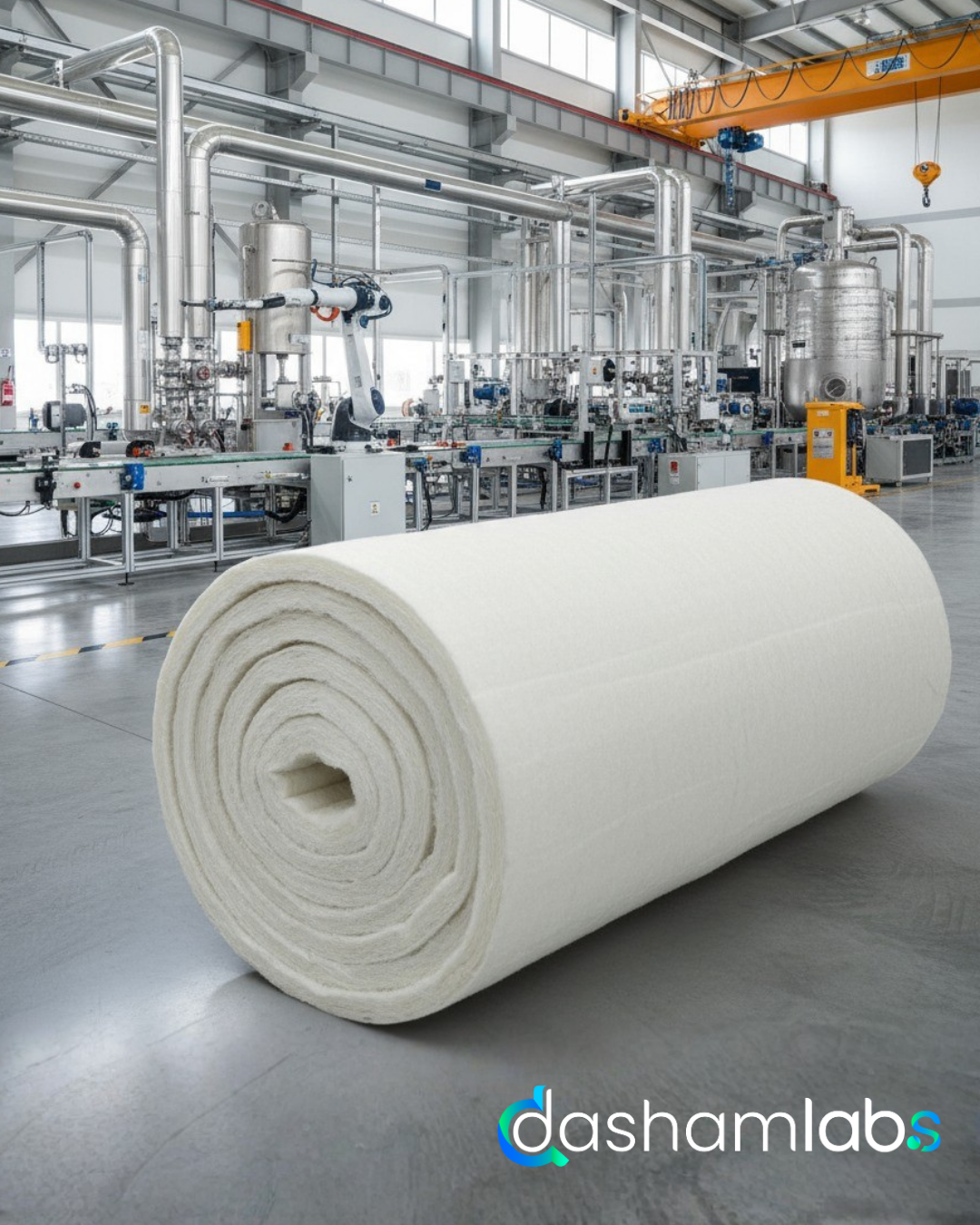
Our flagship product is a flexible silica aerogel blanket: a nano-porous silica network combined with fiber reinforcement.
|
Property |
Specification |
|
Thermal conductivity (λ) |
0.016 W/m·K (room temperature) |
|
Operating temperature range |
–50 °C to 650 °C, continuous operation |
|
Density |
200 kg/m³ |
|
Fire performance |
Non-combustible |
|
Thickness options |
3 mm, 5 mm, 10 mm |
|
Hydrophobic and CUI resistance |
Prevents moisture ingress and corrosion under insulation |
|
Sustainability |
Low environmental footprint, optimized manufacturing process |
Against traditional insulation at 0.030 to 0.090 W/m·K, our product delivers 3–5x better thermal performance while being 70–90% thinner and lighter. Formats include 1 m² evaluation pieces in 3, 5, or 10 mm, and commercial rolls of 20 m × 1.5 m × 10 mm covering 30 m² each.
Full specifications, thermal curves, safety data, and installation guidelines are available on request from info@dashamlabs.com.
Industrial Heat Insulation Solutions by Sector
Energy and Process Plants
Heat loss from steam lines, vessels, and equipment is a direct cost. Our solutions reduce that loss, stabilize process temperatures, and bring surface temperatures down for safer working conditions.
Oil and Gas
Process temperatures must be maintained across long pipe runs, often outdoors. Hydrophobic behavior reduces corrosion under insulation, one of the sector’s costliest maintenance problems.
Automotive, Including Electric Vehicles
Space and weight are tightly limited in vehicles. A thin, light, non-combustible product helps engineers meet thermal targets without adding bulk.
Cold Chain
Last-mile cold chain equipment needs stable temperatures with minimum wall thickness. With a range from –50 °C upward, our product suits low-temperature duty where thin walls mean more usable space.
Aerospace and Defense
Weight-sensitive systems benefit from a layer that delivers thermal protection at a fraction of conventional weight.
Construction and Infrastructure
Thin layers save space in walls, roofs, and building systems while improving energy efficiency.
Energy Saving Insulation Products
Energy saving is the clearest return on an insulation upgrade. A thin aerogel layer reduces the energy needed to maintain process temperatures, lowering fuel and power consumption across a plant.
The savings extend beyond the meter:
- Lower surface temperatures: safer working conditions near hot equipment and support for compliance with safety and energy regulations.
- Less maintenance: hydrophobic insulation resists moisture damage and the corrosion that drives repair cycles.
- Longer service life: insulation that holds its thermal properties reduces the need for repair or replacement.
- Reclaimed space: thinner layers free up room around equipment and improve maintenance access.
- Lower lifecycle cost: a higher upfront price is offset by energy savings, reduced thickness, and lower upkeep.
For energy managers, the calculation is straightforward. Compare the installed cost with annual energy savings and maintenance avoided over the asset’s life.
Download Technical
Documentation
Access full technical specifications, performance curves, safety data, and installation guidelines.
For Industrial Insulation Contractors in India
We supply the industrial insulation contractors India depends on, along with EPC firms and fabricators, with insulation that performs on site, not just on paper. A flexible blanket brings practical advantages to installation teams:
- It conforms closely to pipes, bends, vessels, and irregular equipment, reducing air gaps and thermal bridges.
- It is light to handle and does not crumble like fragile alternatives.
- Thinner layers fit more easily in congested areas and during shutdowns with limited access.
- Consistent sbatch-to-batch specifications keep estimates and method statements reliable.
If you are bidding work and need figures you can stand behind, our team can walk your estimators through the full specification. Contractors working on retrofits gain the most, since upgrades often must fit within existing space.
Industrial Insulation Solutions for Common Plant Problems
Every industrial plant has its own constraints, but the same handful of problems keep coming up. Here is how our industrial insulation solutions address them.
Heat loss from steam and process lines. Long runs of hot pipe bleed energy continuously. A thin aerogel layer cuts that loss without the bulk of conventional insulation, so existing pipe spacing and supports still work.
Corrosion under insulation on outdoor pipework. Water that soaks into insulation sits against steel and corrodes it. A hydrophobic layer keeps water out, protecting the asset and the thermal envelope.
Congested racks and tight clearances. When there is no room for a thicker layer, industrial teams often accept weaker results. Thin insulation balances clearance and efficiency.
Hot surfaces in operator areas. Surface temperatures near walkways and platforms are a safety concern. Better industrial insulation lowers those temperatures.
Short shutdown windows. Insulation work often happens during shutdowns. A flexible, lightweight blanket fits faster around complex equipment, helping crews finish within the window.
Choosing an Industrial Insulation Partner
Specifying insulation is a long-term decision, so the supplier matters as much as the datasheet. The industrial insulation manufacturers in India that you rely on should be able to demonstrate:
- Process control: a manufacturer that owns its chemistry and manufacturing can keep specifications steady from batch to batch.
- Verified numbers: published values with the conditions they were measured under, not headline claims.
- Complete documentation: datasheets and safety data available on request for approvals and audits.
- Evaluation supply: the option to test before committing to a bulk order.
- Scale: industrial-scale manufacturing capable of supporting volume requirements.
- Local presence: a local plant with engineers who can support specification and technical queries.
Judged on those points, the gap between a trader and a producer becomes obvious quickly. Ask how long a supplier has run its own line, whether it can show you the same values twice, and who you would call if a delivery arrived with a query attached. Those answers separate genuine capability from a well-written brochure.
Where Industrial Insulation Pays Back Fastest
Not every surface deserves the same priority. Payback is quickest where temperatures are highest, equipment runs continuously, and space is scarce. In most industrial plants, that means steam headers and distribution lines, hot vessels and reactors, equipment operating around the clock, and outdoor pipework exposed to rain and humidity.
A practical approach is to start with those areas, measure the results, and extend the specification across the site once the numbers are proven. Keep a record of what was measured before and after, since that evidence is what gets the next phase approved. Because a thin layer can often be applied where thicker options never fit, many plants find opportunities that were previously written off as impossible.
Matching Industrial Solutions to Operating Conditions
The right specification depends on what the surface actually does. Industrial duty falls into a few broad bands, and each one points to a different configuration.
Sub-ambient and cold duty. Cold chain equipment and chilled lines need stable temperatures with minimum wall build-up. Our product covers duty from –50 °C upward.
Ambient and warm surfaces. Here the aim is usually condensation control and modest temperature control, so the thinnest configuration is often enough.
Hot process duty. Steam headers, reactors, and hot vessels are where the highest returns sit. Thicker configurations suit surfaces demanding maximum thermal protection, while thin ones fit congested industrial areas.
Cyclic and outdoor duty. Surfaces that heat and cool repeatedly, or sit exposed to monsoon conditions, need a hydrophobic, dimensionally stable solution that will not compress or absorb water.
Our technical team reviews operating temperature, surface condition, available space, and performance goals before recommending a configuration, so the solution matches the duty rather than a generic rule of thumb. Where a site has many different duties, one specification can often cover several, which simplifies purchasing and stores.
From Pilot to Plant-Wide Rollout
Large industrial sites rarely change specifications everywhere at once. A staged approach works better and builds internal confidence:
- Pilot. Apply an evaluation piece to one representative line or vessel and record before-and-after readings.
- Verify. Compare surface temperatures, process stability, and fuel or power consumption against the previous arrangement.
- Standardise. Once the numbers hold, write the specification into your industrial standards for new projects and turnarounds.
- Roll out. Extend across similar duties, prioritizing the highest-temperature, longest-running assets first.
This approach keeps risk low and gives procurement a defensible case built on your own measurements rather than a supplier claim. It also spreads spending across budget cycles, which is often what decides whether an upgrade goes ahead. A single successful trial becomes a repeatable industrial solution.
Comparing Thermal Insulation Materials
|
Factor |
Conventional insulation |
DashamLabs silica aerogel |
|
Thermal conductivity |
λ 0.030–0.090 W/m·K |
λ 0.016 W/m·K |
|
Relative performance |
Baseline |
3–5x better |
|
Thickness and weight |
Bulky |
70–90% thinner and lighter |
|
Moisture |
Can absorb water |
Fully hydrophobic |
|
Fire |
Varies by product |
Non-combustible |
|
Complex geometry |
Often difficult |
Flexible, conforms closely |
Design Thinner, Lighter Thermal Systems Today
Be among the first to deploy scalable aerogel insulation in your platform, made in India and built for the world. Samples currently available in limited quantities for qualified projects.
How to Specify Our Insulation for Your Plant
- Request an evaluation piece. Choose 3, 5, or 10 mm and tell us your industry and quantity.
- Test it on your equipment. Confirm thermal performance, handling, and fit in real operating conditions.
- Review the documentation. Request the datasheets for specifications and safety data.
- Share your requirements. Operating temperature, surface conditions, available space, and area to cover determine the right thickness.
- Plan supply. Our team prepares a quote and a supply plan for pilot or bulk volumes.
For a full guide to ordering, see our Buy Aerogel Insulation page. (Link target to be added once that page is live.)
Frequently Asked Questions
Are you an insulation manufacturer or a trading company?
We are a manufacturer. We control our process, specifications, and quality testing, and supply directly to industrial plants, OEMs, and contractors.
Do you supply nationwide?
Yes. We manufacture at IMT Bawal, Rewari, Haryana, and supply industrial projects nationwide.
Do you carry out installation?
We manufacture and supply the insulation. Your teams or the installer you appoint handles installation, and we support them with technical documentation and specification guidance.
What temperature range does the insulation cover?
Continuous operation from –50 °C to 650 °C.
Can we test before placing a bulk industrial order?
Yes. We offer evaluation material in limited quantities for qualified testing and pilot projects.
How is pricing determined?
Pricing depends on thickness, format, order volume, and application requirements. Share your project details, and we will prepare a quote.
Talk to Our Technical Team
Cut heat loss, reclaim space, and improve efficiency with insulation made in India for the world’s toughest applications. Request an evaluation piece or speak with our technical team about the surfaces costing you the most today.