
DashamLabs —
Aerogel Insulation for Last-Mile Cold Chain in India
DashamLabs’ patented silica aerogel insulation blanket lets you cut wall thickness and preserve usable payload volume — engineered in India for temperature-sensitive shippers.
Every Millimetre of Space Has a Cost.
Every insulated shipper is a trade-off. Thicker walls keep the payload cold for longer, but they also shrink the space inside, so the same box carries fewer vials, or you pay for a bigger box, a bigger vehicle and a bigger freight bill. In the last mile, where boxes are handled often and space is tight, that trade-off is felt on every delivery.
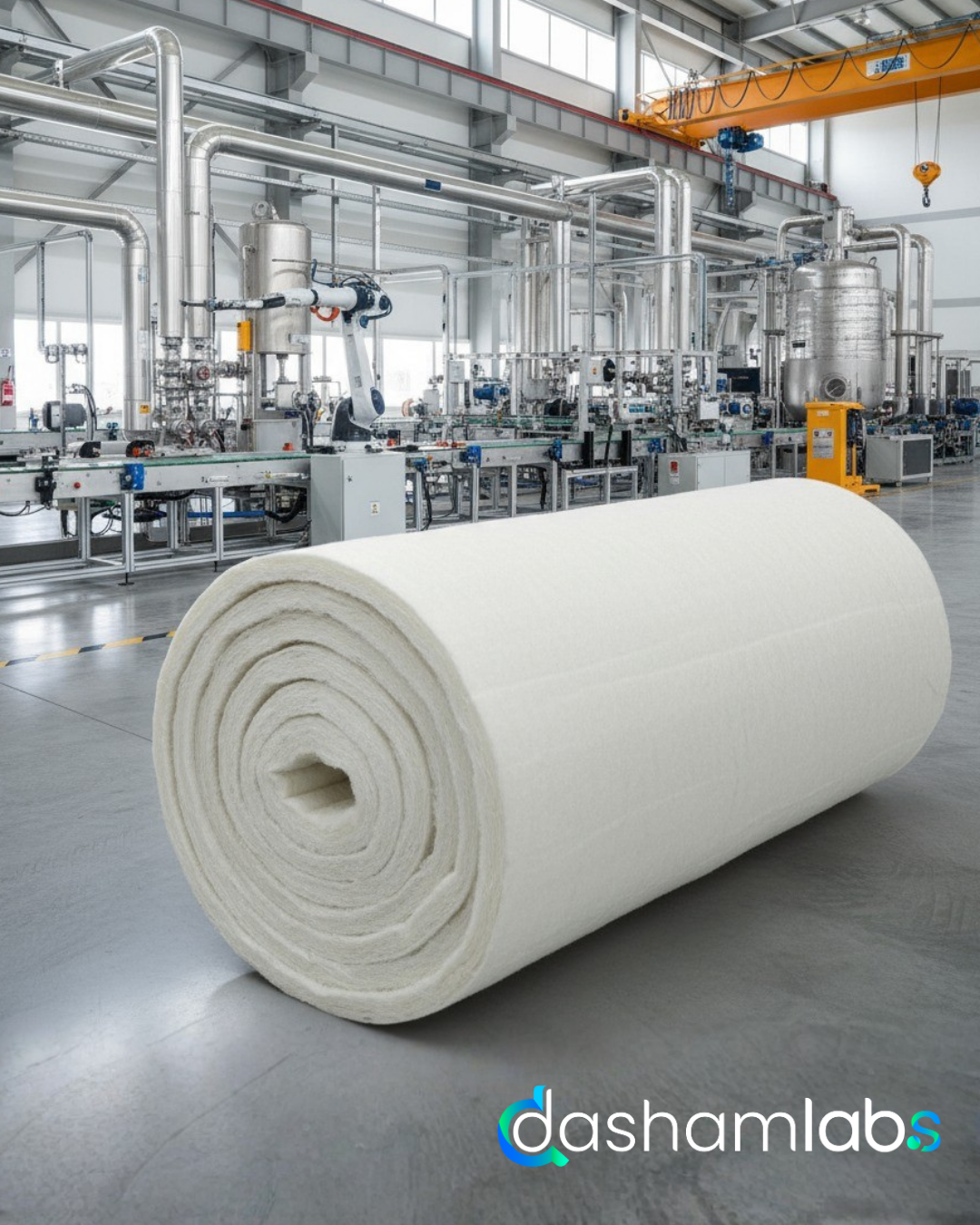
Aerogel insulation for cold chain changes the arithmetic. DashamLabs’ silica aerogel insulation blanket delivers λ ~ 0.016 W/m·K at room temperature — up to 5× lower thermal conductivity than conventional insulation — so a shipper designer can reach for a thermal target with 70% lower thickness, and hand the freed millimetres back to the payload.
For decades, aerogel stayed in labs and aerospace programmes. We set it free: a patented, Made-in-India process that turns it into a flexible, hydrophobic, lightweight blanket you can actually build with.
Key Features:
Upto 5X Lower Thermal Conductivity vs conventional insulation
70% Lower Thickness vs traditional insulation
–50 °C to +650 °C range for Continuous Operation
Nano-porous Structure
Fiber Reinforcement
Why Last-Mile Cold Chain Teams
Choose Dashamlabs
Why Thin-Wall Insulation Matters in the Last Mile
India’s cold chain is growing fast. One industry report projects the market rising from USD 12,775 million in 2025 to USD 27,456 million by 2031 (Ken Research, India Cold Chain Market report, 2026), while noting that last-mile connectivity remains uneven. That is exactly where packaging does the heavy lifting: when a shipment leaves the cold store for the final stretch, the box is the cold chain.
Two things make the last mile unforgiving. Handling is frequent — boxes are loaded, unloaded and carried by hand. And the environment is unpredictable, from air-conditioned hubs to hot vehicles and doorsteps. Both push designers towards insulation that is thin enough to preserve payload, light enough to carry and tough enough to survive handling.
Less Bulk. More Usable Space. Smarter Shipper Design. Aerogel is the material that lets you have all three.
Where thin walls pay off:
- Payload density: more vials, ampoules or units in the same outer footprint.
- Lighter boxes: an aerogel blanket is lightweight, which matters for hand-carried and air-freighted parcels.
- Smarter pack-outs: freed volume can carry more product or a different coolant arrangement — your call, not the wall’s.
- Simpler retrofits: slimmer insulation can help existing box dimensions work harder.
How Aerogel Insulation Blanket Works in a Cold Chain Shipper
Silica aerogel is the world’s lightest solid — up to 99.8% air, arranged in a labyrinth of microscopic pores that dramatically slows heat transfer. DashamLabs integrates that nanoporous silica aerogel into a fibrous matrix and adds a hydrophobic treatment, producing a flexible blanket rather than a brittle block.
For a shipper designer, three properties matter most:
- Low λ: λ ~ 0.016 W/m·K at room temperature, so each millimetre of wall does more work.
- Flexibility: the blanket bends around box geometry and is delivered as 3, 5 and 10 mm sheets, so you can match thickness to the wall you have.
- Hydrophobic: the blanket prevents moisture ingress, a practical benefit when boxes move between cold rooms, vehicles and warm, humid air.
Independent academic work points the same way. A peer-reviewed simulation study on aerogel packaging for cold-chain biologistics (Journal of Packaging Technology and Research, Springer Nature, 2023) reports that aerogels show superior insulating capability to extruded polystyrene and polyurethane foam commonly used in shipping.
Aerogel Insulation Applications in Cold Chain:
- Pharma and vial shippers — Thin-wall insulated shippers for vials and pharmaceuticals, with more usable payload volume in the same box.
- Thin-wall insulated cold-chain boxes — Slimmer walls for parcels that are handled by hand and delivered door to door.
- Space-constrained pack-outs — Fit more product, or a bigger coolant allowance, without changing the outer dimensions.
- Insulated delivery totes for perishables — Light, flexible insulation for last-mile totes where weight and handling matter.
- Small refrigerated vehicle and van panels — Thin, non-combustible insulation where interior height and width are tight.
- Retrofit of existing shippers — Upgrade the wall build without redesigning the whole box.
Download Technical
Documentation
Access full technical specifications, performance curves, safety data, and installation guidelines.
Why Cold Chain Teams Choose DashamLabs
- Patented Indian technology: patented silica aerogel insulation technology, engineered in India and for the world — 1st Made in India patented technology.
- A real manufacturer: engineered and manufactured at DashamLabs; direct-from-manufacturer supply, not a trading company.
- Numbers you can design with: λ ~ 0.016 W/m·K, 70% lower thickness, 3 / 5 / 10 mm formats.
- Scientist-led team: founders from IIT Roorkee, Harvard Business School and Clemson University, with an inventor co-founder who has spent two decades in aerogel research.
- Backed and partnered: ARCI (International Advanced Research Centre for Powder Metallurgy and New Materials) as technology partner; investors Speciale Invest, IIMA Ventures and Theia Ventures.
- Local support: manufactured in Rewari, Haryana, with technical documentation, application and installation guidance, and support for customised and bulk requirements across India.
Frequently Asked Questions About Aerogel in Cold Chain
Can aerogel insulation be used in cold chain shippers? Yes. Silica aerogel is a proven high-performance insulator, and DashamLabs’ insulation blanket is designed for exactly the trade-off shippers face: thermal performance against wall thickness. Thin-wall insulated shippers for pharmaceuticals and vials are a target application, because slimmer walls preserve usable payload volume. Design and qualification of the full shipper stays with your packaging team.
How much thinner can aerogel make a shipper wall? DashamLabs’ aerogel blanket offers 70% lower thickness compared with traditional insulation at equivalent performance, with λ ~ 0.016 W/m·K at room temperature. The gain in a real shipper depends on your thermal target, coolant strategy and wall build, so we recommend testing a sample in your own pack-out rather than assuming a figure.
Does aerogel insulation work for 2–8 °C shipments? The continuous operating range of DashamLabs’ aerogel blanket is –50 °C to +650 °C, so 2–8 °C sits comfortably within it. Whether a particular shipper holds that band for the journey depends on wall build, coolant, payload and ambient conditions, so validate with your own thermal qualification.
Is aerogel blanket moisture-resistant? Yes. The blanket is hydrophobic: a hydrophobic treatment prevents moisture ingress, which helps insulation keep its performance and avoids added weight from absorbed water. This matters where boxes move between cold rooms, vehicles and warm, humid air. See our note on moisture resistance in the blog for the science behind it.
Is aerogel safe to handle and is it fire-resistant? DashamLabs’ aerogel blanket is lightweight, flexible, safe to handle and easy to install. It is fire-resistant and non-combustible. A Material Safety Data Sheet (MSDS) is available on request from info@dashamlabs.com, along with the Technical Data Sheet (TDS).
How much does aerogel insulation cost for cold chain use? Aerogel costs more per sheet than foam, so judge it on total cost of ownership: the payload you gain, the box size you avoid, weight and handling. Pricing depends on thickness, volume and format, so we quote per project rather than publish a list price. Request a sample or a quote through our team.
How do I get an aerogel sample in India? Use the sample request form. Samples are 1 m² sheets (3 m × 330 mm) in 3, 5 or 10 mm thickness, offered for testing, prototyping and pilot projects, in limited quantities for qualified projects. Tell us your industry, quantity and application in the message field, and our team will follow up.
Changing the Game with
Dashamlabs' Aerogel
Scalable
Affordable
Flexible
Real-world ready
Sustainable
Minimal environmental footprint
λ ~ 0.016 W/m·K, –50°C to 650°C stability, fire-resistant, hydrophobic, 70–90% thinner/lighter. Read the Full Technical Specifications
Transform Your Industry Today
Be among the first to deploy scalable aerogel insulation made in India — for better performance, lower costs, and a greener future.
Request your sample now and see the difference in energy efficiency and durability.