
Thermal Management for Data Centers: Reducing Cooling Costs with Aerogel
If you run or manage a data center — or you’re on the engineering or procurement side of one — cooling costs are probably keeping you up at night. With GPU thermal design power already at 1,200W and chips expected to exceed 1,500W in the near future, the old ways of keeping servers cool just aren’t cutting it anymore.
This guide is for data center operators, hyperscalers, cooling engineers, and infrastructure buyers who want a clear picture of where aerogel fits into modern thermal management strategies — and whether it’s worth the investment.
Here’s what we’ll cover:
- Why traditional air cooling is hitting a wall in high-density computing environments and what’s driving the shift to liquid cooling
- How aerogel changes the thermal management game, from improving cold plate performance to cutting heat transfer losses across the cooling chain
- What the real cost savings look like, including how aerogel fits into total cost of ownership calculations over a 10-year horizon
Cooling is no longer just a facilities problem — it’s a competitive one. Let’s break down how aerogel is becoming a serious part of the solution.
The Growing Thermal Challenge in Modern Data Centers
Rising Chip TDP Demands Urgent Cooling Innovation
Modern processors are pushing thermal design power (TDP) to unprecedented levels. While traditional data centers operated comfortably at 5–10kW per rack, today’s high-performance environments routinely exceed 30kW to 100kW+ per rack. This exponential leap means cooling infrastructure must evolve just as rapidly as the silicon it protects—because virtually all power consumed by a chip ultimately converts into heat.
AI, Cloud, and Crypto Mining Drive Unprecedented Heat Loads
Unlike conventional enterprise workloads that burst intermittently, AI and machine learning demand continuous, high-intensity GPU utilization, creating sustained heat generation at a massive scale. This unrelenting thermal pressure, compounded by hyperscale cloud expansion, is driving the data center cooling market toward an estimated USD 16.56 billion in 2024.
Why Traditional Air Cooling Has Reached Its Limits
With this in mind, air cooling faces a fundamental physical ceiling. At densities above 20kW per rack, moving sufficient chilled air creates destructive “wind tunnel” effects—causing mechanical vibration and turbulence that, ironically, trap heat rather than exhaust it. The result: cooling systems consume energy rivaling the IT equipment itself, making legacy air-only approaches operationally and financially unsustainable.
Understanding Today’s Data Center Cooling Landscape

Air Cooling: Benefits, Limitations, and Declining Efficiency
Traditional air-based methods, such as Computer Room Air Conditioning (CRAC), remain in use due to their simplicity and compatibility with existing building infrastructure. However, they are notoriously energy-inefficient and struggle to meet the thermal demands of large-scale, high-density deployments. Evaporative cooling improves efficiency and reduces costs, but introduces significant water-consumption challenges, with large facilities consuming millions of gallons daily—a growing sustainability liability that operators can no longer ignore.
Direct-to-Chip Cold Plate Cooling: Cost-Effective and Retrofit-Friendly
Direct-to-chip (D2C) cooling circulates chilled liquid through pipes positioned directly adjacent to heat-generating components like CPUs and GPUs, targeting only active heat sources. This precision eliminates wasted energy on cooling unoccupied server room space. At approximately $650,000 per megawatt, D2C is more accessible than immersion alternatives, though coolant leakage risks and added complexity during server upgrades remain operational concerns that warrant careful evaluation.
Immersion Cooling: Superior Performance with High Entry Barriers
Immersion cooling submerges IT equipment entirely in non-conductive liquid, delivering exceptional heat dissipation without relying on air or water-based systems. While highly effective and environmentally favorable, the entry cost is steep—single-phase systems cost roughly $1 million per megawatt. For large data centers averaging 100 MW capacity, scaling these systems becomes financially prohibitive for many operators.
Single-Phase vs. Two-Phase Cooling: Comparing Effectiveness and Complexity
| Feature | Single-Phase Immersion | Multi-Phase (Two-Phase) Immersion |
| Heat Dissipation Method | Fluid absorption | Boiling and evaporation |
| Cooling Speed | Moderate | Superior |
| Cost per MW | ~$1 million | Higher than single-phase |
| Leak Risk | Lower, detectable early | Managed through system design |
| Best For | Sustainability-focused centers | High-performance, maximum-capacity needs |
With this in mind, multi-phase immersion cooling leads in raw thermal performance by leveraging the dielectric fluid’s boiling point to rapidly evacuate heat, making it ideal for hyper-dense workloads. However, its premium cost makes it out of reach for budget-constrained operators, underscoring why many facilities seek supplementary thermal management strategies to maximize returns with their chosen primary cooling method.
How Aerogel Transforms Thermal Management in Data Centers

Aerogel as an Advanced Thermal Interface Material for High-Density Servers
Aerogel’s exceptionally low thermal conductivity — below 40 mW·m⁻¹K⁻¹ — makes it a compelling thermal interface material for high-density server environments. Innovations like phase-change aerogels further enhance performance by embedding micron-scale phase-change capsules within oriented aerogel walls, achieving solar spectral reflectance exceeding 96% and infrared emissivity exceeding 95%. These properties allow aerogel to actively buffer temperature fluctuations, reducing heat shocks that standard insulation materials struggle to handle during day-and-night operational cycles.
Reducing Heat Transfer Losses Between Components with Aerogel Insulation
With this in mind, conventional insulation materials such as standard foams have low heat capacity and poor thermal inertia, resulting in inadequate cooling during peak loads. Aerogel addresses this by storing excess cold nocturnally and releasing it during daytime cooling gaps, maintaining consistent component temperatures. The high enthalpy of 146.1 J/g ensures substantial thermal energy absorption, thereby minimizing heat transfer losses between critical server components and the surrounding infrastructure.
Compatibility of Aerogel Solutions with Existing Cooling Infrastructure
Now that we have covered aerogel’s core thermal properties, its flexible, thin-profile form factors — demonstrated across products like Spaceloft® and PyroThin® — confirm straightforward integration with existing cooling infrastructure without requiring major structural modifications. Key compatibility advantages include:
- Ultrathin profiles fitting within tight server rack clearances
- Flexible formats adaptable to varied cooling system geometries
- Passive radiative cooling integration complements active cooling systems already in place
Key Benefits of Aerogel for Cutting Data Center Cooling Costs

Lower Energy Consumption Through Superior Thermal Resistance
Aerogel’s ultra-small air pockets create exceptional thermal resistance, blocking heat transfer through walls, floors, and roofs far more effectively than conventional materials. Studies show aerogel delivers 10–30% greater energy savings than traditional insulation, directly reducing the mechanical cooling load that data centers must sustain continuously.
Supporting Higher Computing Density Without Overheating Risks
With this in mind, aerogel’s superior heat-blocking capability allows operators to pack more computing hardware into existing footprints. Because heat is contained and managed more precisely, high-density server racks generate less thermal spillover, reducing the risk of overheating even as processing demands scale upward.
Measurable Improvements in Power Usage Effectiveness (PUE)
| Factor | Traditional Insulation | Aerogel Insulation |
| Energy Savings | Baseline | 10–30% higher |
| Heat Resistance | Standard | Superior |
| ROI Timeline | 7+ years | ~5 years |
Previously, cooling inefficiencies significantly inflated PUE scores. Aerogel’s thinner yet stronger thermal barrier reduces cooling energy consumption, measurably lowering PUE ratios toward the ideal 1.0 and translating directly into lower operational expenditure for data center operators.
Integrating Aerogel into the Data Center Cooling Value Chain
Role of Aerogel in Cold Plate and Liquid Cooling System Design
Aerogel-based structures are redefining cold plate design by enabling superior liquid transport and heat exchange within compact cooling assemblies. The AlN-based fiber aerogel thermo-cooler (AFC) integrates monocrystalline aluminum nitride nanofibers with vertically aligned microchannels, achieving liquid transport rates of 8.33 mm s⁻¹ and cooling rates exceeding 156.8°C s⁻¹—five times higher than advanced cooling materials. These properties make aerogel an exceptional candidate for next-generation cold plate cores where rapid, sustained heat dissipation is critical.
Enhancing Coolant Distribution Unit Performance with Aerogel Components
With this in mind, incorporating AFC components into coolant distribution units (CDUs) significantly improves thermal regulation efficiency. The vertically aligned, tortuosity-free channels ensure unobstructed coolant flow, preventing steam blockages and maintaining stable capillary action over extended operation. With cooling powers of approximately 1.34 MW m⁻² and service life limited only by coolant availability, aerogel-enhanced CDUs deliver consistent performance even under extreme thermal loads, thereby directly reducing the energy overhead associated with traditional pumped liquid-cooling infrastructure.
Partnering Across the Supply Chain to Deploy Aerogel Solutions
Now that we have covered integration at the component level, supply chain collaboration becomes essential for scalable deployment. Manufacturing AFC structures involves chemical vapor deposition for nanofiber synthesis, directional freeze-shaping, and calcination—processes that require specialized materials science expertise. Data center operators must partner with aerogel fabricators, cooling system integrators, and facilities engineers to co-develop standardized modules. Such cross-functional partnerships ensure that aerogel’s extraordinary thermal properties translate effectively from laboratory fabrication into reliable, field-deployable cooling solutions across diverse data center configurations.
Total Cost of Ownership Savings with Aerogel-Enhanced Cooling

Long-Term TCO Advantages Over Conventional Cooling Approaches
Advanced cooling solutions, particularly those enhanced with aerogel insulation, consistently deliver lower operating costs over a three- to five-year deployment cycle. By improving PUE from the traditional 1.5–1.8 range down to 1.2 or below, organizations can eliminate 20–40% of operational overhead. Extended hardware lifespan through stable thermal management further reduces capital depreciation and unplanned replacement costs, compounding savings year over year compared to conventional air-cooled infrastructure.
Reducing Operational Costs in AI vs. Non-AI Data Center Applications
| Workload Type | Typical Rack Density | Cooling Overhead Impact |
| Traditional (non-AI) | 5–10 kW | Moderate; air cooling viable |
| AI/ML Training Clusters | 30–50 kW | High, advanced cooling is essential |
| HPC/GPU-Intensive SaaS | 40–100+ kW | Critical; immersion or direct-to-chip required |
AI and ML workloads generate sustained thermal loads that standard air cooling cannot manage cost-effectively beyond 15–20 kW per rack. For non-AI environments, aerogel-enhanced insulation still reduces cooling overhead, but the ROI scales dramatically with density. Organizations running GPU-dense AI training clusters can consolidate 30 racks into 10, cutting real estate costs, network complexity, and energy consumption simultaneously—directly lowering per-compute-unit operational expenditure.
Aerogel as a Sustainability Enabler for Meeting Energy Efficiency Targets
With this in mind, aerogel-enhanced cooling also supports measurable sustainability outcomes. Improved PUE translates directly into fewer kilowatt-hours purchased and less waste heat generated. For example, improving PUE from 1.6 to 1.2 across a 1 MW compute deployment saves approximately 3.5 million kWh annually—reducing both carbon footprint and utility costs. Higher coolant operating temperatures enabled by superior insulation further extend free-cooling hours, reducing reliance on energy-intensive mechanical refrigeration and helping organizations meet their energy-efficiency commitments.
Future Outlook for Aerogel in Next-Generation Data Center Cooling

Scaling Aerogel Adoption Alongside Rising TDP Roadmaps from Nvidia and Intel
As processor TDPs from Nvidia and Intel continue to climb, thermal management systems must evolve in parallel. Aerogel’s ultra-low thermal conductivity makes it a critical insulation layer that prevents heat migration between adjacent components, directly supporting next-generation high-TDP architectures. Direct liquid cooling (DLC), which research from Dell Technologies identifies as requiring the fewest technical improvements to meet future cooling demands, integrates naturally with aerogel barriers to channel heat efficiently while minimizing thermal cross-talk between densely packed server components.
Market Growth Opportunities for Aerogel in Hyperscale Data Centers
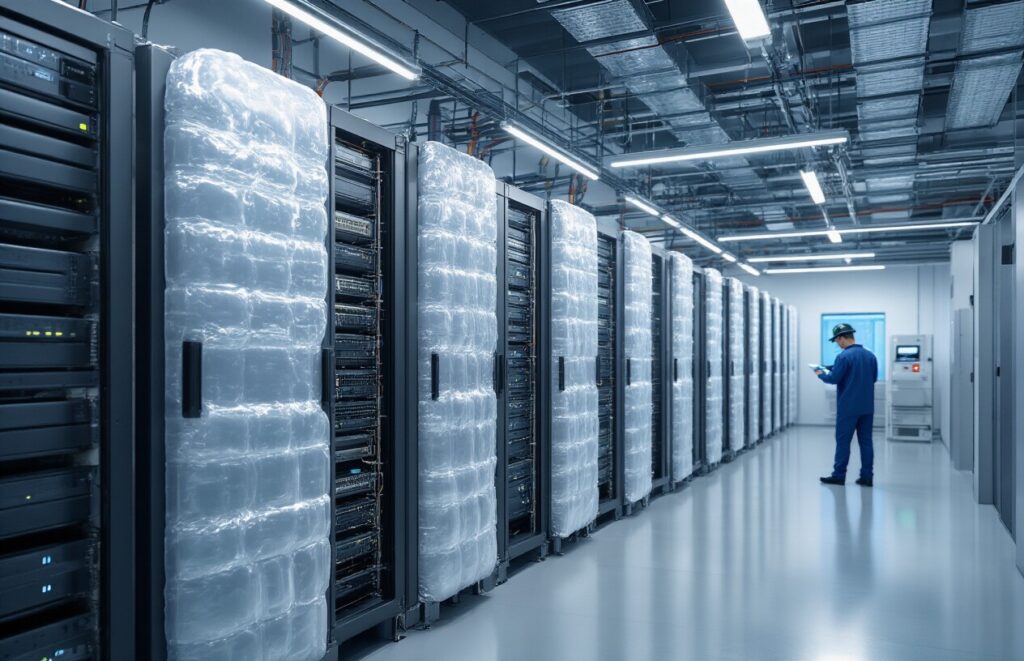
Hyperscale operators managing thousands of high-density racks face compounding thermal challenges where even marginal insulation improvements deliver significant cost reductions at scale. Aerogel panels and blankets applied to server enclosures, raised floors, and hot/cold aisle containment systems deliver measurable PUE improvements in large deployments.
Emerging Innovations Combining Aerogel with Immersion and Hybrid Cooling Systems
With this in mind, next-generation hybrid cooling architectures are exploring aerogel as a complementary layer alongside immersion cooling, where it can insulate facility infrastructure surrounding immersion tanks, reducing ambient heat gain. As cooling strategies increasingly blend air, liquid, and immersion approaches, aerogel’s versatility across form factors makes it a foundational material for thermally resilient, cost-optimized data center designs.

The thermal management landscape for data centers is undergoing a fundamental shift. Rising chip TDPs—already reaching 1,200W with Nvidia’s B200 GPU and projected to surpass 1,500W in the near future—are pushing traditional air cooling to its limits. Liquid cooling technologies, particularly cold plate systems, are emerging as the most cost-effective and scalable response to this challenge. Aerogel, with its exceptional insulating properties, fits naturally into this evolving cooling value chain, offering data center operators a practical way to reduce thermal losses, lower energy consumption, and improve overall system efficiency without requiring extensive infrastructure overhauls.
For data center operators, hyperscalers, and cooling solution providers facing intense economic pressure, the combination of advanced liquid cooling and aerogel-enhanced thermal management represents a compelling path forward. With direct-to-liquid cooling already demonstrating up to 13% lower total cost of ownership over ten years compared to immersion cooling alternatives, every additional efficiency gain matters. Incorporating aerogel into your thermal management strategy is not just a technical upgrade—it is a measurable step toward reducing operational costs, meeting sustainability targets, and staying competitive in an increasingly power-hungry computing environment. Now is the time to evaluate where aerogel solutions can be integrated into your data center cooling infrastructure.