
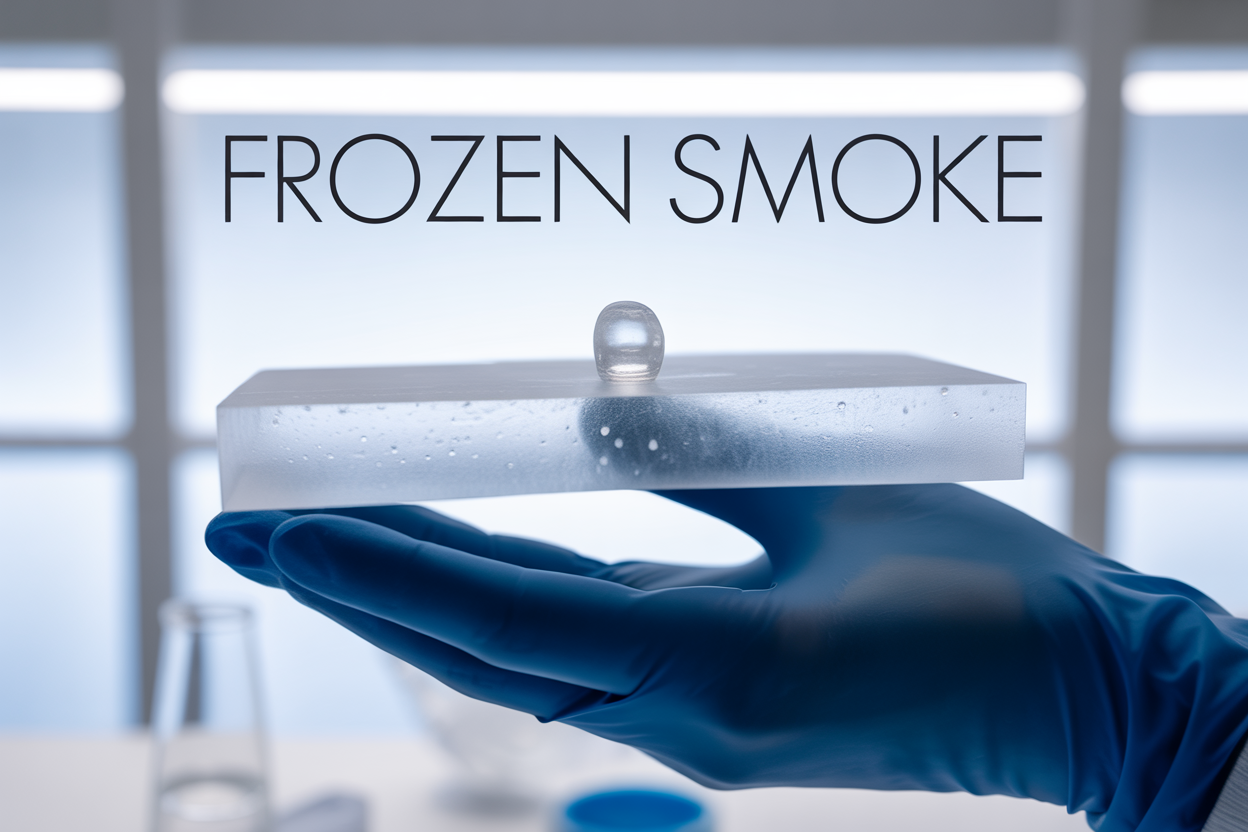
Aerogel looks like frozen smoke trapped in glass—and there’s fascinating science behind this nickname. This translucent, ghostly material has captured the attention of scientists, engineers, and curious minds who want to understand how something can be 99% air yet still hold its shape.
This guide is for science enthusiasts, students, and professionals who’ve heard about aerogel’s incredible properties but want to dig deeper into what makes this material so special. We’ll explore how aerogel achieves its smoke-like appearance through its unique structure, walk through the manufacturing process that creates this “frozen smoke” effect, and examine the breakthrough applications that leverage aerogel’s remarkable characteristics.
You’ll discover why this material feels like touching a cloud, how scientists create something that’s mostly empty space, and what makes aerogel perfect for everything from NASA missions to your next winter jacket.
Understanding Aerogel’s Unique Physical Properties
Discover Why Aerogel Contains 99.8% Air Despite Being Solid
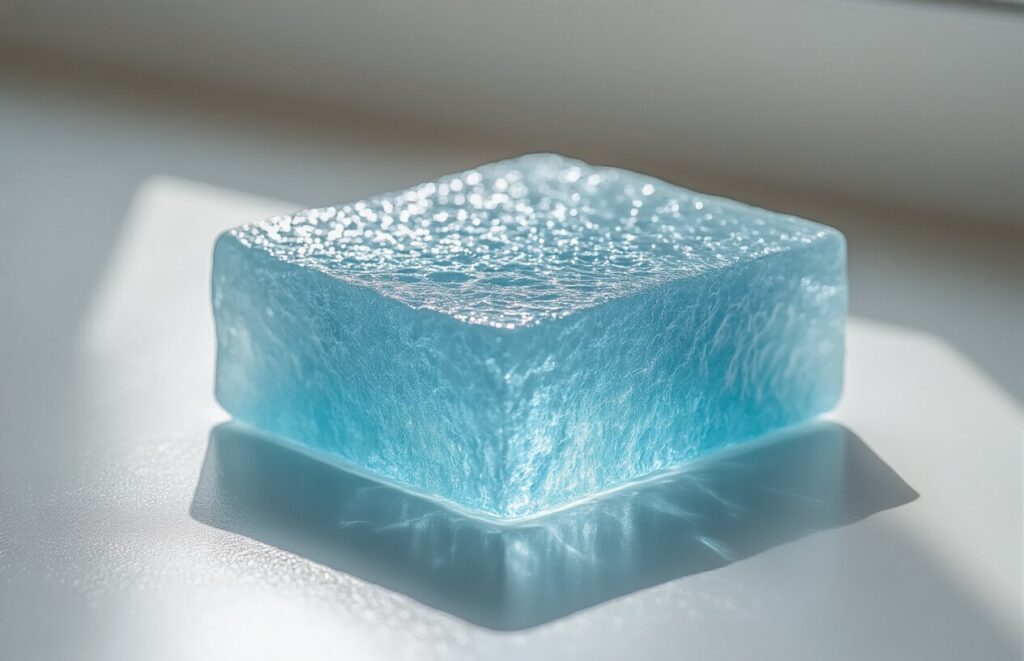
Aerogel’s mind-blowing composition stems from its intricate nanoporous structure, where solid particles form an interconnected web spanning just 2-5% of the material’s volume. The remaining space contains trapped air molecules within pores measuring only 20-40 nanometers across. This creates a solid framework so sparse that light scatters through it like fog, giving aerogel its ghostly, translucent appearance that earned its “frozen smoke” nickname.
Learn How Aerogel Achieves Record-Breaking Low Density
The material’s density ranges from 0.0011 to 0.5 g/cm³, making it lighter than many gases at standard conditions. Silica aerogel, the most common type, weighs roughly three times more than air itself. This extraordinary lightness comes from maximizing empty space while maintaining structural integrity through carefully engineered particle networks that resist compression.
Explore the Material’s Extraordinary Insulation Capabilities
Aerogel’s thermal conductivity reaches as low as 0.013 W/m·K, outperforming traditional insulation materials by significant margins. The nanoscale pores eliminate convective heat transfer, while the minimal solid content reduces conductive pathways. This combination creates thermal barriers so effective that aerogel can protect human hands from blowtorch flames or keep ice frozen in a fire.
The Science Behind Aerogel’s Smoke-Like Appearance
Uncover How Light Scattering Creates the Ethereal Visual Effect
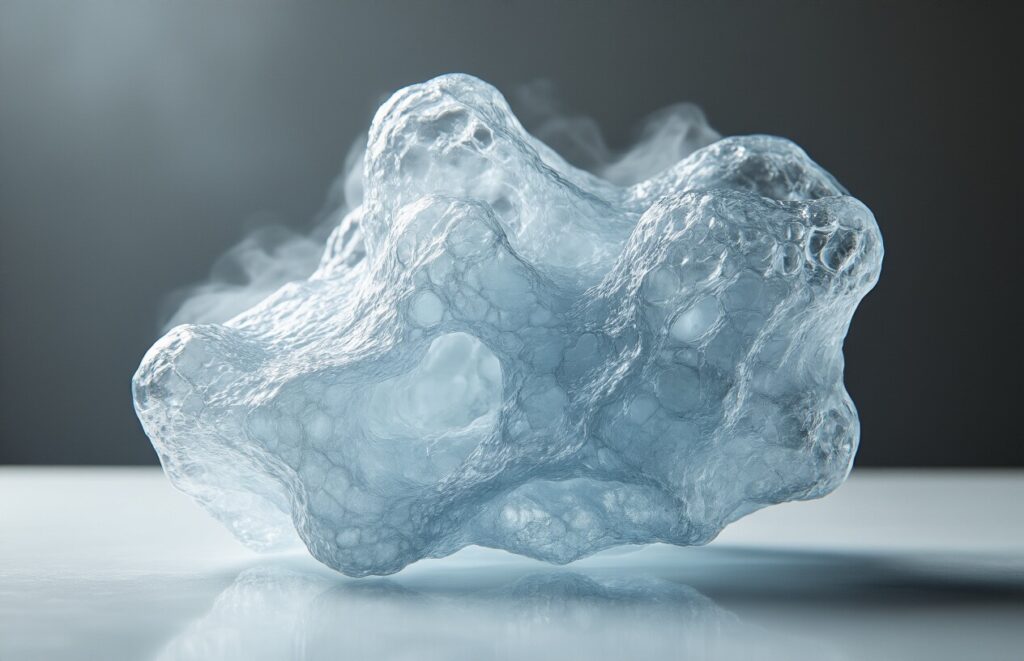
Aerogel’s ghostly appearance comes from its incredible ability to scatter light in all directions. The material’s countless tiny pores, each measuring just nanometers across, bounce light rays around like a pinball machine. This scattering effect makes aerogel appear cloudy and ethereal, exactly like smoke trapped in a solid form. When photons hit these microscopic structures, they get deflected multiple times before reaching your eyes, creating that distinctive hazy glow.
Understand Why Aerogel Appears Translucent Yet Solid
Learn About the Nano-Scale Structure That Mimics Smoke Particles
The secret lies in aerogel’s incredibly fine network of silica particles, which measure just 2-5 nanometers in diameter. These particles cluster together to form delicate chains and branches, creating a structure that’s 99% air. This arrangement mimics the way smoke particles float and interact with light, except these “particles” are locked in place within a solid framework.
Discover How Refractive Index Similarities Fool the Human Eye
Aerogel’s refractive index sits extremely close to that of air, typically around 1.05 compared to air’s 1.0. This similarity means light barely bends when moving between the material and the surrounding air, making aerogel nearly invisible from certain angles while maintaining its smoke-like translucency.
Manufacturing Process That Creates Frozen Smoke

Master the Sol-Gel Process That Forms Aerogel’s Foundation
The sol-gel process begins when liquid precursors transform into a three-dimensional network through hydrolysis and condensation reactions. Scientists create a “sol” – a colloidal suspension of particles – which gradually forms a “gel” as cross-linked structures develop throughout the material.
Temperature, pH, and catalyst concentration control how fast this gelation occurs. The resulting wet gel retains the same porous structure that makes aerogel famous, but it still contains liquid solvent that must be carefully removed without collapsing the delicate framework.
Understand Critical Point Drying and Its Role in Preservation
Critical point drying removes solvent by heating the gel above the critical point, where the liquid and gas phases become indistinguishable. At this point, surface tension disappears completely, allowing the solvent to escape without creating the destructive forces that would normally collapse the nanoscale structure.
This process occurs in specialized autoclaves, where precise control of temperature and pressure ensures the gel’s architecture remains intact. The result is a material that retains over 90% air content while maintaining structural integrity.
Learn Why Traditional Drying Methods Destroy the Structure
Standard evaporation creates enormous surface tension forces as liquid transforms to vapor at pore surfaces. These capillary forces generate pressures exceeding 100 atmospheres, which can easily crush the delicate silica network that gives aerogel its unique properties.
Even freeze-drying fails because ice crystal formation damages the gel structure. Only supercritical drying bypasses these destructive phase transitions, preserving the nanoporous architecture that gives aerogel its smoke-like appearance and extraordinary insulating properties.
Breakthrough Applications Leveraging Aerogel’s Smoke-Like Properties
Revolutionize Space Exploration with Ultra-Light Insulation
NASA’s Parker Solar Probe relies on silica aerogel shields to survive temperatures exceeding 2,500°F while approaching the Sun. The material’s extraordinary 99.8% air content delivers unmatched thermal protection without adding critical weight penalties that plague space missions. Aerogel’s smoke-like structure traps heat so effectively that a blowtorch flame applied to one side barely warms the opposite surface.
Transform Building Efficiency with Advanced Thermal Barriers
Modern skyscrapers integrate aerogel-enhanced windows that reduce energy consumption by up to 50% compared to traditional glass systems. These translucent panels maintain crystal-clear visibility while providing insulation values three times superior to conventional materials. Aerogel blankets wrapped around building exteriors create seamless thermal envelopes that eliminate cold bridges and dramatically cut heating costs.
Enhance Electronics with Superior Heat Management
High-performance processors generate intense heat that can destroy sensitive components within seconds. Aerogel thermal interface materials absorb and dissipate this heat while weighing 90% less than copper alternatives. Gaming laptops and data center servers now operate at peak performance without thermal throttling, thanks to aerogel’s exceptional heat management capabilities.
Advance Environmental Cleanup with Selective Absorption
Oil spill cleanup crews deploy aerogel sorbents that absorb petroleum products while repelling water completely. These smart materials can soak up 900 times their weight in oil, making cleanup operations faster and more efficient than traditional methods. Aerogel filters also capture heavy metals and toxic chemicals from contaminated water sources with remarkable selectivity.
Improve Safety Equipment with Lightweight Protection
Firefighters wear aerogel-lined gear that provides superior protection against extreme heat while reducing equipment weight by 40%. This breakthrough allows first responders to work longer periods without fatigue while maintaining maximum safety standards. Military personnel benefit from aerogel body armor that stops projectiles while remaining flexible and comfortable during extended missions.
Future Innovations in Aerogel Technology
Overcome Current Manufacturing Cost Limitations
Next-generation manufacturing techniques are driving down aerogel production costs through automated sol-gel processes and continuous production lines. Companies are developing scalable supercritical drying methods that reduce energy consumption by 40% while maintaining material quality. Advanced precursor materials and recycling systems are making aerogel production economically viable for consumer applications.
Develop New Composite Materials for Enhanced Performance
Scientists are creating hybrid aerogel composites by incorporating carbon nanotubes, graphene, and ceramic fibers to enhance mechanical strength without compromising the signature low density. These advanced materials combine aerogel’s insulation properties with improved durability and electrical conductivity. Bio-based aerogels using cellulose and chitosan are emerging as sustainable alternatives that maintain the distinctive smoke-like transparency while offering biodegradability.
Scale Production for Mass Market Applications
Industrial-scale aerogel manufacturing is transitioning from batch processing to continuous production systems capable of producing tons per day. Modular manufacturing facilities are being designed to serve regional markets, reducing transportation costs and enabling customized formulations. Strategic partnerships between aerogel manufacturers and major industries like automotive and construction are establishing supply chains that support widespread adoption across multiple sectors.
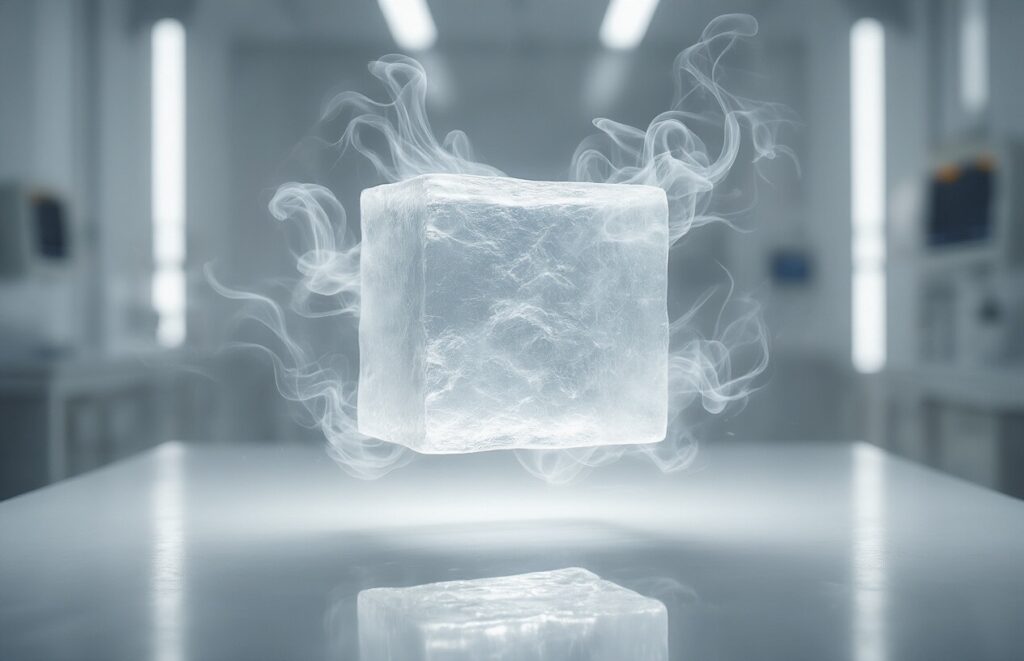
Aerogel truly lives up to its “frozen smoke” nickname with its remarkable combination of near-weightless density and translucency. This extraordinary material demonstrates how cutting-edge science can create something that seems to defy the laws of physics – solid yet barely there, strong yet gossamer-light. The manufacturing process that replaces liquid with gas while preserving the gel’s structure creates a material that looks like captured smoke but performs like high-tech insulation.
The applications we’re seeing today are just the beginning of aerogel’s potential. From keeping spacecraft instruments safe in the harsh vacuum of space to improving energy efficiency in our homes, this “frozen smoke” is quietly revolutionizing multiple industries. As scientists continue to push the boundaries of aerogel technology, we can expect even more innovative applications that leverage its unique smoke-like properties. Keep an eye on this space – aerogel might just be the invisible superhero material that transforms how we think about insulation, protection, and lightweight engineering.