
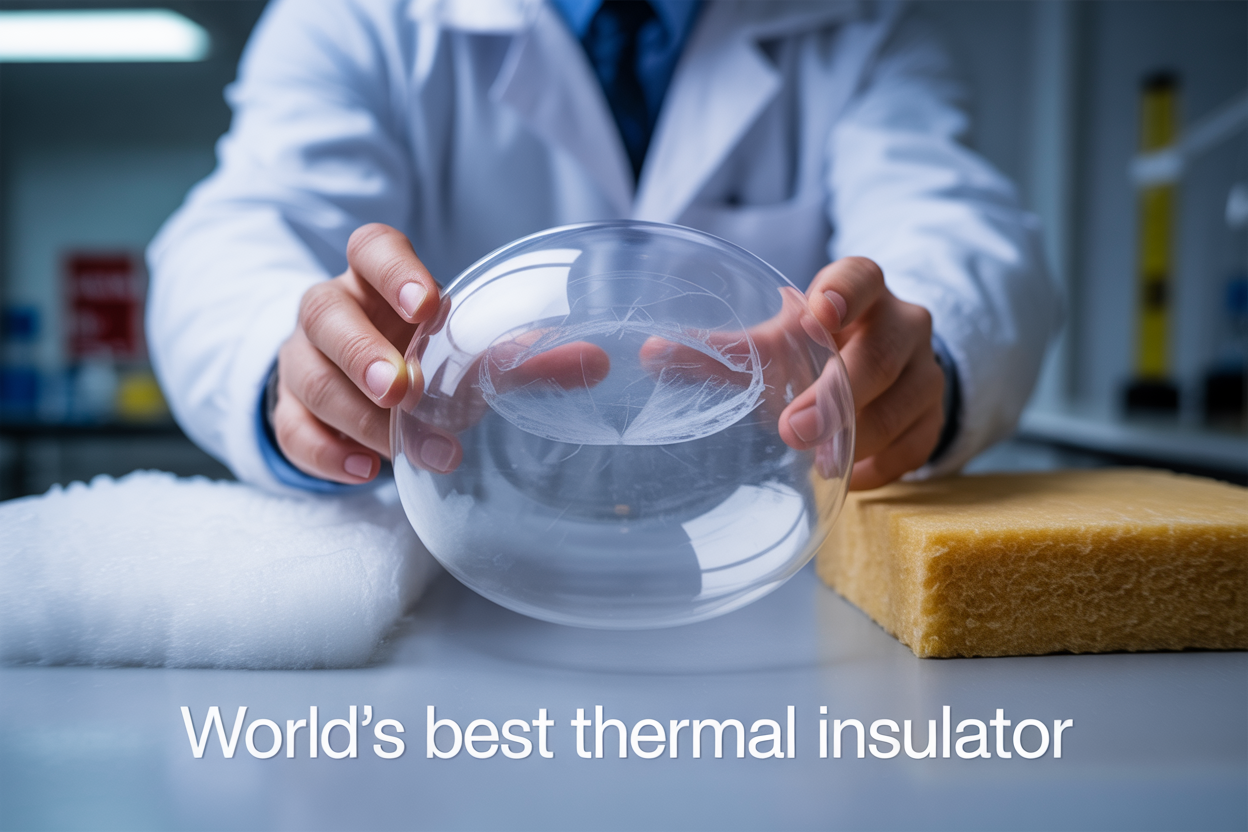
Silica aerogel holds the title as the world’s most effective thermal insulator, and there’s solid science behind this claim. This ultra-lightweight material blocks heat transfer better than any other insulator on the market today.
This guide is for engineers, researchers, homeowners considering high-performance insulation, and anyone curious about advanced materials that could revolutionize energy efficiency.
You’ll discover how silica aerogel’s unique nanoporous structure traps air at the molecular level, creating unmatched thermal resistance. We’ll also explore how its remarkable physical properties—including being 99% air while remaining solid—make it ideal for everything from spacecraft to building insulation. Finally, we’ll examine real-world applications that prove why industries choose aerogel over traditional materials when maximum thermal performance is critical.
Understanding Silica Aerogel’s Unique Structure and Composition
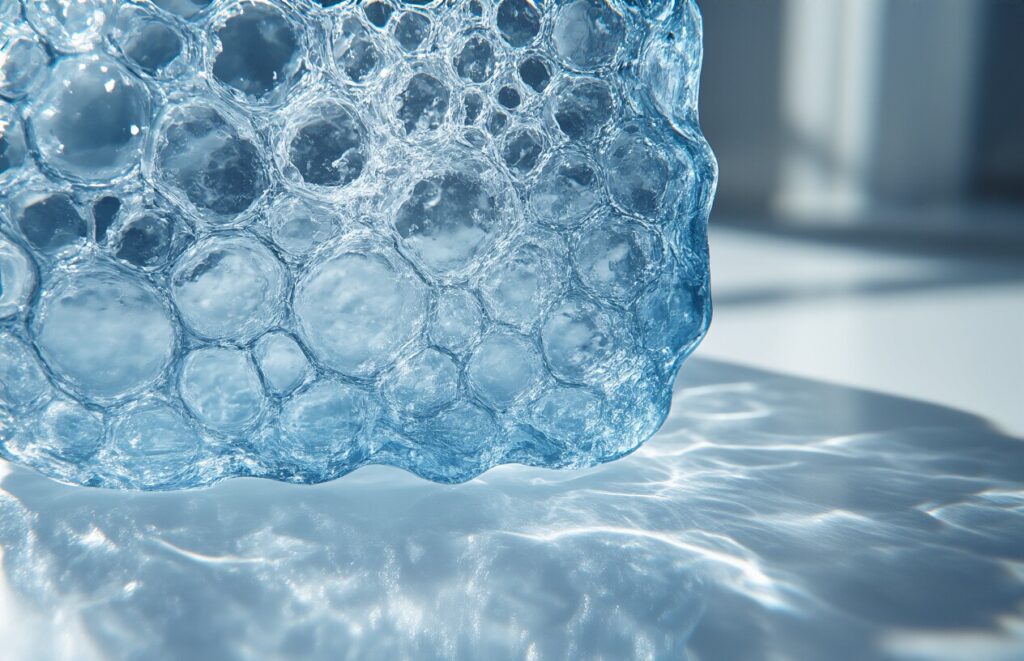
Revolutionary 99.8% Air Content Creates Unmatched Insulation
Silica aerogel’s extraordinary insulation capabilities stem from its mind-blowing composition – nearly 99.8% air trapped within an incredibly delicate silica framework. This means that in a piece of aerogel the size of a sugar cube, only about 0.2% is solid. The remaining space contains air molecules that become virtually motionless, creating an almost perfect barrier against heat transfer.
Nanoscale Silica Network Traps Air in Microscopic Pockets
The silica skeleton forms an intricate three-dimensional network of interconnected particles just 2-5 nanometers in size. These microscopic silica chains create billions of tiny air pockets, each smaller than the mean free path of air molecules. This unique structure impedes air circulation and convective heat transfer, while its nanoscale dimensions effectively block conductive heat flow through the solid material.
Ultra-Low Density Eliminates Heat Transfer Pathways
With densities as low as 0.003 grams per cubic centimeter, aerogel contains fewer solid pathways for heat conduction than any other known material. The sparse silica network means heat has extremely limited routes to travel through the material. This ultra-low density also makes aerogel incredibly lightweight – a piece can literally float on a soap bubble without bursting it.
Transparent Properties Allow Light While Blocking Heat
Despite its remarkable insulating properties, silica aerogel remains optically transparent, allowing up to 95% of light to pass through while blocking heat transfer. This transparency comes from the nanoscale structure being smaller than visible light wavelengths. The material appears slightly blue due to Rayleigh scattering, the same phenomenon that makes the sky blue, but maintains excellent optical clarity for most applications.
Superior Thermal Performance Compared to Traditional Insulators
Thermal Conductivity 39 Times Lower Than Fiberglass
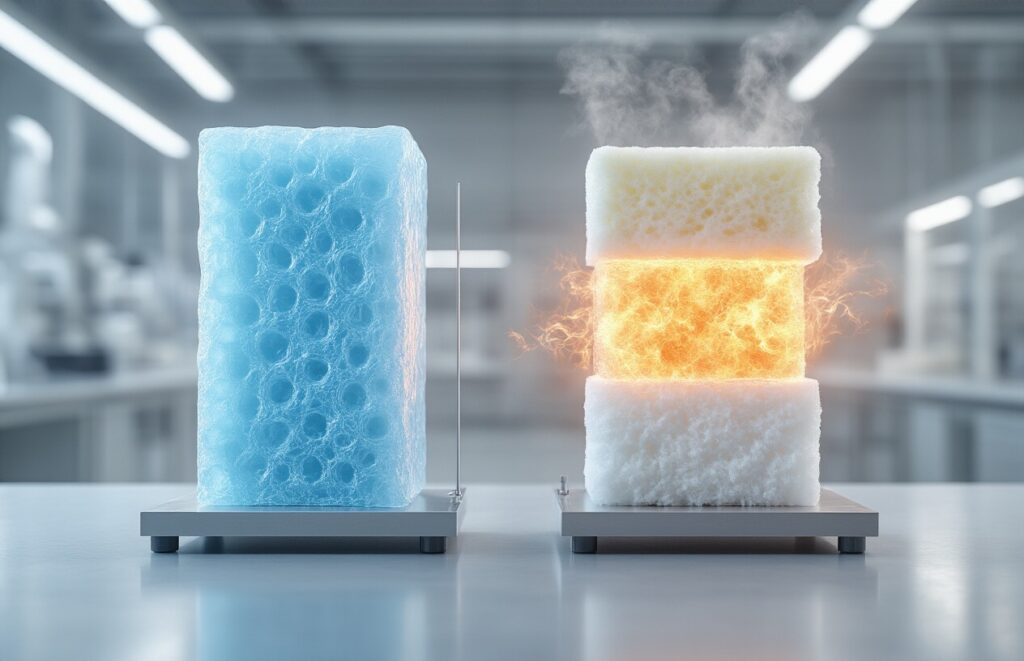
Silica aerogel has an exceptionally low thermal conductivity of 0.003 W/mK, making it nearly 39 times more effective than standard fiberglass insulation. This exceptional performance stems from its unique nanostructure, which traps air in tiny pockets that prevent heat transfer through convection and conduction.
Outperforms Foam Insulation by 300% Efficiency Rating
Traditional foam insulation simply can’t match aerogel’s performance metrics. While standard polyurethane foam offers R-values around 6 per inch, silica aerogel delivers R-values exceeding 18 per inch. This 300% efficiency advantage means buildings require significantly less insulation thickness while achieving superior thermal protection, translating to major space savings and energy cost reductions.
Maintains Performance in Extreme Temperature Ranges
| Temperature Range | Aerogel Performance | Traditional Insulation |
| -200°C to 1000°C | Stable thermal properties | Degrades or fails |
| Cryogenic applications | Maintains R-18+ rating | Brittle, cracking |
| High-heat environments | No thermal bridging | Melting, off-gassing |
Aerogel’s thermal performance remains consistent across extreme temperatures where conventional materials fail completely. From aerospace applications experiencing -200°C in space to industrial furnaces reaching 1000°C, aerogel maintains its insulating properties without degradation, making it invaluable for specialized applications.
Remarkable Physical Properties Beyond Insulation
Incredible Strength-to-Weight Ratio Supports 4000 Times Its Weight
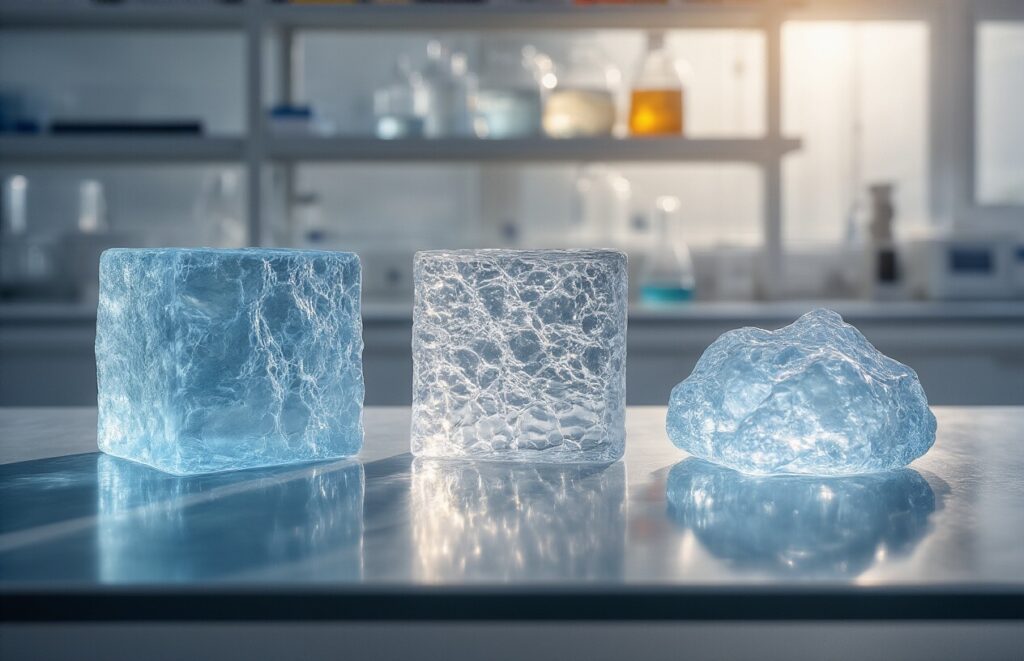
Silica aerogel might look fragile like spun glass, but it packs serious structural strength. This material can support objects weighing up to 4,000 times its own weight without breaking. A small aerogel block weighing just a few grams can hold a brick or even heavier objects. The secret lies in its three-dimensional network of silica particles that distribute weight evenly across countless tiny struts, creating an incredibly efficient load-bearing structure.
Fire Resistance Up to 1200°C Without Degradation
When exposed to extreme temperatures reaching 1200°C, silica aerogel maintains its structural integrity and insulating properties. Unlike traditional insulation materials that melt, burn, or release toxic gases, aerogel simply glows red-hot while protecting whatever sits behind it. This exceptional fire resistance makes it invaluable for aerospace applications and industrial settings where extreme heat poses constant challenges.
Hydrophobic Surface Repels Water and Moisture
Specially treated silica aerogel features hydrophobic properties that make water droplets roll off like mercury on glass. This moisture resistance prevents the material from absorbing water, which would compromise its thermal performance. The hydrophobic surface treatment creates a protective barrier that maintains the aerogel’s air-filled structure even in humid environments.
Flexible Structure Withstands Compression and Bending
Modern aerogel formulations exhibit surprising flexibility compared to their brittle predecessors. These materials can be compressed significantly and bounce back to their original shape without permanent damage. The flexible versions can even be bent and twisted while maintaining their insulating properties, opening up new possibilities for curved surfaces and complex geometries in various applications.
Real-World Applications Proving Superior Performance
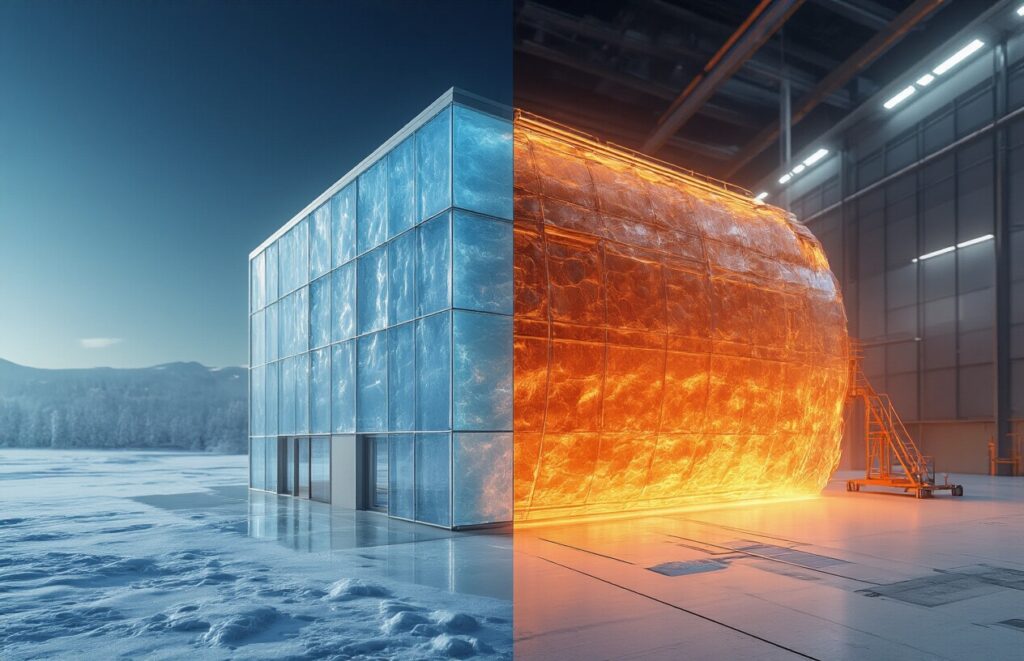
NASA Space Missions Rely on Aerogel for Equipment Protection
NASA has used silica aerogel for decades to protect sensitive equipment from extreme temperature fluctuations in space. The Mars Pathfinder mission featured aerogel insulation that kept electronic components operational in temperatures ranging from -100°F to 200°F. Current space missions continue using aerogel blankets because they provide exceptional thermal protection while adding minimal weight to spacecraft.
Building Industry Achieves 50% Energy Savings with Aerogel Panels
Commercial buildings incorporating aerogel insulation panels report energy savings up to 50% compared to traditional insulation methods. The Empire State Building’s recent retrofit included aerogel-enhanced windows that reduced heat transfer by 40%. These panels achieve superior insulation with just 10mm thickness, allowing architects to maximize interior space while meeting strict energy efficiency standards.
Industrial Applications Reduce Heat Loss by 80%
Manufacturing facilities using aerogel insulation on pipes and equipment see dramatic reductions in heat loss. Steel plants report 80% less thermal energy waste when aerogel blankets wrap furnaces and processing equipment. Oil refineries have adopted aerogel coatings for high-temperature pipelines, maintaining optimal temperatures while reducing energy costs by thousands of dollars monthly.
Consumer Products Deliver Maximum Comfort with Minimal Thickness
Outdoor gear companies now integrate aerogel into jackets and sleeping bags, providing warmth equivalent to traditional down insulation at half the thickness. Athletic wear brands use aerogel fibers in winter sports apparel to keep athletes comfortable in sub-zero conditions. Home appliance manufacturers incorporate aerogel in ovens and water heaters, improving energy efficiency while reducing external surface temperatures for safety.
Manufacturing Process Creates Optimal Insulation Properties

Sol-Gel Chemistry Forms Precise Nanoscale Architecture
The sol-gel process begins with liquid silica precursors that undergo hydrolysis and condensation, forming a three-dimensional network of interconnected silica particles. This chemical transformation occurs at the molecular level, enabling scientists to control pore-size distribution and overall network density. The resulting gel contains up to 99% air trapped within a delicate silica framework, enabling exceptional thermal insulation.
Supercritical Drying Preserves Delicate Pore Structure
Traditional drying methods collapse the gel’s fragile structure due to surface tension, but supercritical drying eliminates this issue entirely. By heating the gel above the critical point of the solvent, the liquid-gas phase boundary disappears, allowing the solvent to escape without damaging the nanoscale architecture. Preserving the original pore structure maintains the ultra-low density and thermal conductivity that make aerogel superior to conventional insulation materials.
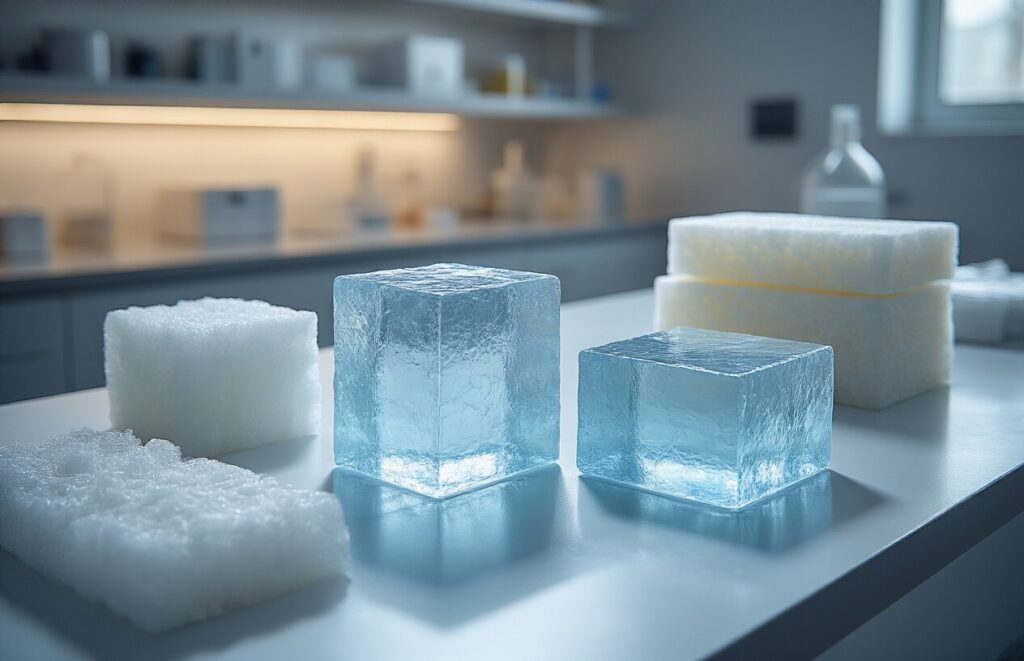
Silica aerogel is the ultimate thermal insulator, thanks to its nanostructure that traps air in tiny pockets, creating a barrier that heat simply can’t cross. Its performance exceeds that of traditional insulation materials, delivering thermal conductivity as low as 0.013 W/mK and being surprisingly lightweight and strong enough for demanding applications. From NASA’s space missions to high-performance building insulation, aerogel delivers value in the most challenging environments where temperature control is critical.
The manufacturing process that creates this wonder material might be complex, but the results speak for themselves. If you’re working on a project where thermal performance can’t be compromised, silica aerogel deserves serious consideration. Yes, it costs more upfront than standard insulation, but when you need the absolute best thermal protection available, there’s really no substitute for this remarkable material.